
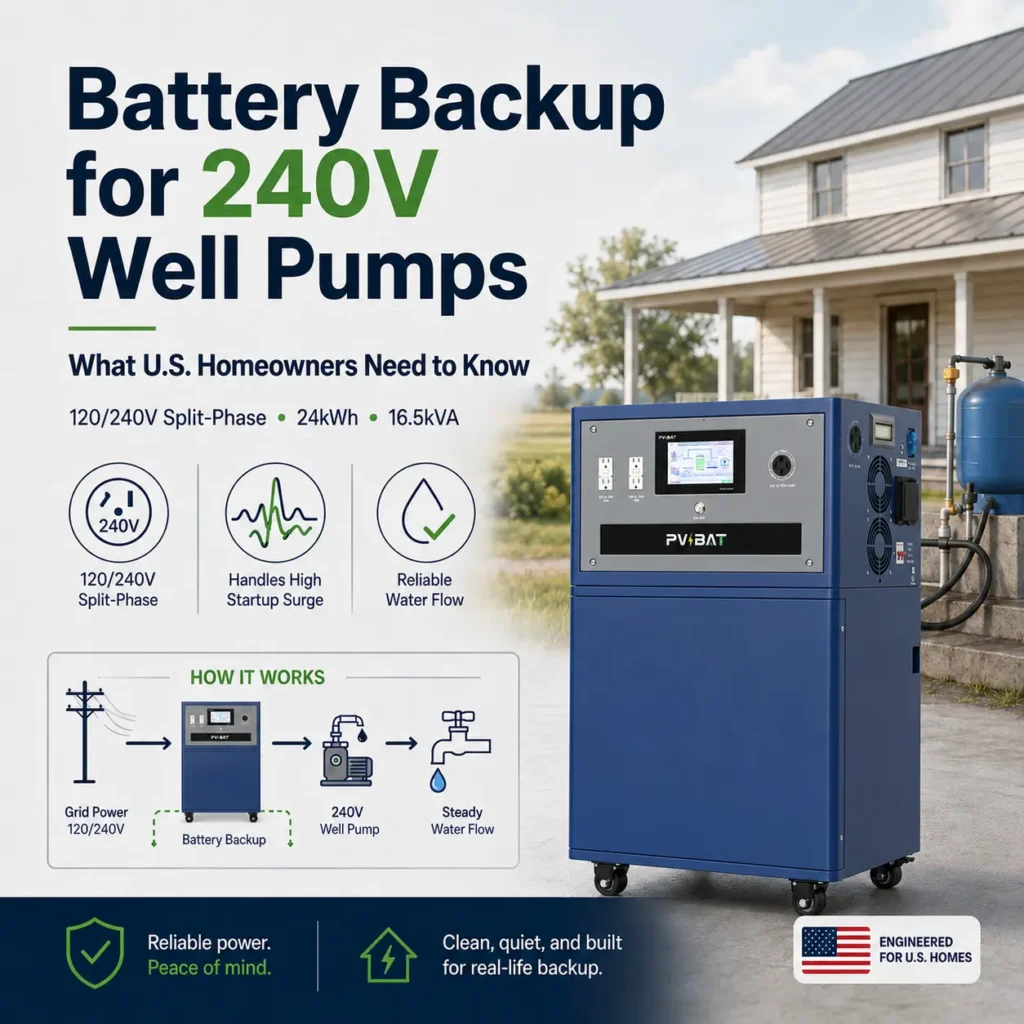
Battery Backup for 240V Well Pumps: What U.S. Rural Homeowners Need to Know
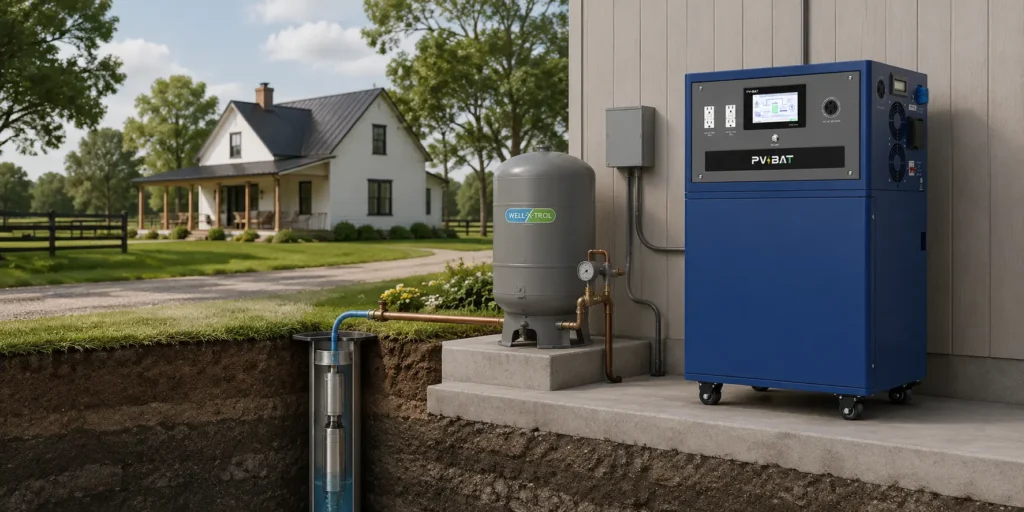
For many rural homeowners in the United States, a power outage does not just mean losing lights and internet. It can also mean losing water.
If your home depends on a private well, your well pump is one of the most important loads to protect. Without power, the pressure tank may provide water for a short period, but once pressure drops, the pump needs electricity to bring water back into the house.
That is why battery backup for a 240V well pump needs to be planned differently from ordinary backup power for phones, lights, and small appliances.
Why Well Pumps Are Harder to Back Up
A well pump can be a demanding load for two reasons.
First, many well pumps in the U.S. use 240V power. A backup battery that only provides 120V output will not run a 240V pump without additional equipment.
Second, pumps often have high startup surge. The motor may require much more power for a short moment when it starts than it uses while running. A small battery station may advertise enough running watts, but fail when the pump tries to start.
This is why both continuous output and surge capability matter.
120V vs 240V Backup Power
Many portable power stations are built for 120V devices: laptops, lights, refrigerators, and small tools. That can work for basic emergency use, but it does not solve the problem for 240V well pumps.
For well pump backup, look for a system that supports 120/240V split-phase output. This is the standard power format used by many U.S. homes and larger residential loads.
The PVBAT TIGER-T4-72 is designed with 120/240V split-phase output and a 16.5kVA low-frequency transformer inverter, making it a practical option for homes that need to support heavier loads like pumps, tools, and rural property equipment.
How Much Battery Capacity Do You Need?
Battery capacity determines how long the pump and other loads can run. A well pump usually does not run continuously. It cycles on when pressure drops, then shuts off when the pressure tank is refilled.
That cycling behavior helps preserve battery runtime. However, the total runtime still depends on water usage. A family using showers, laundry, dishwashing, irrigation, and livestock water will consume much more energy than a household using water only for basic needs during an outage.
A 24kWh system gives homeowners more flexibility than small emergency batteries. It can support the pump while also powering essential loads such as refrigeration, Wi-Fi, lights, and selected outlets.
Do Not Forget the Pressure Tank
Your pressure tank is part of the backup plan. A larger pressure tank can reduce pump cycling because it stores pressurized water. Fewer pump starts may reduce stress on the system and improve backup efficiency.
If your pump starts too often, your backup system may need to handle repeated surge events. Before investing in backup power, it is worth checking whether the pressure tank, pressure switch, and pump are in good condition.
Can Solar Help?
Yes. Solar charging can extend backup duration, especially during multi-day outages. A battery charged only from the grid gives you stored energy. A battery paired with solar gives you the ability to recover energy while the grid is down.
For rural homes, cabins, farms, and off-grid properties, this can be a major advantage. The TIGER-T4-72 supports solar/grid charging configurations, making it useful for both emergency backup and more independent energy systems.
What About Generators?
Gas and propane generators are common for well pump backup, but they come with tradeoffs. They require fuel, maintenance, ventilation, oil changes, and safe outdoor placement. They are also noisy.
Battery backup is quieter and cleaner. It does not replace every generator use case, but it can be a better fit for homeowners who want low-maintenance backup for essential loads. In some cases, a hybrid approach works well: battery for quiet daily backup, generator for extended emergency charging.
Installation Considerations
A well pump backup system should be installed with proper electrical protection and switching. Do not backfeed a home through unsafe wiring. Use appropriate transfer equipment, breakers, disconnects, and wiring methods based on local code.
A licensed electrician should review your well pump circuit, pump horsepower, voltage, startup requirements, and backup power connection before installation.
When TIGER-T4-72 Makes Sense
The PVBAT TIGER-T4-72 is a strong option when you need more than light-duty backup. Its combination of 24kWh battery capacity and 16.5kVA low-frequency inverter output makes it suitable for rural homes, farms, workshops, cabins, and properties with 240V loads.
It is especially relevant if your backup plan includes a well pump plus other essential circuits, not just a single appliance.
FAQ
Can a battery backup run a 240V well pump?
Yes, if the system supports 120/240V split-phase output and has enough inverter capacity for startup surge and running power.
Is a small portable power station enough for a well pump?
Usually not for 240V well pumps. Many small units are 120V only and may not have enough surge capacity.
How long can a battery run a well pump?
It depends on pump size, water usage, pressure tank size, and other loads. Since well pumps cycle on and off, runtime can be much longer than if the pump ran continuously.
Should I use solar with well pump backup?
Solar can extend runtime during long outages and is highly useful for rural homes, cabins, and farms.