TIGER-T4-72-user-guide

Introduction and Comparison of the PVBAT TIGER-T4-72

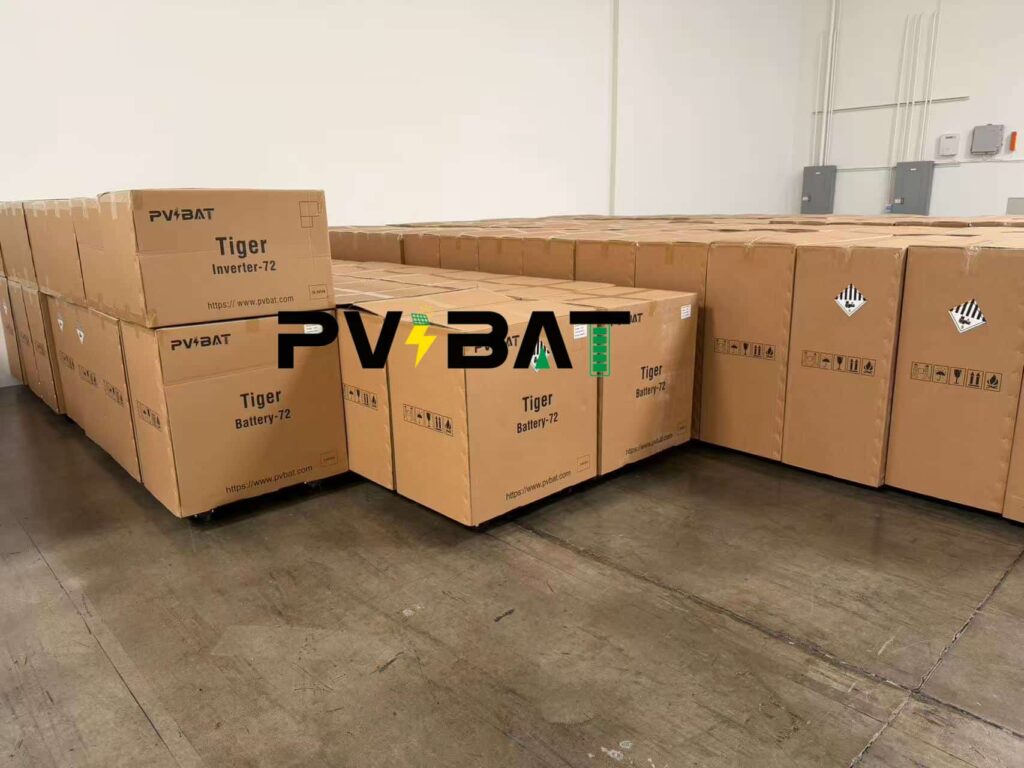
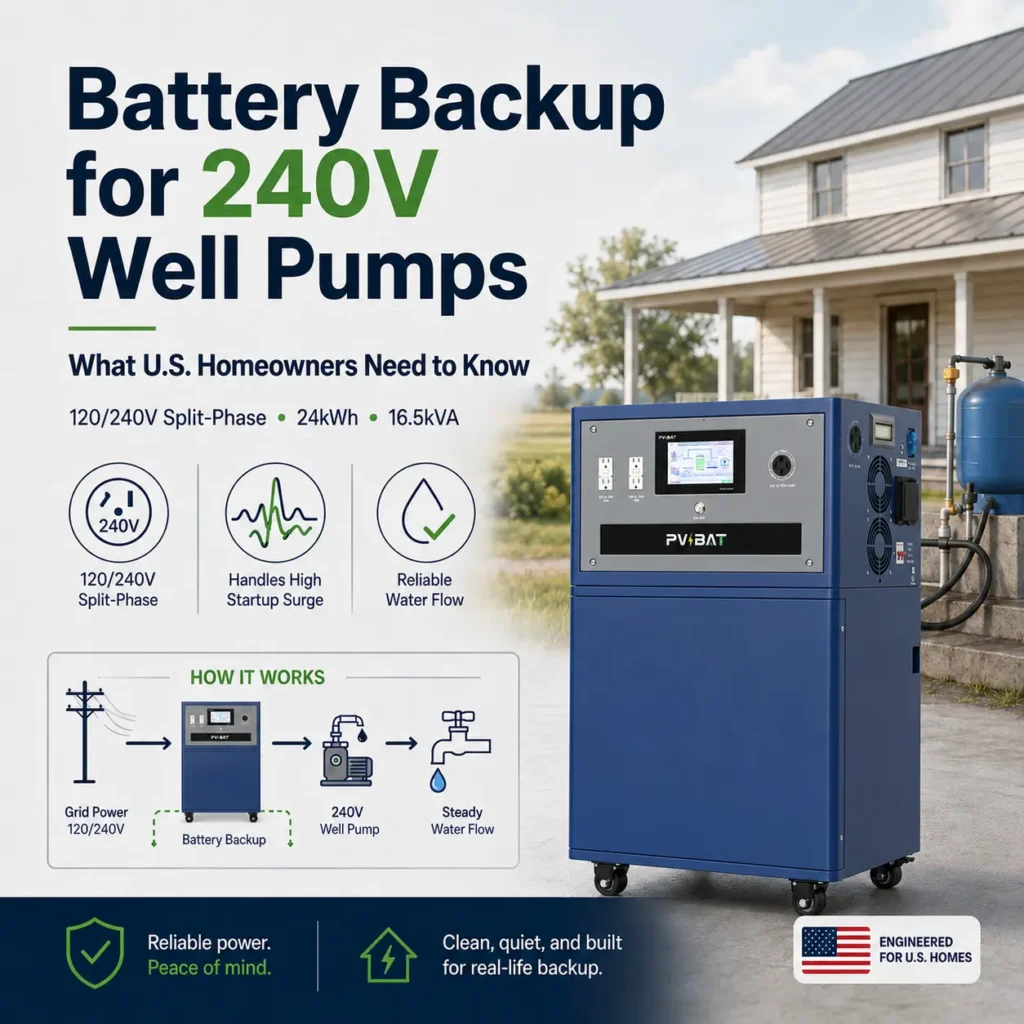
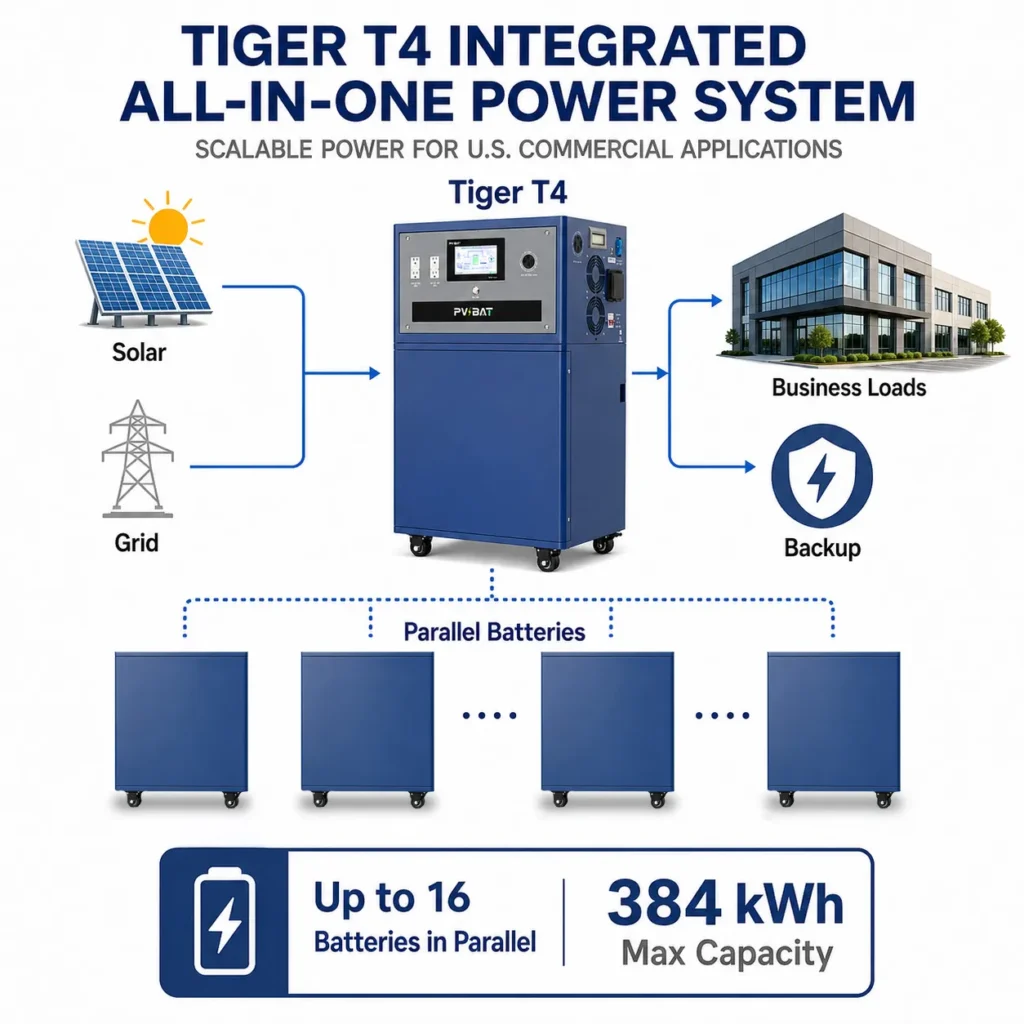
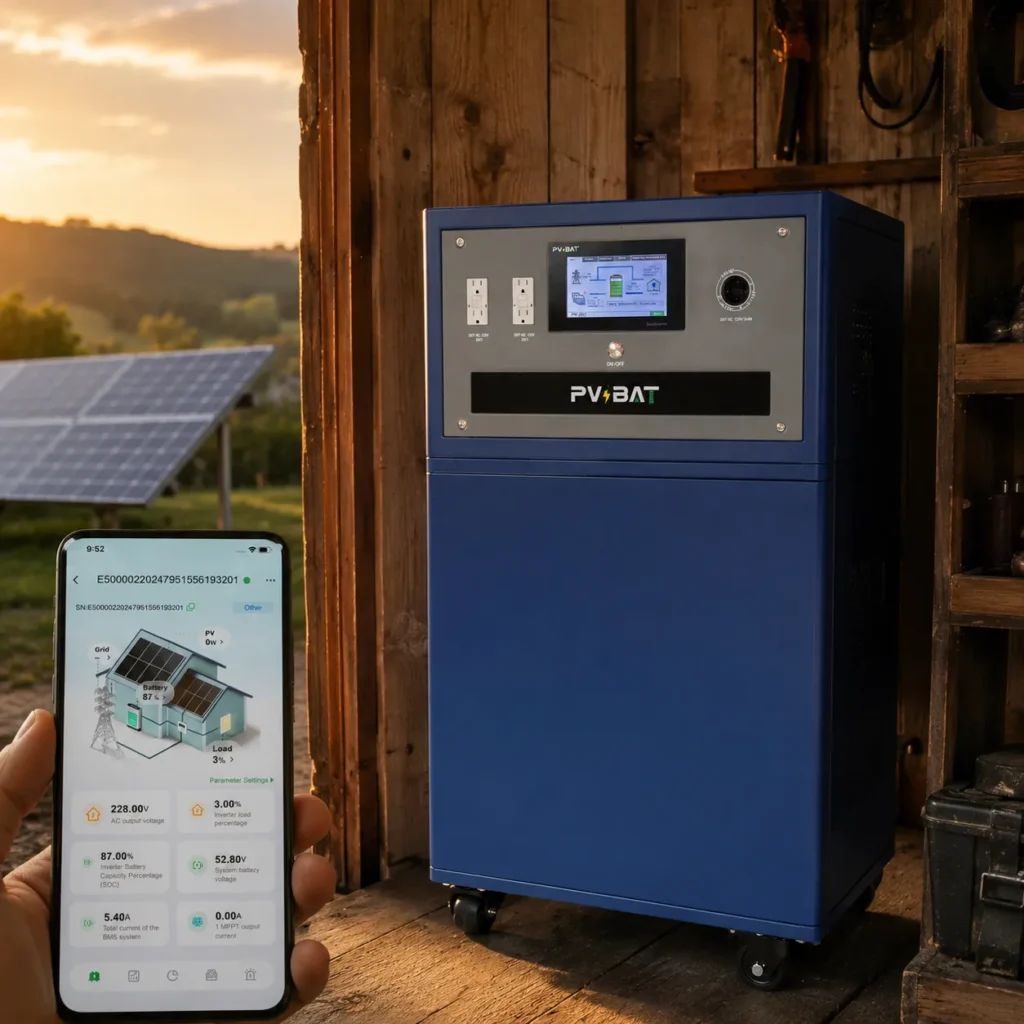
Introduction and Comparison of the PVBAT TIGER-T4-72 No Professional Installation Needed – Just Roll It Out, No Fear of Power Outages​ If you’ve ever looked into home energy storage, you probably know how much hassle and cost can come with installing a traditional battery system.Portable power stations work fine for camping or running small appliances outdoors. But if you need to power larger equipment, runtime tends to be short—and some devices won’t even start up.What about gas generators? They’re loud, they smell, and you’d better keep five gallons of fuel stored in your garage—hoping it doesn’t go bad.Then there’s the DIY battery route. Sure, if you’re an electrical engineer with plenty of time, give it a shot. But for most of us? That’s a stretch.That’s exactly how the PVBAT Tiger-T4-72​ stands apart from the rest. So what makes the Tiger-T4 different? Most home batteries are stationary. Once installed, they’re essentially fixed in place.Not the Tiger-T4.It’s mounted on heavy-duty locking casters, features plug-and-play connectors, and can be moved anywhere you need it—garage, basement, workshop, off-grid cabin, even beside a greenhouse or a well pump. No drilling, no wall mounting, and no electrician required.Plus, it packs a large 24kWh capacity. Typical wall-mounted units offer just 10–15kWh, while portable power stations rarely exceed 5kWh. A single Tiger-T4 can back up your entire home—no need to stack multiple units. And if that’s not enough, you can easily add more 24kWh battery packs, supporting up to 16 in parallel for a total of 384kWh.  It Can Actually Power Your Home—Not Just Charge Your Phone Many people make the same mistake: they buy a “backup power source,” only to find it can’t even start their fridge—let alone a sump pump, garage door, or window AC unit.The Tiger-T4 comes equipped with a 16.5kVA low-frequency transformer inverter​ and a 3:1 surge factor. In plain terms, that means it can handle the sudden power spike when large appliances kick on. Your fridge, well pump, power tools, even a 240V dryer or a mini-split AC unit? No problem.It includes both standard 120V and 240V outlets​ (split-phase), so you don’t need to modify your home’s electrical panel. Just plug the appliance you need right into the unit.If you want to connect it to your whole-house electrical system, you can do that too. But unlike permanent wall-mounted batteries, the Tiger-T4 uses plug-and-play cables—so you can set it up yourself and skip the expensive installation fees. Solar AND Grid Charging — This Is Where Tiger-T4 Really Pulls Away This is the part that actually separates Tiger-T4 from the pack.Solar:​ Hook up your panels straight to the unit — up to 8kW PV input, built-in MPPT, no external solar controller to buy, no extra box to wire in.Grid (wall outlet):​ Or just plug it into a regular wall outlet and charge from the grid. Simple as that.Mix & match:​ Use one, or use both together — whatever works that day.Translation: you’re not locked into one charging method.​Got roof or ground-mount solar? Let it soak up sun. No panels? Wait for off-peak hours, plug it into the wall, and top it up cheap.And yeah — with the mobile app​ you can schedule charge windows and discharge windows, so your power plan actually runs on autopilot instead of guesswork. Power Goes Out? It Switches in 10 Milliseconds. The moment utility power drops, Tiger-T4 automatically switches to battery in about 10 ms—faster than the blink of an eye. Lights don’t flicker, your TV doesn’t reboot, and sensitive essentials keep running like nothing happened.No dragging a generator out in the rain. No exhaust smell. No midnight dash for gasoline.You just keep living your life.(If you’re powering medical/lifesupport gear, always verify your device’s transfer-time requirement and follow local codes—but for everyday home essentials, that 10 ms handoff is the point of the design.) Who Is This Thing Actually For? Honest truth: the Tiger-T4 isn’t for everyone.​But if any of the following sounds like you, it’s probably a great fit.1) You live where the grid likes to quit on you​Hurricane alleys, ice/snow belts, wildfire zones—places where storms or public-safety shutoffs knock the power out again and again. You want a backup plan that doesn’t turn into a second job.2) You’ve got a garage, workshop, barn/stable, or warehouse​You need real 240V to run gear, but you don’twant to daisy-chain heavy extension cords from the house across the yard. Roll the Tiger-T4 where the work is.3) Off-grid (or semi-off-grid) cabin owners​With 24kWh​ onboard and up to 8kW of solar input, this is a setup you can actually build daily life around—not a toy you test once and forget.4) You looked at wall-mounted systems… and the electrician’s quote scared you off​If “permanent” feels like too much hassle and too much money, Tiger-T4 was made for exactly this situation—plug-and-play, no wall-penetrations, no calling in a pro just to get started. And yeah—it’ll absolutely pull duty as a whole-home backup in a typical suburban house.But its real edge is the part nobody else talks about: it rolls on heavy-duty casters.​ One unit, wherever you actually need power today. Look, We Gotta Be Honest — It’s Not Perfect. 1. It’s Heavy. Physics is Physics.We’re talking 24kWh of battery here. The heavy-duty locking casters make it easy to roll around the garage or driveway, but trying to lift this thing into the back of your SUV by yourself? Yeah, not happening. It stays on the ground, and that’s exactly why it’s stable and safe.2. Do the math on extreme startup loads.For 99% of normal homes — fridges, well pumps, power tools, even a mini-split — it handles the surge like a champ. But if you’ve got a massive five-ton central AC unit, plus the well pump, plusthe shop air compressor all trying to kick on at the exact same second? You’d have to check the numbers. Under real-world household conditions, though, you’ll almost never hit that wall.3. If you’re already “that guy” with a fully built-out system…Look, if you’ve already dropped the coin on a custom solar

Introduction and Comparison of the PVBAT TIGER-T4-72 Read More »

How Home Batteries Work LFP, Split-Phase Power, Inverters & Monitoring

How Home Batteries Work: LFP, Split-Phase Power, Inverters & Monitoring

How Modern Home Batteries Work: LFP Chemistry, 120/240V Split-Phase Power, Inverters, Gateways, and Smart Monitoring A Home Battery Is More Than a Battery When people say “home battery,” they usually picture a single box mounted on a wall. In reality, a modern battery backup system is a combination of energy storage, power electronics, controls, and safety equipment. A complete system usually includes: Battery cells Battery Management System, or BMS Inverter or inverter/charger Backup gateway or transfer equipment Monitoring app and controls Disconnects, labels, wiring, and protective equipment The battery stores energy. The rest of the system makes that energy usable, safe, automatic, and visible. Why LFP Chemistry Is Popular for Home Storage Many stationary home storage systems use lithium iron phosphate, often called LFP or LiFePO₄. LFP is popular because it is known for: Strong thermal stability Long cycle life Good performance for stationary storage Lower risk profile compared with some other lithium chemistries Reliable daily charge and discharge use That said, chemistry is only one part of safety. Enclosure design, fusing, BMS quality, installation practices, and code compliance all matter. What the Inverter Does Batteries store DC power. Homes use AC power. The inverter is the equipment that converts battery energy into usable household electricity. In some systems, it also manages charging from solar, the grid, or another energy source. A good inverter must manage: Voltage Frequency Continuous output Surge loads Charging and discharging Grid interaction Backup operation This is why kW ratings matter. The inverter determines how much load the system can support at one time. What the Gateway or Transfer Switch Does During a grid outage, your home battery must disconnect from the utility grid. This is called anti-islanding, and it helps protect utility workers and equipment. The gateway or transfer switch manages that separation. It detects the outage, isolates the home from the grid, and allows the battery to power backed-up loads. When grid power returns, the gateway reconnects the home safely. A well-designed transfer system is what makes backup power feel automatic. Why U.S. Homes Need 120/240V Split-Phase Support Most U.S. homes use split-phase power. Some loads use 120V, such as lights, outlets, routers, and many small appliances. Larger loads often use 240V, including dryers, ranges, well pumps, central AC units, and many heat pumps. A whole-home-ready battery system must be able to feed both legs of the electrical panel properly. If it cannot, you may run into tripped equipment, unsupported loads, or voltage issues. That is why system design should always consider your actual panel and load profile. kW, kWh, and Surge Power There are three performance numbers homeowners should understand. kWh = stored energyThis affects runtime. kW = continuous power outputThis affects how much the battery can run at once. Surge power = short startup capabilityThis matters for motors, compressors, pumps, and HVAC equipment. A system that looks large on paper may still struggle if its power output or surge capability does not match your home’s loads. Soft-starters can help with some motor loads, but they are not magic. They are one part of good engineering. Smart Monitoring and App Control Modern battery systems usually include an app or online dashboard. Depending on the system, you may be able to see: Battery charge level Solar production Home energy use Grid import and export Backup reserve settings Alerts and system status Operating mode Historical performance Monitoring is not just a convenience feature. It helps you understand how your home uses energy and how your backup system is performing. Safety and Code Details That Matter Professional installation should include: Correct neutral-ground bonding Proper disconnects and emergency shutoff labeling Clear circuit directories and placards Code-compliant wiring and conduit Anti-islanding protection Proper battery location and clearance Permit and inspection approval These details may not be exciting, but they protect your home, your family, and the people working on the grid. FAQ Is LFP safer than other lithium batteries?LFP is widely used for stationary storage because of its stability and cycle life. However, overall safety still depends on the full system design and installation quality. Can I expand my battery later?Many modular systems can be expanded, but you should plan for expansion from the beginning. Breaker space, feeder sizing, wall space, and gateway capacity all matter. Can a home battery work without solar?Yes. A battery can be installed without solar for backup or energy shifting, but without solar or generator support, it will not recharge itself during a long outage.

How Home Batteries Work: LFP, Split-Phase Power, Inverters & Monitoring Read More »

Power Outage Backup Essentials vs Whole-Home Battery vs Generator Hybrid

Power Outage Backup: Essentials vs Whole-Home Battery vs Generator Hybrid

Power Outage Backup Options: Essentials Backup vs Whole-Home Backup vs Hybrid Generator + Battery Systems What Most Families Actually Need During a Blackout During an outage, most families do not need every appliance running at once. They usually need: Fridge and freezer protection Wi-Fi and phones charged Lights in key rooms Garage door access Security system power A furnace blower, fan, window AC, mini-split, or heat pump in some cases That is exactly where a battery backup system performs well. It is quiet, automatic, and does not require fuel storage or manual startup. For many homes, a well-designed essentials or comfort backup system is enough to make an outage feel manageable. Option 1: Critical-Loads Subpanel A critical-loads subpanel backs up selected circuits only. An electrician moves important circuits, such as the refrigerator, Wi-Fi, lights, and a few outlets, into a smaller backed-up panel. When the grid goes down, the battery powers those selected loads. Pros: Lower cost than whole-home backup Smaller battery can last longer Easier to control what the battery powers Good for budget-conscious outage preparation Cons: Only selected circuits are backed up Missed circuits require future electrical work Less flexible than whole-home backup This is a strong option for homeowners who care most about essentials. Option 2: Whole-Home Backup Whole-home backup uses a gateway or transfer device to power most or all of the main panel during an outage. This feels more convenient because you do not have to think as much about which circuits are backed up. However, the battery still has limits. The real constraint is not just battery capacity. It is also continuous power output and surge capability. Large loads such as central air conditioning, well pumps, electric ranges, and compressors may need load management or automatic shedding so the system does not try to power everything at once. Pros: More convenient Fewer decisions during an outage Can support a near-normal home experience Works well with smart load management Cons: Higher installed cost Often requires more battery capacity More electrical design work Heavy loads must be managed carefully Whole-home backup is best for homeowners who want comfort, convenience, and fewer limitations. Option 3: Hybrid Generator + Battery A hybrid setup combines battery backup with a generator input or generator support strategy. The battery handles short outages automatically and quietly. If the outage lasts longer, a generator can recharge the battery or support selected loads through a properly installed and isolated connection. This can be especially useful for rural homes, storm-prone areas, or locations where multi-day outages are realistic. Pros: Excellent for long-duration outages Battery handles short outages silently Generator can extend runtime when needed Can reduce generator use compared with generator-only backup Cons: Requires careful electrical design Must be installed with proper isolation Generator still requires fuel and maintenance Not every battery system supports every generator setup A hybrid system is often the best choice when you want both daily convenience and extended emergency resilience. Red-Flag Questions to Ask Any Installer Before signing a contract, ask: Can you show me the one-line diagram for the permit submission? Will my AC, well pump, or other motor load be supported, or will it be automatically shed? What reserve setting do you recommend so the battery does not drain too low overnight? Who pulls the permit and schedules inspection? Who handles utility approval or Permission to Operate? Who do I call if the system alarms at 2 a.m.? A professional installer should be able to answer these questions clearly. FAQ Is a battery quieter than a generator?Yes. A battery system is usually silent during operation, while a generator produces engine noise and exhaust. Can a battery power my whole house?Sometimes, but it depends on your loads, battery power output, battery capacity, and load management design. Do I still need a generator?Not always. For short outages, a battery may be enough. For multi-day outages, a hybrid system may be worth considering.

Power Outage Backup: Essentials vs Whole-Home Battery vs Generator Hybrid Read More »

Solar + Battery vs Battery-Only Retrofit Options, Costs & When You Do Not Need Solar

Solar + Battery vs Battery-Only: Retrofit Options, Costs & When You Do Not Need Solar

Solar + Battery vs Battery-Only: Which One Makes Sense for Your Home and How Retrofits Actually Work The Short Answer Solar + battery is usually the strongest long-term setup. Your home makes energy, stores energy, and uses that energy when it matters most. During an outage, solar can help recharge the battery during the day, which can stretch backup from hours into days when conditions are right. Battery-only can still be a smart choice if your main goal is outage protection, your roof is shaded or poorly oriented, or you want backup now while planning solar later. The best option depends on your roof, your utility rates, your outage risk, and how much independence you want from the grid. If You Already Have Solar If you already have panels, the key phrase to understand is: AC-coupled retrofit. Many existing solar systems can add storage without removing the current inverter. An AC-coupled battery and gateway can be installed alongside your existing system to manage charging, discharging, and backup transfer. That makes battery retrofits possible for many homes that already have solar. What Your Installer Should Check First Before promising a retrofit, your installer should review: Your inverter brand, model, and firmware age Whether your current system supports battery integration or export controls Main panel capacity, busbar rating, and available breaker space Utility interconnection requirements Whether backup will cover selected circuits or the whole home Whether additional electrical upgrades are needed A good retrofit starts with your existing equipment, not with a generic battery recommendation. If You Do Not Have Solar Yet You can still install a home battery without solar. A battery-only system can help with: Backup protectionIt can keep essentials running when the grid goes down. Time-of-Use energy shiftingIn some utility territories, a battery can charge during lower-cost periods and discharge during expensive peak periods. Future solar readinessYou can plan conduit, wall space, and electrical layout now so adding solar later is easier. The important limitation is simple: without solar or a generator input, a battery does not refill itself during a long blackout. It can protect you for shorter outages, but it will eventually run down. When Solar + Battery Is Usually Better Solar + battery is often the better choice if you want: Lower long-term utility bills More control over your energy use Better resilience during longer outages Greater use of your own solar production Less dependence on buying power from the grid during peak hours This setup is especially valuable in areas where export rates are low and self-consumption is more valuable than sending energy back to the grid. When Battery-Only Still Makes Sense Battery-only can be a practical choice if: Your roof is heavily shaded You are not ready for a full solar project Your main concern is outage protection You want a lower upfront project than solar + battery Your utility rates make battery operation attractive You plan to add solar later For many homeowners, battery-only is a first step toward energy resilience. FAQ Will adding a battery affect my net metering?It can. Battery settings may change how your system exports power or limits export. Your installer should model this before you sign anything. Can I install a battery now and add solar later?Yes, in many cases. The smartest approach is to plan the electrical layout so future solar expansion does not require major rework. Is a battery-only system worth it?It can be, especially if you value automatic backup power and quiet operation during outages.

Solar + Battery vs Battery-Only: Retrofit Options, Costs & When You Do Not Need Solar Read More »

Home Battery Backup Buying Guide 2026 Sizing, Costs & Backup Tiers

Home Battery Backup Buying Guide 2026: Sizing, Costs & Backup Tiers

Home Battery Backup Buying Guide 2026: What Size Battery You Actually Need, What It Can Power, and How to Avoid Overbuying Start With the Three Questions That Actually Matter A lot of homeowners start the buying process by asking, “Do I need a 10 kWh battery or a 13.5 kWh battery?” That is understandable, but it is usually the wrong place to begin. Before choosing a battery size, you need to answer three practical questions: What do you want to keep running during an outage?Are you only trying to keep essentials online, or do you want the house to feel close to normal? Do you already have solar?If yes, your inverter type matters. It helps determine whether your battery will be an AC-coupled retrofit, a DC-coupled system, or part of a hybrid setup. What does your utility rate plan look like?If you are on a Time-of-Use rate plan, your battery may help outside of outages by storing lower-cost energy and using it during expensive peak hours. The right battery is not always the biggest one. It is the one that matches your home, your loads, your outage goals, and your budget. kW vs kWh: The Sizing Mistake Most Shoppers Make Home battery specs can be confusing because two numbers matter at the same time: kWh = energy capacityThis tells you how much energy the battery can store. Think of it as runtime. kW = power outputThis tells you how much load the battery can handle at once. Think of it as lifting capacity. A battery can have plenty of stored energy and still shut down if its power output is not strong enough for the loads you are trying to run at the same time. Central air conditioning, well pumps, induction cooktops, and other 240V loads can demand more power than homeowners expect, especially at startup. A simple way to remember it: kWh tells you how long it can run. kW tells you what it can run. Three Practical Backup Tiers Instead of starting with a random battery size, start by choosing the level of backup you actually want. Backup Tier What Usually Stays On Typical Starting Point* Best For Tier 1: Essentials Backup Fridge/freezer, Wi-Fi router, selected lights, garage door, a few outlets, gas furnace blower or small fan About 5–10 usable kWh plus a critical-loads subpanel Storm and fire outage preparation on a budget Tier 2: Comfort Essentials Everything in Tier 1, plus more kitchen outlets, microwave, and often a window AC, mini-split, or small heat pump About 10–14 usable kWh Families who want food, lights, internet, and some heating or cooling Tier 3: Whole-Home or Near-Whole-Home Backup Most or all of the main panel, with load management for heavy appliances About 20–27+ usable kWh Homes with central AC, electric heat pumps, well pumps, medical needs, or a “don’t make me think about it” goal *These are general starting points. The right system depends on your electrical panel, 240V loads, HVAC equipment, load management, and whether soft-start equipment is needed. What a Complete Home Battery Quote Should Include If a proposal only gives you a battery price, it is not a complete quote. You are buying an installed backup system, not just a box on the wall. A clear quote should show: Battery model, usable kWh, continuous kW, chemistry, and warranty terms Backup method: critical-loads subpanel, service-entrance gateway, or hybrid system Main panel evaluation, including amperage, breaker space, grounding, and feeder sizing Exterior disconnects, labels, and required safety equipment Permit, inspection, and utility Permission to Operate handling Monitoring app setup, firmware updates, and service responsibility Whether future expansion is possible without major rework This is how you compare proposals fairly. Two quotes can look similar at first glance but include very different scopes of work. Quick FAQ Can I add a battery to my existing solar system?Often, yes. Many existing solar systems can add a battery through AC coupling, but it depends on your inverter, main panel, available space, and local utility rules. Do I need whole-home backup?Not always. Many homeowners are happier with a well-designed essentials or comfort backup system because it costs less and can run longer during an outage. Is bigger always better?No. Oversizing can add cost without improving your real experience. The goal is to size the system around the loads you truly care about.

Home Battery Backup Buying Guide 2026: Sizing, Costs & Backup Tiers Read More »

100 kWh Mobile Battery Power for Construction Sites A Cleaner Alternative to Diesel Generators

100 kWh Mobile Battery Power for Construction Sites: A Cleaner Alternative to Diesel Generators

Construction teams don’t need flashy construction equipment that fails to deliver on real job-site demands. What crews truly need is reliable power — one that’s easy to move, quick to connect, simple to charge, and ready for immediate use without complicated setup processes. This is exactly the problem the CognaVolt MSP-100 100 kWh mobile power system is built to solve. This unit is far more robust than compact portable batteries designed for camping and recreational use. It also stands apart from fixed energy storage cabinets that require crane installation and permanent placement. The MSP-100fills a critical market gap: a high-capacity, track-mounted mobile battery solution engineered exclusively for dynamic construction site operations, covering temporary power supply, emergency backup power, and off-grid project work. For American contractors, equipment rental firms, utility maintenance crews, and project managers looking to cut down on generator noise, frequent fuel refills, and unnecessary engine idling, the 100 kWh mobile battery system revolutionizes the way temporary power is deployed on job sites. 100 kWh Mobile Battery Power for Construction Sites 100 kWh Battery System Optimized for Heavy-Duty Job-Site Operations At its core, the MSP-100 platform features a premium 100 kWh LFP (Lithium Iron Phosphate) battery system. LFP chemistry is the industry standard for industrial power applications, renowned for its exceptional stability, long service life, and outstanding performance in frequent charge-discharge cycle scenarios. These professional-grade attributes translate directly to tangible benefits on construction sites. This high-capacity battery system fully supports all common temporary power demands for on-site operations: On-site office trailer power supply LED tower lighting for day and night operations On-site security systems and surveillance cameras Charging stations for cordless construction tools Ventilation fans, water pumps and other small mechanical equipment Temporary power setups for on-site events and short-term projects Emergency power backup for critical equipment Power support for remote utility and infrastructure construction Built on a 72V nominal battery platform with a dual-pack design, the unit is equipped with a professional Battery Management System (BMS). This intelligent system continuously monitors overall battery health, regulates charging and discharging processes, and safeguards the battery packs from damage caused by abnormal current, voltage fluctuations and extreme temperatures. Though invisible to most users, this core protection technology serves as the reliable backbone of daily on-site power operations. 18 kW Pure Sine Wave Output for Tools, Trailers and Sensitive Electronic Devices The MSP-100 system comes fitted with an 18 kW pure sine wave inverter, supporting configurable 120/240V output voltages. This configuration perfectly matches the standard power specifications of most American construction sites, delivering stable AC power for hand tools, site office trailers, lighting systems and various electrical equipment. Pure sine wave power output is indispensable for powering precision electronics, battery chargers, intelligent control systems, variable-speed power tools and communication devices — equipment that cannot tolerate unstable, distorted power from conventional generators. While diesel generators can deliver high power output, their rough power supply, constant engine vibration, exhaust emissions and mandatory refueling breaks often disrupt sensitive equipment operation and on-site work continuity. In contrast, battery-powered systems deliver clean, stable power with zero emissions and no operational interruptions. Operating at just 53 decibels under normal working conditions, the MSP-100 solves the noise pollution pain point of traditional generators. It can be placed close to work areas, temporary trailers and night construction zones, making it ideal for urban projects with strict noise restriction regulations and sensitive surrounding communities. Versatile Charging Solutions: AC, Solar, DC and Generator Compatibility Field practicality is the core of mobile power equipment, and flexible recharging options are key to sustained on-site performance. The MSP-100 supports multiple independent charging modes to adapt to complex and variable construction site conditions: 240V AC mains charging Solar PV panel charging DC direct charging Auxiliary generator charging Simultaneous charging and discharging operation The unit is equipped with dual solar input channels, each rated at 80A, with a compatible PV voltage range of90–230V DC. This allows seamless pairing with solar array setups, enabling long-duration off-grid power supply for remote sites with no grid access. It also effectively reduces reliance on diesel generators and cuts fuel consumption. This multi-scenario charging flexibility brings huge operational advantages for construction teams. The system can be charged via shore power when grid electricity is available, topped up by generators or solar panels in remote areas, or powered by a hybrid combination of energy sources. For isolated job sites, this versatility eliminates frequent fuel delivery trips and ensures uninterrupted power supply for ongoing work. Track-Mounted Mobility: Designed for On-Site Movement, Not Static Placement The biggest competitive advantage of the MSP-100 over conventional fixed battery storage devices lies in its outstanding mobility. This is not a simple standalone battery box, but a professional crawler-type mobile power platform built for active on-site relocation. Featuring a dual electric drive motor crawler base and full wireless remote control operation, the MSP-100 can traverse uneven construction terrain, approach temporary work zones freely, and move the power source directly to high-demand areas. This eliminates the hassle of laying ultra-long power cables across the site or using heavy trucks to reposition towable generators. The core physical parameters of the unit are tailored for construction site adaptability: Total weight: approximately 2,800 lb Overall width: 44 in Overall depth: 65.5 in Overall height: 41.7 in Ground clearance: about 17 cm Track width: about 23 cm Maximum remote control range: 400 meters (open terrain) Safety protection: automatic shutdown in case of remote signal loss For American construction sites featuring limited space, constantly changing terrain and dynamic work areas requiring frequent power relocation, this flexible mobility delivers tangible time-saving and efficiency-boosting benefits. Multi-Functional Working Platform: Integrated Towing and Load-Bearing Capacity Beyond its core power supply function, the MSP-100 serves as a multi-purpose on-site working platform to maximize equipment utilization. It boasts a 5,000 lb towing capacity and a 500 lb platform load-bearing limit, allowing users to haul and transport lightweight construction materials, auxiliary tools and supporting equipment within safe rated parameters. It is important to note that the MSP-100 is first and foremost a professional power supply platform, not a replacement for skid steers or professional utility

100 kWh Mobile Battery Power for Construction Sites: A Cleaner Alternative to Diesel Generators Read More »

Mobile 100 kWh Battery Power for Farms, Events, and Emergency Backup

Mobile 100 kWh Battery Power for Farms, Events, and Emergency Backup

Mobile 100 kWh Battery Power for Farms, Events, and Emergency Backup Power problems look different depending on where you are. At outdoor construction sites, power equipment, impact drills, welding machines, cutters, water pumps, and other industrial equipment may be needed; on farms, there may be a need to meet the power demand for refrigeration equipment, insulation equipment, automated equipment lighting, etc. During a power outage, this relates to whether the load can continue to operate normally or whether one can only hurriedly look for fuel. The MSP-100 100 kWh mobile battery system was built for those kinds of situations. It gives users a large-capacity power source that can be charged from AC, solar, DC, or a compatible generator, then moved into position on a tracked platform. For many U.S. farms, venues, municipalities, and emergency-response teams, that combination is more useful than a stationary battery and more convenient than relying only on diesel generators. A Serious Battery System, Not a Small Portable Power Box MSP-100 is a mobile energy system with a capacity of 100 KWh, using lithium iron phosphate battery technology, which is widely used in the industrial energy storage field due to its excellent thermal stability and long lifespan. This makes it very suitable for customers who often need stable power output. The system uses a dual battery-pack configuration with BMS management, a 72V nominal architecture, and a large onboard energy reserve. In plain English, MSP-100 is designed for real field work: repeated charging, repeated use, and monitored battery operation. For a rural property, that could mean backup power for selected loads during outages. For an event company, it could mean quiet power near guests, vendors, or production areas. For a municipality, it could mean mobile electricity for temporary operations without leaving a diesel generator running all day. 120/240V Power for U.S. Equipment One of the biggest questions with any power system is simple: what can it actually run? MSP-100 is equipped with an 18 kW pure sine wave inverter and configurable 120/240V AC output, making it suitable for many common U.S. electrical loads when properly sized and connected. That may include: Lighting systems Charging stations Small pumps Refrigeration equipment Office trailers Security systems Communications gear Vendor booths Mobile service equipment Selected backup circuits The pure sine wave output is important because many modern devices use electronics, chargers, motors, or controls that prefer clean AC power. Rough power can create problems. Clean power helps protect equipment and keeps operations smoother. As with any backup or off-grid system, users should confirm load requirements before connecting equipment, especially for motors, compressors, welders, HVAC units, and other high-surge loads. Quiet Power Where Noise Actually Matters A diesel generator may be acceptable at a remote worksite, but it is often a poor fit near people. At a wedding venue, farmers market, film set, campground, livestock area, residential property, or emergency shelter, noise matters. Exhaust matters. Refueling matters. Placement matters. MSP-100 operates at approximately 53 dB, which makes it much easier to use near activity areas compared with many engine-driven generators. That does not just improve comfort. It can open up better placement options. Instead of pushing the power source far away and running long cable lines, users can position power closer to the load, reducing setup time and improving site layout. For event operators, that can mean cleaner guest areas.For farms, it can mean less disturbance near animals or workers.For emergency teams, it can mean backup power without adding engine noise to an already stressful situation. Track-Driven Mobility for Real-World Ground Conditions A major reason MSP-100 stands out is that it moves. The unit is built on a tracked platform with remote-control operation. It is not limited to smooth warehouse floors or perfect pavement. The track system helps the unit move across jobsite surfaces, outdoor venues, farm roads, compacted dirt, gravel, and other practical field conditions. Key mobility specs include: Two electric drive motors Remote operation Open-area remote-control range up to 400 meters Signal-loss stop behavior Approximate ground clearance of 17 cm Electronic braking system Static holding capability on slopes up to 35 degrees, under appropriate safety conditions This makes MSP-100 especially useful when power needs to move throughout the day. At a fairground, it can support one area during setup and another area during the event.On a farm, it can be moved between barns, pumps, gates, and equipment zones.For emergency backup, it can be staged where power is needed most without waiting for a truck-mounted generator to be repositioned. Multiple Ways to Recharge MSP-100 supports several charging options, giving users more control over how they keep the system ready. Charging options include: 240V AC charging Solar PV input DC charging Generator-compatible charging Simultaneous charging and power output The solar input supports 2 x 80A with a PV voltage range of 90–230V DC, giving the system the ability to recover energy from solar arrays when the site supports it. For U.S. users, this flexibility is important. A farm may charge from utility power overnight and use solar during the day.An event company may charge at the shop, then use the system in the field.A backup-power customer may recharge from a generator when the grid is down, reducing the amount of time the generator needs to run.A remote property may use a mix of solar and generator support depending on weather and load demand. The value is not just the battery capacity. It is the ability to recharge in more than one way. Practical Use Cases Across the U.S. MSP-100 is a good fit for a wide range of American use cases where power needs to be large, quiet, movable, and flexible. Farms and ranches Power temporary pumps, tools, chargers, barn equipment, gate systems, lighting, or selected backup loads without hauling a generator back and forth. Outdoor events Provide quieter power for booths, lighting, production equipment, ticketing stations, food service support, or backstage areas. Emergency backup Stage battery power near critical loads during outages, storms, utility maintenance, or temporary infrastructure failures. Remote properties Support off-grid cabins, workshops, field stations, private roads, agricultural sites, or

Mobile 100 kWh Battery Power for Farms, Events, and Emergency Backup Read More »

U.S. Homes with 120V/240V Split-Phase Power: Essential Knowledge for Choosing a Battery Storage System—Otherwise, Your Devices Won’t Run

U.S. Homes with 120V/240V Split-Phase Power: Essential Knowledge for Choosing a Battery Storage System—Otherwise, Your Devices Won’t Run

When installing solar panels or energy storage systems in the U.S., **120V/240V split-phase power** is a concept you can’t avoid. If you don’t understand it, you might buy the wrong inverter or find that your air conditioner or water pump won’t run. What is 120V/240V split-phase power?U.S. residential electrical systems have three wires: L1 (live), L2 (live), and N (neutral).L1-N: 120V (standard outlets, lights, refrigerators, Wi-Fi)L2-N: 120VL1-L2: 240V (air conditioners, electric stoves, dryers, deep well pumps, water heaters, charging stations) Why is this important for energy storage systems?Supports only 120V: Can only power lights, refrigerators, and outlets; 240V devices are completely unusableSupports 120V/240V: Can power all household appliances; no need to panic during a power outage How should batteries and inverters be matched?Battery: 48V/51.2V DC; does not distinguish between 120V and 240VInverter: Determines the output voltage; must select a model that supports 120V/240V phase-separated output Backup Options: Critical Loads vs. Whole-House CoverageCritical Loads (Cost-Effective): Only protects the refrigerator, lights, Wi-Fi, water pump, and essential outletsWhole-House Backup (More Expensive): Supports air conditioners, electric stoves, and charging stations; requires high-capacity batteries + high-power inverter Quick Q&ACan a 120V battery power 240V devices?   It depends on the inverter, not the batteryDo U.S. households absolutely need 240V?   Not if you’re only covering basic needs; but if you want to run air conditioners and water pumps, it’s essential

U.S. Homes with 120V/240V Split-Phase Power: Essential Knowledge for Choosing a Battery Storage System—Otherwise, Your Devices Won’t Run Read More »

What's the difference between 16.58 kWh, 20.48 kWh, and 32.15 kWh Don't just buy anything

Home Energy Storage: Why Choose LiFePO4? Safety and Durability Are Non-Negotiable

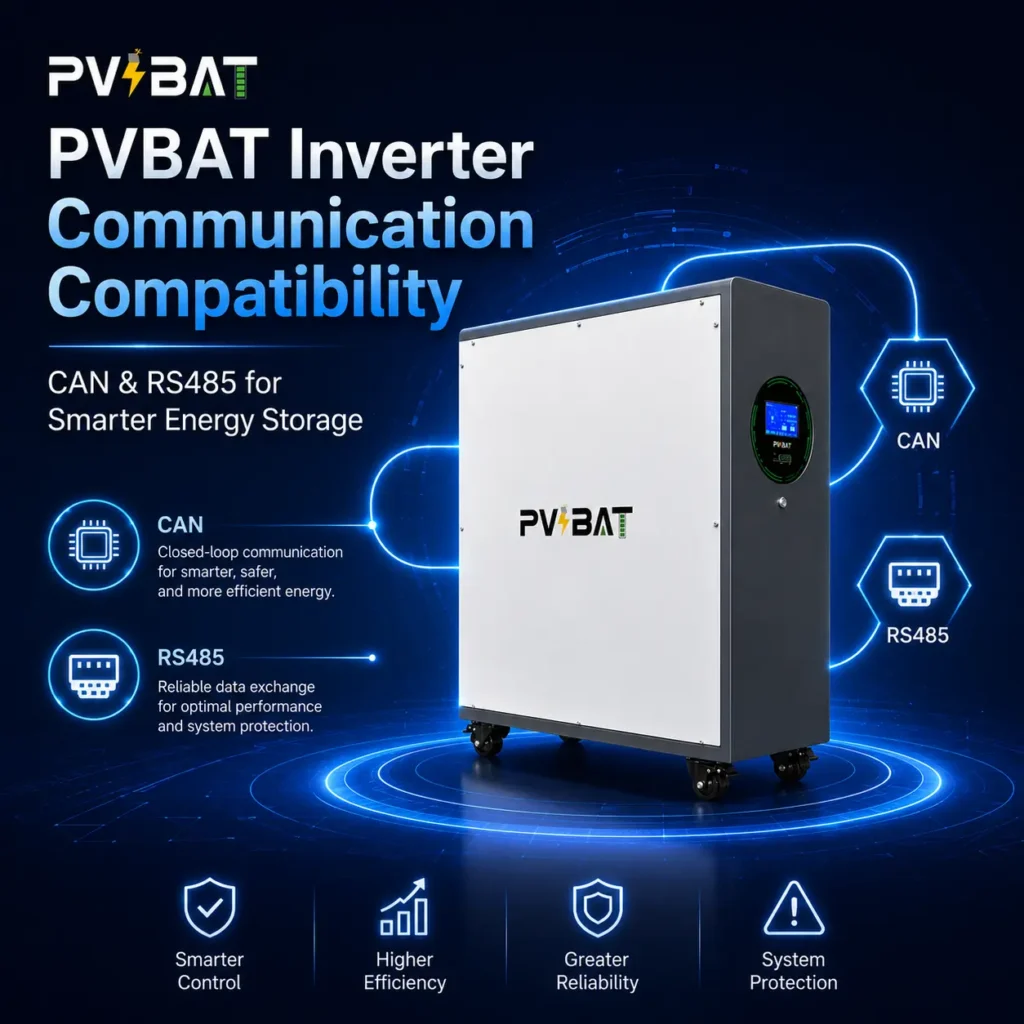
When buying a battery, don’t just look at price and capacity—safety, lifespan, and stability are what really matter. Lithium iron phosphate (LiFePO4) is the top choice for home energy storage, and the reason is simple: it’s safe, durable, and hassle-free. What is a BMS? The “Brain” of the BatteryBMS stands for Battery Management System—never buy a battery without one! It monitors the following in real time: voltage, current, temperature, charge level, and cell balancing. It provides immediate protection against abnormalities such as overcharging, over-discharging, overcurrent, short circuits, high temperatures, and low temperatures. Cycle Life: Determines How Many Years You Can Use ItLiFePO4 outperforms lead-acid batteries by a wide margin and can last for over a decade even with daily charging and discharging. When evaluating lifespan, don’t just look at the numbers—focus on:Depth of Discharge (DoD)Test temperatureCharge/discharge rateCapacity degradation standards Thermal Stability: Safety First for Home InstallationLiFePO4 is non-flammable, non-explosive, and heat-resistant, making it suitable for garages, storage rooms, and outdoor use. Note: Avoid direct sunlight, keep away from heat sources, prevent water accumulation, and ensure proper ventilation. How to determine if a battery is reliable?Cells: Must be LiFePO4BMS: Full protection featuresCertifications: Official safety certificationsWarranty: At least 10 yearsCommunication: Supports CAN/RS485, capable of integrating with inverters In short: For home energy storage, LiFePO4 + BMS is the bare minimum.

Home Energy Storage: Why Choose LiFePO4? Safety and Durability Are Non-Negotiable Read More »

24kWh & 16.5kVA:PVBT TIGER-T4-72 Redefining Backup Power for Multiple Scenarios

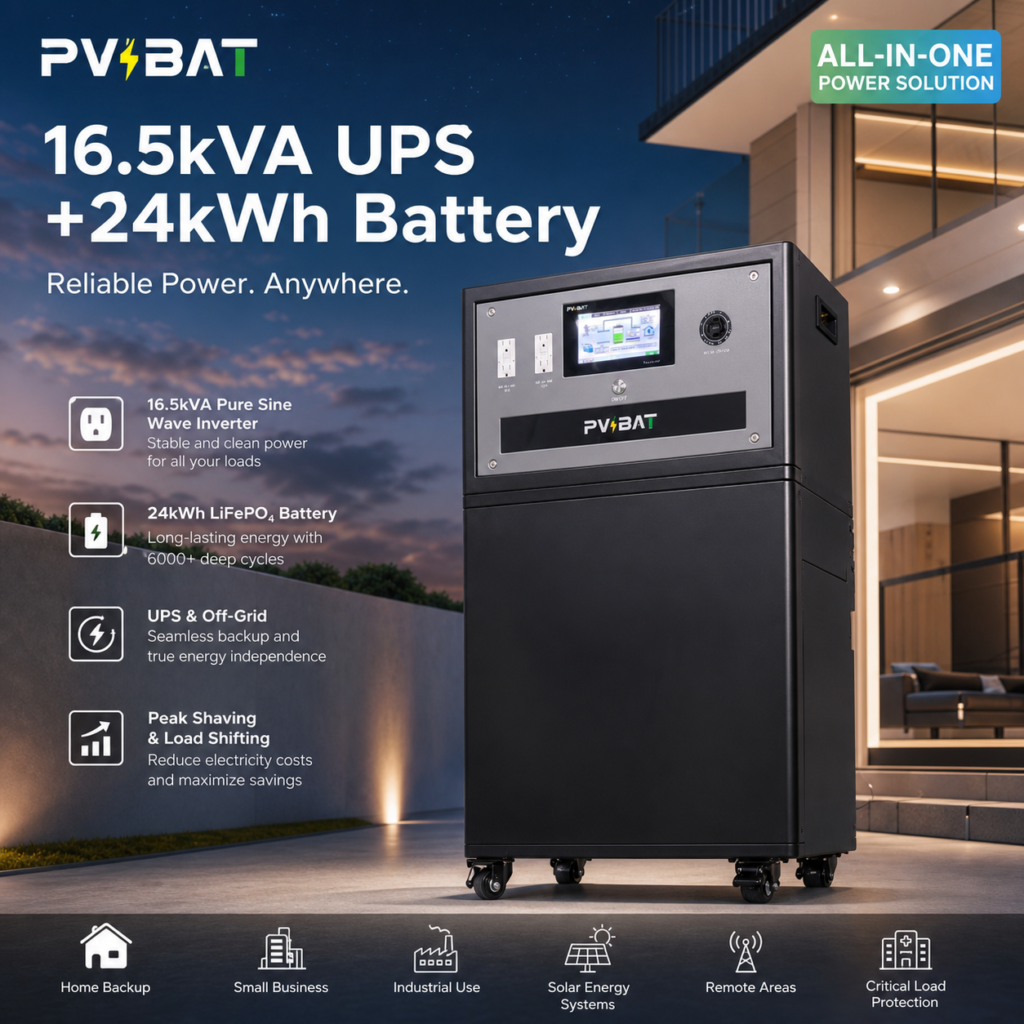
24kWh & 16.5kVA:PVBT TIGER-T4-72 Redefining Backup Power for Multiple Scenarios The PVBAT TIGER-T4-72 isn’t just another small backup battery. It’s built for when you need real capacity and reliable power. With a 24kWh LiFePO₄ battery, 16.5kVA inverter, 120/240V split-phase power, and multiple NEMA outlets, it’s a complete energy storage solution for homes, workshops, RVs, emergencies, and small businesses. Most compact systems need multiple modules to reach decent capacity. The TIGER-T4-72 comes ready to go—big power, all in one unit. Why Choose the TIGER-T4-72? 24kWh Large Battery A built-in 24kWh LiFePO₄ pack keeps your fridge, lights, tools, pumps, and essential devices running longer when the grid goes down. 16.5kVA Strong Output The integrated inverter delivers 16.5kVA continuous power—enough for bigger loads and heavy-duty backup use. 120/240V Split-Phase Made for North American homes. Works with 120V standard devices and 240V large appliances like dryers, ACs, and pumps. Multiple NEMA Outlets Plug and play with common gear: NEMA 14-50R NEMA L14-30R Four 120V AC outlets Connects directly to home appliances, tools, RVs, transfer switches, and accessories. Safe & Durable LFP Chemistry We use LiFePO₄ (LFP) batteries—stable, safe, and built to last. 6,000+ Cycles Up to 6,000 cycles at 80% discharge—years of reliable daily and emergency use. Easy to Move & Place Floor-standing with built-in wheels. Move it where you need it, no fixed installation required. Expandable 48V System Start with one unit, add up to 20 batteries in parallel for bigger storage projects. Advantage Comparison Feature PVBAT TIGER-T4-72 Typical Consumer Backup Typical Modular Home Battery Battery Capacity 24kWh (built-in) 6–12kWh 5–15kWh Output Power 16.5kVA 7–12kW 3–7kW per unit Battery Type LiFePO₄ (LFP) LFP/lithium LFP/lithium Split-Phase 120/240V Some models Needs setup Direct Outlets NEMA 14-50R, L14-30R + 4×120V Limited Hardwired Mobility Wheels, easy to move Portable/semi Fixed install Cycle Life 6,000 @ 80% DoD Varies Varies Expansion Up to 20 units Limited System-dependent Best For Home backup, workshop, RV, emergency, small business Home/personal backup Whole-home storage   Key Specifications Specification PVBAT TIGER-T4-72 Rated Energy 24kWh Battery Voltage 51.2V System Voltage 48V Battery Chemistry LiFePO₄ (LFP) Inverter Output 16.5kVA AC Output 120/240V split-phase Main AC Port NEMA 14-50R Front Outlets 4 × 120V + 1 × L14-30R PV Input 90–230VDC (open circuit) PV Connector BE175 AC Breaker 63A AC Input NEMA SS2-50P, 120/240V, 50A Cycle Life 6,000 @ 80% DoD Communication 2 × RS485 Monitoring Wi-Fi / Bluetooth Temp Range Charge: 0–55°C / Discharge: -20–60°C Expansion Up to 20 batteries parallel Dimensions 1150 × 620 × 391 mm Weight 245kg / 540lbs Installation Floor-standing, wheels included Warranty 10 years  Shop now → Short Homepage Version More Capacity. More Power. Easier to Use. The PVBAT TIGER-T4-72 packs a 24kWh battery, 16.5kVA inverter, 120/240V power, and multiple NEMA outlets into one mobile unit. Perfect for home backup, emergencies, workshops, RVs, and small businesses. Big power, simple setup. Key Highlights 24kWh LiFePO₄ battery 5kVA high power 120/240V split-phase Multiple NEMA outlets 6,000+ cycles Expandable design Easy to move Wi-Fi/Bluetooth monitoring 10-year warranty Disclaimer Specs may change based on configuration and environment. Runtime depends on your loads and battery level. Always have a qualified electrician check compatibility with wiring, switches, solar, and grid before installation.

24kWh & 16.5kVA:PVBT TIGER-T4-72 Redefining Backup Power for Multiple Scenarios Read More »