


For many U.S. rural homes, a grid outage is not only dark rooms—it is also no water once the pressure tank empties. Battery backup for a 240V well pump needs 120/240V split-phase output, enough continuous inverter power, and headroom for startup surge—not a 120V-only camping station. Battery kWh mainly decides how long the pump can cycle while you also run essentials. An all-in-one example class is the PVBAT TIGER-T4-72 (24 kWh · 16.5 kVA · 13 kW continuous · 120/240V), but compatibility still requires a nameplate review. Panel or transfer connections need a licensed electrician; PVBAT offers support, installation guidance, and California warehouse coordination—not installation.
Why well pumps are harder to back up than lights and laptops
A private well pump is a demanding backup load for two reasons.
First, voltage. Many U.S. residential well pumps use 240V. A backup source that only provides 120V will not run that motor without additional conversion equipment—and most small portable power stations never leave the 120V world.
Second, startup surge. When a pump motor starts, it can briefly demand far more power than it uses while running (often discussed as locked-rotor amps / LRA on a nameplate). A product brochure may advertise enough “running watts” and still fail the moment the pressure switch calls for water.
That is why you evaluate continuous output and surge capability together—then capacity (kWh) for runtime.
For a scenario-oriented product overview, see 240V Well Pump Battery Backup. For whole-home sizing context, see the 2026 home battery backup buying guide.
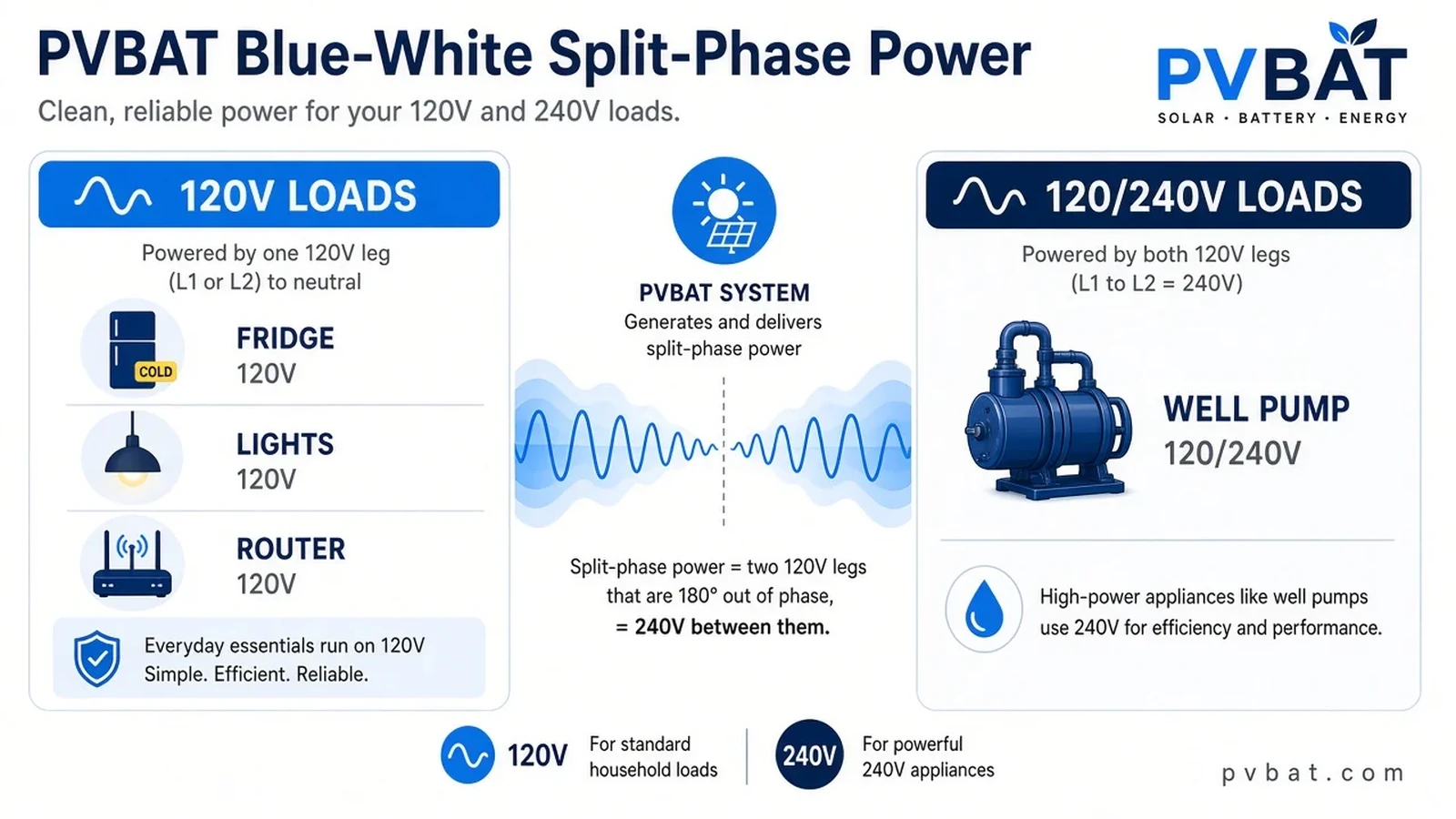
120V vs 120/240V split-phase backup
| Backup type | Typical fit | Well pump reality |
|---|---|---|
| 120V-only portable station | Phones, lights, many fridges, small tools | Usually cannot supply a 240V pump |
| 120/240V split-phase ESS / inverter | U.S. homes, shops, selected 240V appliances | Required voltage class for many residential well pumps—if continuous and surge limits also clear |
Split-phase 120/240V is the standard format behind many American residential services and larger loads. When you shop backup for a well, treat “120/240V” as a gate check, not a nice-to-have badge.
Continuous power vs startup surge (preview)
Think in two steps:
- Can it start? Surge / LRA headroom and motor characteristics.
- Can it keep running? Continuous kW / kVA while other loads share the inverter.
- How long? Battery kWh, water use, and how often the pump cycles.
This article stays at the practical overview level. A dedicated walk-through of nameplates, LRA, and inverter sizing will publish as Well Pump Startup Surge: How to Size a Battery Inverter.
Until then, the minimum homework is simple: photograph the pump nameplate (voltage, HP or FLA, LRA if listed, Hz, phase) and share it before anyone promises a match.
How much battery capacity (kWh) do you need?
Capacity sets how long the pump and your other essential loads can run from stored energy.
A well pump usually does not run continuously. It starts when pressure drops, fills the pressure tank, then stops. That cycling can stretch runtime compared with a motor that never shuts off—but household behavior still dominates:
- Short showers and careful water use → fewer cycles
- Laundry, dishwashing, irrigation, livestock water → more cycles and faster drain
A 24 kWh class system generally gives more flexibility than a small emergency battery: room for the pump plus refrigeration, Wi-Fi, lights, and selected outlets during an outage. For illustrative household runtimes at different average loads, see What Can a 24kWh Battery Backup Run?.
There is no universal “hours of water” number without your pump data and usage pattern—treat any single figure online as a starting conversation, not a guarantee.
Do not forget the pressure tank
Your pressure tank is part of the backup plan.
A healthy, adequately sized tank stores pressurized water and can reduce how often the pump starts. Fewer starts means fewer surge events for the inverter to absorb and often a calmer backup experience.
If the pump short-cycles today, fix the tank, pressure switch, or related plumbing issues as part of resilience planning—not only after you buy a battery. Backup power does not cure a failing tank.
Solar and generators: optional extenders, not magic
Solar: Useful when you want to recover energy during multi-day outages. A grid-charged battery gives you a stored reserve; solar (where installed and correctly coupled) can refill that reserve while the utility is down. Rural homes, cabins, and farms often care about this path—see Rural Home Off-Grid Backup Power.
Generators: Still common for well backup. They need fuel, maintenance, safe placement, and noise tolerance. Many properties use a hybrid idea: battery for quiet coverage of essentials and pump cycles; generator as a longer-duration charging source in extended emergencies.
Neither solar nor a generator removes the need to check voltage, continuous power, and surge on the battery/inverter side.
Safety and transfer: do this the code-compliant way
A well pump backup plan should include proper electrical protection and switching.
- Do not backfeed a home through unsafe or informal wiring.
- Use appropriate transfer equipment, breakers, disconnects, and methods required by local code.
- A licensed electrician should review the well pump circuit, horsepower, voltage, startup requirements, and how backup power will connect before anything is energized as a building-tied system.
PVBAT provides U.S. support and installation guidance. We do not install systems. For shipping and pickup questions in the United States, ask about California warehouse coordination and current availability.
When a TIGER-class all-in-one is a candidate
The PVBAT TIGER-T4-72 is a candidate—not a universal guarantee—when you need more than light-duty backup and your review shows a fit for:
- 24 kWh LiFePO4 capacity for essentials + cycling pump loads
- 16.5 kVA inverter rating with 13 kW continuous active output
- 120/240V split-phase output for many U.S. residential 240V contexts
It is especially relevant when the plan includes a well pump plus other essential circuits—not a single small appliance in isolation. Farms and workshops with shared water or shop loads may also review Farm Workshop Backup Power.
Compatibility always depends on pump voltage, running current, startup surge / LRA, connection method, and what else runs at the same time. Submit nameplate details for a guided review rather than assuming every horsepower class will start.
Direct connection of compatible plug-in loads may be possible after voltage, current, surge, and connector checks. Any connection to a home electrical panel, transfer switch, solar array, generator circuit, or utility service requires a qualified electrician.
Quick FAQ
Can a battery backup run a 240V well pump?
Yes—if the system supports 120/240V split-phase output and has enough inverter capacity for startup surge and continuous running power, and the connection method is appropriate. Nameplate review is required; results are not one-size-fits-all.
Is a small portable power station enough for a well pump?
Usually not for 240V well pumps. Many compact units are 120V-only and may also lack surge headroom even when wattage marketing looks attractive.
How long can a battery run a well pump?
It depends on pump size, water usage, pressure tank behavior, inverter efficiency, reserve settings, and what other loads share the battery. Because pumps cycle, runtime can be much longer than a continuous-run calculation suggests—or much shorter if water demand stays high.
What information do I need from the pump nameplate?
At minimum: voltage, phase, HP or FLA, and LRA (if listed), plus frequency. Photos of the nameplate and the breaker/disconnect labeling help a lot. Also note how you plan to connect (direct compatible outlet vs transfer equipment).
Should I use solar with well pump backup?
Solar is not required for a grid-charged battery to provide backup, but it can extend multi-day resilience by recharging when the utility is down. Pair solar only through a compatible, code-compliant design.
Next step
- Photograph the pump nameplate.
- Confirm you need 240V / split-phase, not a 120V-only station.
- Size continuous and surge power first; then choose kWh for the outage length you care about.
- Scenario page: 240V Well Pump Battery Backup
- Product example: TIGER-T4-72
- Related: Buying guide 2026 · 24 kWh runtime examples · Well pump startup surge & inverter sizing
Contact: pvbat.com · +1 (626) 341-8963 · City of Industry, CA · service@pvbat.com
U.S. support & installation guidance. Ask about California warehouse coordination for current stock and logistics.