What's the difference between 16.58 kWh, 20.48 kWh, and 32.15 kWh Don't just buy anything

Home Energy Storage: Why Choose LiFePO4? Safety and Durability Are Non-Negotiable

When buying a battery, don’t just look at price and capacity—safety, lifespan, and stability are what really matter. Lithium iron phosphate (LiFePO4) is the top choice for home energy storage, and the reason is simple: it’s safe, durable, and hassle-free. What is a BMS? The “Brain” of the BatteryBMS stands for Battery Management System—never buy a battery without one! It monitors the following in real time: voltage, current, temperature, charge level, and cell balancing. It provides immediate protection against abnormalities such as overcharging, over-discharging, overcurrent, short circuits, high temperatures, and low temperatures. Cycle Life: Determines How Many Years You Can Use ItLiFePO4 outperforms lead-acid batteries by a wide margin and can last for over a decade even with daily charging and discharging. When evaluating lifespan, don’t just look at the numbers—focus on:Depth of Discharge (DoD)Test temperatureCharge/discharge rateCapacity degradation standards Thermal Stability: Safety First for Home InstallationLiFePO4 is non-flammable, non-explosive, and heat-resistant, making it suitable for garages, storage rooms, and outdoor use. Note: Avoid direct sunlight, keep away from heat sources, prevent water accumulation, and ensure proper ventilation. How to determine if a battery is reliable?Cells: Must be LiFePO4BMS: Full protection featuresCertifications: Official safety certificationsWarranty: At least 10 yearsCommunication: Supports CAN/RS485, capable of integrating with inverters In short: For home energy storage, LiFePO4 + BMS is the bare minimum.

Home Energy Storage: Why Choose LiFePO4? Safety and Durability Are Non-Negotiable Read More »

Hybrid Inverters vs. Standard Inverters: Don’t Make the Wrong Choice—There’s a World of Difference

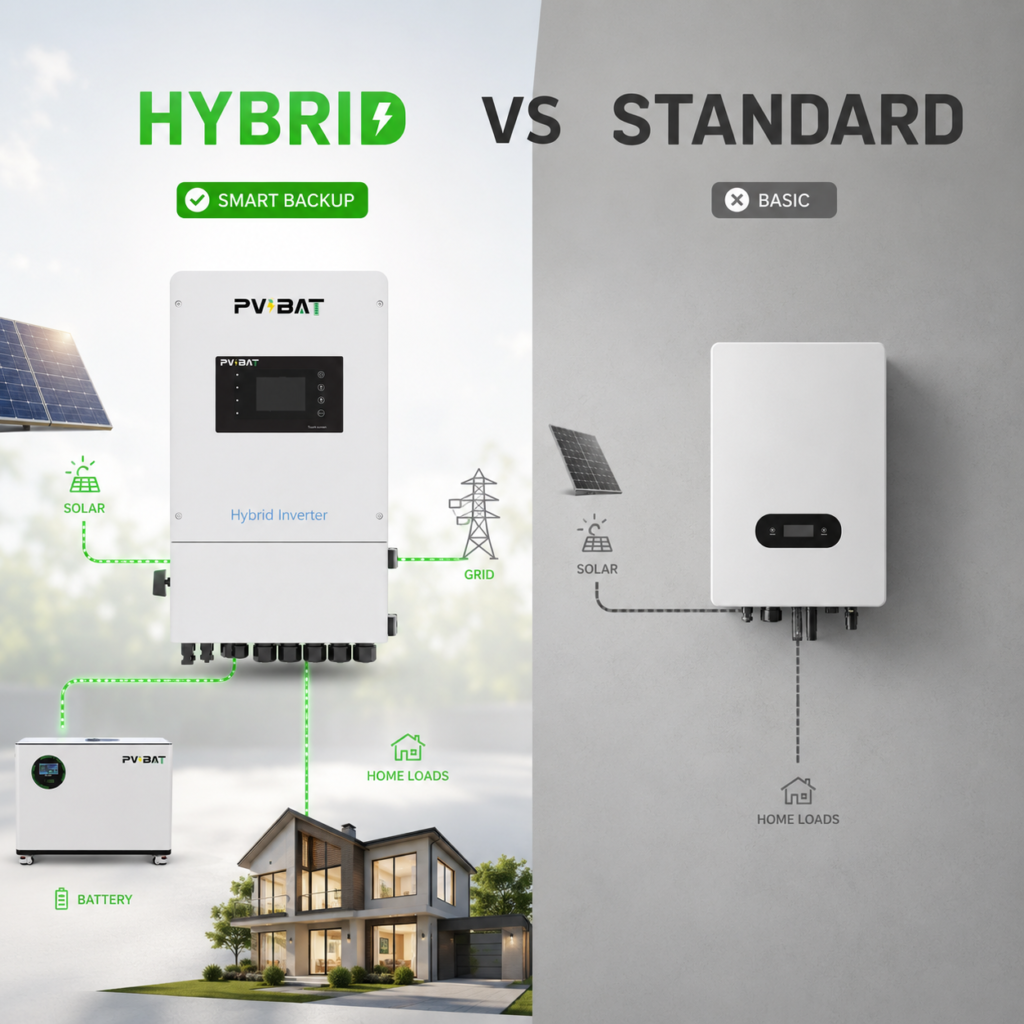
Many people can’t tell the difference between these two types of inverters, which leads to buying the wrong one, rendering it unusable and wasting money. Simply put: Standard Inverter: Converts power only (DC to AC)Hybrid Inverter: Manages the entire home energy system (solar + batteries + grid + loads) Standard Inverter: Simple and affordable, suitable only for pure solar systemsWhat it does: Converts DC power from solar panels or batteries into AC power for household use. Suitable for: Systems with only solar panels, no batteries, tight budgets, and simple setups. Disadvantages: Cannot manage batteries, cannot automatically switch to backup power, and cannot optimize electricity costs. Hybrid Inverter: A must-have for home energy storage—a one-stop solutionWhat it does:Prioritizes solar power for household use → charges batteries → sells excess to the gridIntelligent battery charge/discharge managementAutomatic switchover to backup during power outages, with millisecond-level switchingSaves money with peak-off-peak electricity ratesSupports off-grid operation Key Differences (At a Glance)Standard Inverter: Only converts power; does not manage batteries; weak backup; inexpensiveHybrid Inverter: All-in-one management, battery-friendly, robust backup, slightly more expensive but worth it Which one should you choose for home energy storage?Solar only, no battery: Standard inverterInstalling a battery, need backup, want to save money: Must choose a hybrid inverter What to look for when buying a hybrid inverter?Voltage compatibility (48V/51.2V)Communication protocols (CAN/RS485)120V/240V phase separation (essential for U.S. homes)Continuous power + peak powerSupports parallel operation, off-grid mode, and generator input

Hybrid Inverters vs. Standard Inverters: Don’t Make the Wrong Choice—There’s a World of Difference Read More »

Off-Grid Log Cabins / Farm Energy Storage: Don’t Base Your Choice on Urban Homes—It’s a Whole Different Story

Off-Grid Log Cabins / Farm Energy Storage: Don’t Base Your Choice on Urban Homes—It’s a Whole Different Story

Off-grid, farm, and rural residential settings operate on a completely different power logic than urban areas: cities rely on the grid, while off-grid systems rely on solar panels + batteries + generators. When selecting batteries, don’t just look at capacity; focus on load, starting power, runtime, and scalability. Common power-consuming devices in off-grid/farm settingsRefrigerators, freezers, water pumps, lighting, Wi-Fi, surveillance, power tools, small air conditioners, irrigation equipment. Key Point: Water pumps, freezers, air conditioners, and power tools have high startup power requirements; the inverter must be capable of handling them. Capacity Recommendations (Direct Reference)Small weekend cabin: 10–20 kWh (16.58 kWh/20.48 kWh is sufficient)Year-round cabin: 20–30 kWhBasic farm backup: 20–40 kWhMultiple water pumps / refrigerators / tools: 30kWh+ Long-term off-grid: Multiple battery banks in parallel + solar + generator backupWhy is LiFePO4 suitable for off-grid systems?Long cycle life; daily charging and discharging won’t damage the batteriesLow maintenance; no need for daily monitoringQuiet and clean; more comfortable than a generatorPV charging during the day, battery power at night, generator backup on cloudy or rainy days How to configure an off-grid system?Solar panels (primary power source)Hybrid inverter (energy management)LiFePO4 batteries (energy storage)Distribution panel for critical loadsCircuit breakers + cablesOptional: Generator (backup for cloudy or rainy days)Monitoring system (for remote status checks) Important ReminderIf using water pumps or large power tools, you must verify the inverter’s peak power and the battery’s discharge capacity; otherwise, the equipment may fail to start or be damaged.

Off-Grid Log Cabins / Farm Energy Storage: Don’t Base Your Choice on Urban Homes—It’s a Whole Different Story Read More »

A 20.48 kWh battery—how long will it actually last Don’t be fooled by the theoretical figures

A 20.48 kWh battery—how long will it actually last? Don’t be fooled by the theoretical figures.

The 20.48kWh model is the most popular, but almost everyone asks: Can this battery last through the night during a power outage? How long does it last? Let’s be honest: there’s no set answer—it all depends on how many devices you have running at the same time. First, let’s calculate the actual usable capacityRated at 20.48kWh, but you can actually use 80%–90% of that: Actual usable capacity: 16.4–18.4kWhActual runtime under different loads 500W (refrigerator + lights + Wi-Fi): 32–36 hours1000W (basic appliances + TV + computer): 16–18 hours2000W (plus water pump + small kitchen appliances): 8–9 hours3000W (small air conditioner running): 5–6 hours4000W (multiple high-power devices): About 4 hours Why such a big difference?Refrigerators and air conditioners draw high power during startupAir conditioners are major power consumers; running one cuts runtime in halfSolar power replenishment during the day can double the runtime Who is the 20.48 kWh system suitable for? Frequent power outagesInstalled solar panels and want to use electricity at nightDon’t want to just cover the basics; want to maintain a normal lifestyleDon’t want to buy a generator; find them noisy and troublesome Practical TipsDuring installation, run separate circuits for critical loads: refrigerator, lights, Wi-Fi, water pump, and essential outlets. During a power outage, avoid randomly turning on high-power devices—you’ll have no problem getting through the night.

A 20.48 kWh battery—how long will it actually last? Don’t be fooled by the theoretical figures. Read More »

What's the difference between 16.58 kWh, 20.48 kWh, and 32.15 kWh Don't just buy anything

What’s the difference between 16.58 kWh, 20.48 kWh, and 32.15 kWh? Don’t just buy anything

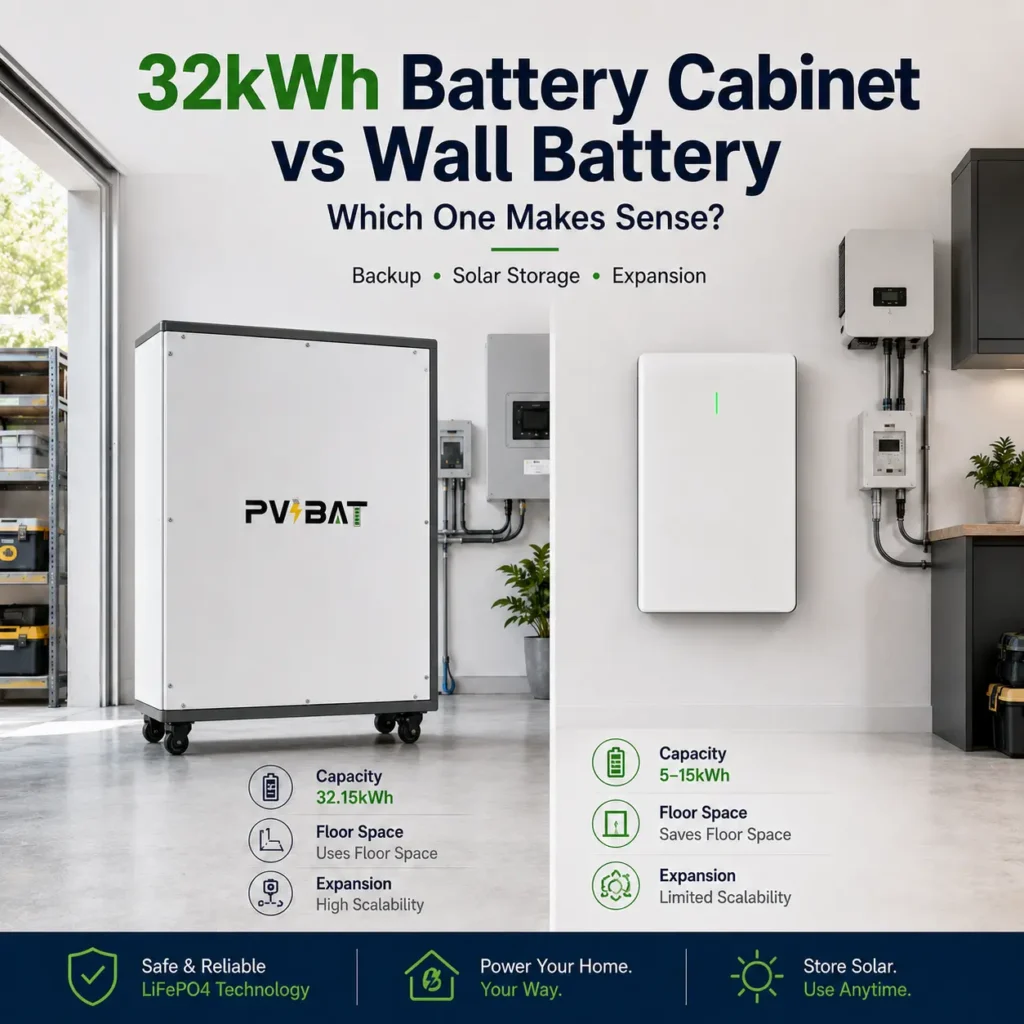
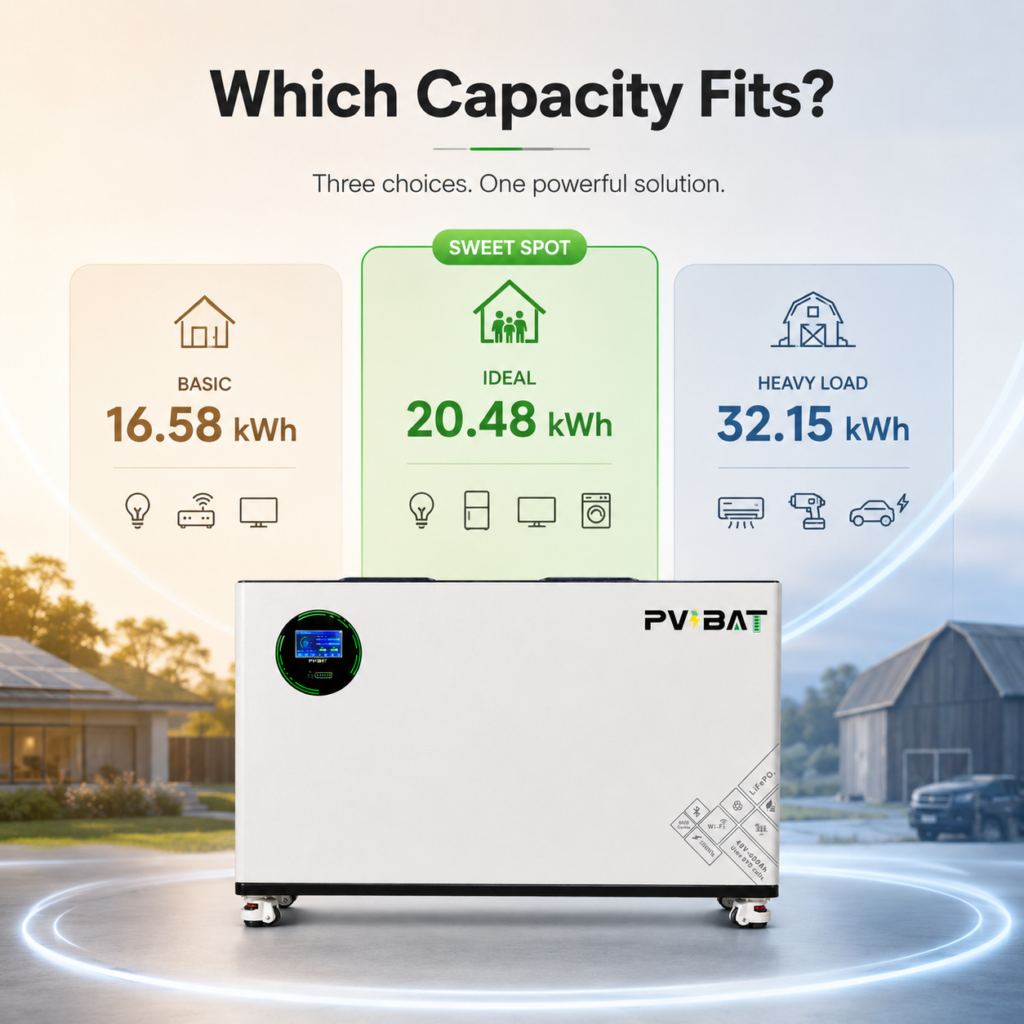
While the capacity figures for these three models may seem similar at first glance, their practical applications, runtime, and cost are completely different. In a nutshell: 16.58 kWh is sufficient, 20.48 kWh offers peace of mind, and 32.15 kWh can handle heavy-duty use. 16.58 kWh: The Essential Choice for Average HouseholdsSuitable for: Standard urban homes, homes with solar panels, tight budgets, and those needing to cover only basic living needs. Can power: Refrigerator, lights, Wi-Fi, TV, smartphones, computers, and common outlets. Not suitable for: Air conditioning, electric stoves, or deep-well pumps—these won’t last long. 20.48kWh: The safe choice for most householdsSuitable for: Areas with frequent power outages, those seeking reliability, homes with solar panels, and those wanting to use solar power at night. Advantages over the 16.58kWh model:Longer backup timeSupports more devices: water pumps, small kitchen appliances, small air conditioners for short periodsBest balance of price and capacity—no waste, no regrets 32.15kWh: For Heavy Loads / Off-Grid Use OnlySuitable for: Large homes, farms, warehouses, small shops, long-term off-grid use, or locations with many water pumps, freezers, and tools. Features: No worries during extended power outages; run high-power devices freely; expand capacity by paralleling multiple units. How to choose quickly?Just want uninterrupted power: 16.58 kWhWant stability and peace of mind: 20.48 kWhLarge homes / farms / off-grid: 32.15 kWh

What’s the difference between 16.58 kWh, 20.48 kWh, and 32.15 kWh? Don’t just buy anything Read More »

How many kWh should a home backup battery be It’s not just a matter of “the bigger, the better.”

How many kWh should a home backup battery be? It’s not just a matter of “the bigger, the better.”

When many people choose a home energy storage battery, their first instinct is: the bigger, the better. But that’s not how it works in reality. There are only three factors that truly determine the capacity you need: the devices you must keep running during a power outage, how long you want to last, the battery’s actual discharge capacity, and inverter efficiency. A simple, practical formula (easy for anyone to use) Battery Capacity ≈ Total Power of Critical Devices × Backup Duration ÷ Actual Discharge Efficiency ÷ Inverter Efficiency Example: You want to power your refrigerator, lights, Wi-Fi, TV, and charge your phone, with a total power of about 1000W (1kW), and you want to last for 12 hours. Theoretical capacity: 1kW × 12h = 12kWh However, lithium iron phosphate (LiFePO4) batteries have a safety margin, so only 80%–90% of the rated capacity is usable. Factoring in inverter losses, you’ll need to purchase at least 15 kWh to ensure reliability. How to Choose Based on Household Needs (Pick the Category That Fits) Basic Backup (5–10 kWh): Refrigerator, lights, Wi-Fi, and phone charging—sufficient for short power outages. Standard Household (10–20 kWh): Supports most daily appliances; the most common and well-balanced option. Whole-House Backup (20–30 kWh+): Supports air conditioners, water pumps, and kitchen appliances; suitable for areas with frequent power outages. Off-Grid / Farm (30 kWh+): For long-term off-grid use with multiple high-power devices; parallel connection of multiple units is recommended. How to Choose Among PVBAT’s Three Popular Capacities 16.58kWh (FALCON-48G2): Sufficient for average households; suitable for solar energy storage and electricity cost optimization. 20.48kWh (BEAR-48G1): The ideal capacity for most households—long runtime, high load capacity, and moderate price. 32.15kWh (ELEPHANT-48628): The top choice for large homes, farms, small businesses, and off-grid applications; remains stable even under heavy loads. Quick Summary Not sure how to choose? Start by listing the equipment you must use during a power outage, calculate the total power consumption and runtime, then select the capacity. Bigger isn’t always better—the most cost-effective approach is to choose a capacity that meets your needs with a little extra margin.

How many kWh should a home backup battery be? It’s not just a matter of “the bigger, the better.” Read More »

chatgpt image 2026年5月15日 21 09 57

Troubleshooting Common Issues with PVBAT Solar Energy Storage Systems: A Guide Even Beginners Can Follow

During long-term operation, photovoltaic energy storage systems are bound to experience minor malfunctions, such as inverter alarms, batteries failing to charge, and decreased power generation efficiency. When faced with these issues, many users are unsure how to troubleshoot them and can only wait for service engineers, which wastes time and disrupts normal use. PVBAT has compiled a list of common system faults and troubleshooting methods that are simple and easy to understand, even for beginners, helping users quickly resolve minor issues and restore normal system operation. We provide a PV storage troubleshooting guide to empower beginners to perform self-diagnosis and resolve common PV storage faults. Fault 1: Inverter alarm displaying “Communication Fault (F01).” Troubleshooting steps: Inspect the communication cables between the inverter and the batteries/PV panels to ensure connections are secure, with no loose or damaged cables; Inspect the communication ports to ensure they are free of dust and oxidation, preventing poor contact; if the issue persists, restart the inverter and battery, then reconnect the communication cables; if the alarm persists after restarting, contact an after-sales engineer to resolve the inverter communication failure. Fault 2: Lithium battery not charging. Troubleshooting: Inspect the lithium battery terminals to ensure positive and negative connections are correct and secure, avoiding reverse polarity; Check the inverter’s charging parameters to ensure the charging current and voltage are set appropriately; Check the lithium battery’s SOC. If the SOC has reached 100%, charging will not occur (this is normal); If the SOC is below 100% and charging still does not occur, check whether the lithium battery is in a protection state (e.g., over-temperature or over-current protection). Wait until the fault is resolved before attempting to charge again to resolve the issue of the energy storage lithium battery not charging.

Troubleshooting Common Issues with PVBAT Solar Energy Storage Systems: A Guide Even Beginners Can Follow Read More »

第十六 2

Don’t Panic During a Power Outage: Real-World Testing of the PVBAT Energy Storage System’s Emergency Power Supply

Power outages are unexpected events that both residential and commercial users may face, especially during summer peak demand periods or severe weather conditions such as heavy rains and typhoons. Power outages not only disrupt daily life and business operations but can also result in significant financial losses. To verify the emergency power supply capabilities of the PVBAT energy storage system, we conducted real-world field tests to determine whether it can truly meet power demands during outages and provide users with peace of mind. This emergency power supply test focused on validating the PVBAT’s emergency power capabilities, offering a reference for users selecting emergency energy storage equipment. Test Scenario 1: Residential Emergency Power Supply (using a PVBAT 6kW hybrid inverter + 48V 628Ah lithium battery). Simulating a typical household power usage scenario, we connected loads such as a refrigerator, air conditioner (1.5 HP), desk lamp, and computer, with a total load power of approximately 3 kW. After the grid power was manually disconnected, the inverter rapidly switched to backup power mode in less than 0.5 seconds, with no noticeable power interruption, and all loads continued to operate normally. During the continuous power supply test, with the battery fully charged, it provided stable power for approximately 10 hours, fully meeting a household’s normal daily power needs. This effectively prevented issues such as food spoilage in the refrigerator and air conditioner shutdown caused by power outages, demonstrating the advantages of residential emergency energy storage. Test Scenario 2: Commercial Emergency Power Supply (using a PVBAT 12kW hybrid inverter paired with two 48V 628Ah lithium-ion batteries in parallel). Simulating a convenience store power usage scenario, the system connects to loads including freezers (2 units), cash registers (2 units), lighting, and air conditioning, with a total load power of approximately 7 kW. After the grid power is cut off, the inverter quickly switches to backup power mode, and all commercial equipment continues to operate normally. With fully charged batteries, it can provide stable power for approximately 10 hours, which is sufficient to sustain the convenience store through a short-term power outage. This prevents economic losses such as food spoilage and the inability to process payments, demonstrating the value of commercial emergency energy storage. Test Scenario 3: Outdoor Emergency Power Supply (paired with the PVBAT TIGER-T4-72 integrated energy storage system). Simulating an outdoor performance scenario, the system was connected to loads such as sound systems, projectors, and LED screens, with a total load power of approximately 10 kW. After the grid power was cut off, the TIGER-T4-72 immediately activated emergency power supply, and all equipment continued to operate normally. With the battery fully charged, it provided a stable power supply for approximately 2.5 hours, fully meeting the power requirements for small-scale outdoor performances. By eliminating reliance on the grid and achieving self-sufficient power supply, this demonstrates the system’s capabilities in outdoor emergency energy storage. Test results demonstrate that the PVBAT energy storage system delivers stable and reliable emergency power supply, featuring fast switching and extended runtime. It effectively addresses power outages in various scenarios—including residential, commercial, and outdoor settings—providing users with peace of mind through assured emergency power protection. This capability represents one of the core competitive advantages of PVBAT products, establishing the brand as a trusted provider of emergency energy storage solutions.

Don’t Panic During a Power Outage: Real-World Testing of the PVBAT Energy Storage System’s Emergency Power Supply Read More »

PVBAT Battery Compatibility: Check This Before You Buy—Otherwise, It Won’t Work Once Installed

PVBAT Battery Compatibility: Check This Before You Buy—Otherwise, It Won’t Work Once Installed

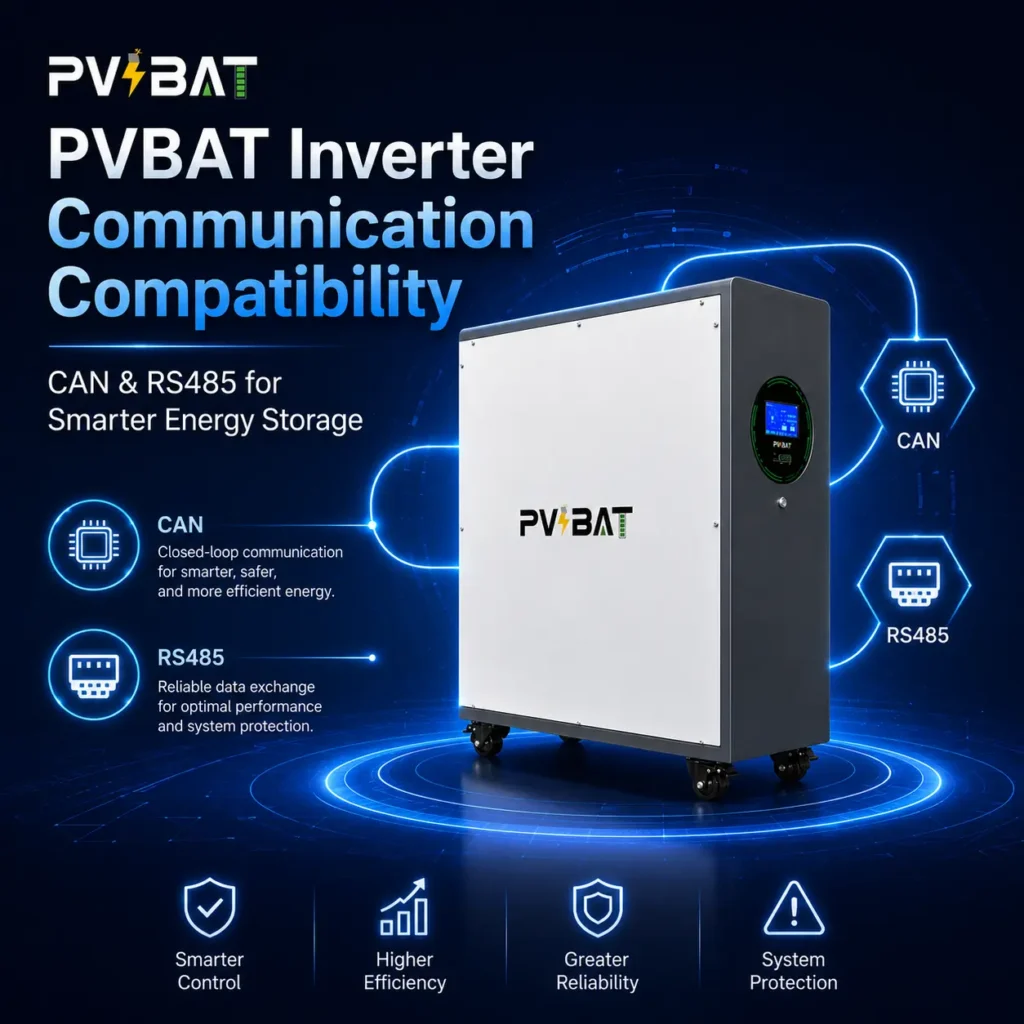
Don’t just buy any battery—no matter how large the capacity, if it’s incompatible with your inverter, it’s a waste of money. Before installing a PVBAT LiFePO4 battery, you must perform these 7 checks. 1. Voltage Matching (Most Basic)Common household battery voltages: 48V/51.2V. Verify:Battery rated voltageInverter input voltage rangeCharge/discharge cut-off voltageMaximum charge/discharge current 2. Communication Protocol (Smart Integration)Common: CAN/RS485With communication: The inverter can read battery level, temperature, and fault codes, providing safer protection.Without communication: It may still function, but you lose smart protection, which is high-risk. 3. Inverter Power Rating (How Many Devices It Can Support)Continuous power: For everyday usePeak power: For the moment devices start up120V/240V Phase-Split: Essential for U.S. homesOff-Grid Mode: Backup during power outagesParallel Expansion: Add batteries later 4. Battery Parallel Connection (Future Expansion)Confirm: Supports parallel connection; maximum number of parallel units. For example, if 20.48 kWh is insufficient, multiple sets can be paralleled to reach 40 kWh+, suitable for heavy loads or off-grid use. 5. Pre-installation Checklist (Check off as you go)Does the inverter support 48V/51.2V?Do the batteries and inverter use the same communication protocol?Does the inverter support the local voltage (120V/240V)?Is the battery’s discharge capacity sufficient for your home’s maximum load?Do you plan to expand capacity by adding more batteries in the future?Are there official wiring diagrams and parameter settings available?Has a professional installer confirmed the installation plan? 6. Official Compatibility List (Recommended to be posted on the official website)TableInverter Brand / Model Voltage Match Communication Protocol Status RemarksBrand A Model X 48V/51.2V CAN Tested Set parameters according to manualBrand B Model Y 48V/51.2V RS485 Compatible Select corresponding protocolBrand C Model Z To be confirmed To be confirmed Under testing Contact technical support 7. Summary in a nutshellWhen buying batteries, check compatibility first, then capacity. Voltage, communication, power, and parallel connection—if these four factors match, the system will be stable after installation.

PVBAT Battery Compatibility: Check This Before You Buy—Otherwise, It Won’t Work Once Installed Read More »

第十二 2

PVBAT 48V 628Ah Lithium-Ion Battery Parallel Connection Guide: Hassle-Free Capacity Expansion, Stable and Efficient

For scenarios with high power demands, such as medium-to-large households and small commercial spaces, the capacity of a single lithium-ion battery is often insufficient. In such cases, multiple lithium-ion batteries must be connected in parallel to increase capacity. However, connecting lithium-ion batteries in parallel requires strict adherence to wiring standards, address configuration, and device compatibility; improper operation can easily lead to uneven charge distribution among batteries, communication failures, or even equipment damage. The PVBAT 48V 628Ah lithium-ion battery supports multi-module parallel operation. Combined with a detailed lithium-ion battery parallel connection guide, it allows users to expand capacity with confidence, ensuring stable and efficient system operation and helping users achieve energy storage capacity expansion. First, preparations before parallel connection. Ensure that all lithium batteries to be connected in parallel are of the PVBAT 48V 628Ah model. Avoid mixing different models or brands of lithium batteries (which can easily lead to charge imbalance and affect battery life). Check the status of each lithium battery to ensure there are no faults or damage, and that the SOC (State of Charge) is consistent (it is recommended to charge them all to 60%-80%). Prepare dedicated parallel connection boxes, circuit breakers, and communication cables, ensuring the cable specifications meet requirements (refer to the manual for recommended specifications) to avoid safety hazards caused by incompatible cables, and complete preparations for lithium battery parallel connection. Second, the parallel connection wiring procedure. Move all lithium batteries to the installation location, ensuring the installation surface is level and secure, and leaving sufficient space for heat dissipation to prevent battery overheating; Using the junction box and circuit breakers, connect the positive and negative terminals of multiple lithium-ion batteries in parallel. Strictly distinguish between positive and negative terminals during wiring to prevent reverse connection; connect the communication cables in the order of “Host Link Port OUT → Slave Link Port IN,” connecting all paralleled batteries sequentially. Ensure all connections are secure and free of looseness to prevent poor contact, and perform the lithium-ion battery parallel wiring according to standard procedures. Next, configure the addresses. When multiple batteries are used in parallel, set the addresses via the DIP switches on the BMS to distinguish between different battery modules and avoid address conflicts (refer to the manual for DIP switch settings; addresses 1–20 can be freely selected). Alternatively, you can use the automatic DIP switch function: set all battery DIP switches to the “OFF” position, connect the communication cables, and power on the system. The master unit will automatically assign addresses, eliminating the need for manual configuration. This method offers greater convenience, reduces the likelihood of errors, and ensures proper address setup for the parallel-connected lithium-ion batteries. Finally, perform post-parallel connection debugging. After connection is complete, power on the system to check the communication status of all batteries and ensure there are no communication faults; check the SOC and voltage of each battery to ensure power balance; run the system for a period of time to check the battery charge and discharge status, ensuring the parallel system operates stably and efficiently. If any abnormalities occur, promptly check the wiring and address settings, or contact a PVBAT after-sales engineer for assistance to ensure proper debugging of the lithium battery parallel system.

PVBAT 48V 628Ah Lithium-Ion Battery Parallel Connection Guide: Hassle-Free Capacity Expansion, Stable and Efficient Read More »