
The TIGER-T4-72 can be installed three ways: solar charging only, grid charging with no solar, or solar plus grid. Grid charging uses a licensed electrician to install a NEMA 14-50R outlet and an isolated subpanel, then a 50A cable to the SS2-50P inlet. Front 120V outlets and the L14-30R can power compatible plug-in loads directly. This is an educational overview, not a wiring diagram. Do not backfeed the utility grid.
These diagrams show typical U.S. setups for the TIGER-T4-72 24kWh, 16.5kVA 120/240V battery backup. They are an educational overview only — not a construction or wiring diagram. Installation that involves a utility meter, a charge outlet, a home panel, a transfer method, or an isolated subpanel must be performed by a licensed electrician. Follow the TIGER-T4 user manual and local code / the authority having jurisdiction (AHJ).
What stays the same in every option
- Do not backfeed the utility grid.
- If you use an isolated subpanel, it should supply selected circuits only — not an assumed whole-home feed.
- Compatible plug-in loads can use the front 120V outlets and the front L14-30R directly, after you confirm voltage, current, and startup surge.
- The side NEMA 14-50R on the TIGER-T4-72 is an output. The wall NEMA 14-50R in Options 2 and 3 is a charge outlet that feeds the SS2-50P inlet. Do not treat those two 14-50R connections as the same thing.
- PVBAT provides product specifications and installation guidance. PVBAT does not perform on-site electrical installation.
Option 1: Solar direct charge
This setup charges the TIGER-T4-72 from solar panels only. No utility connection is used in this option.
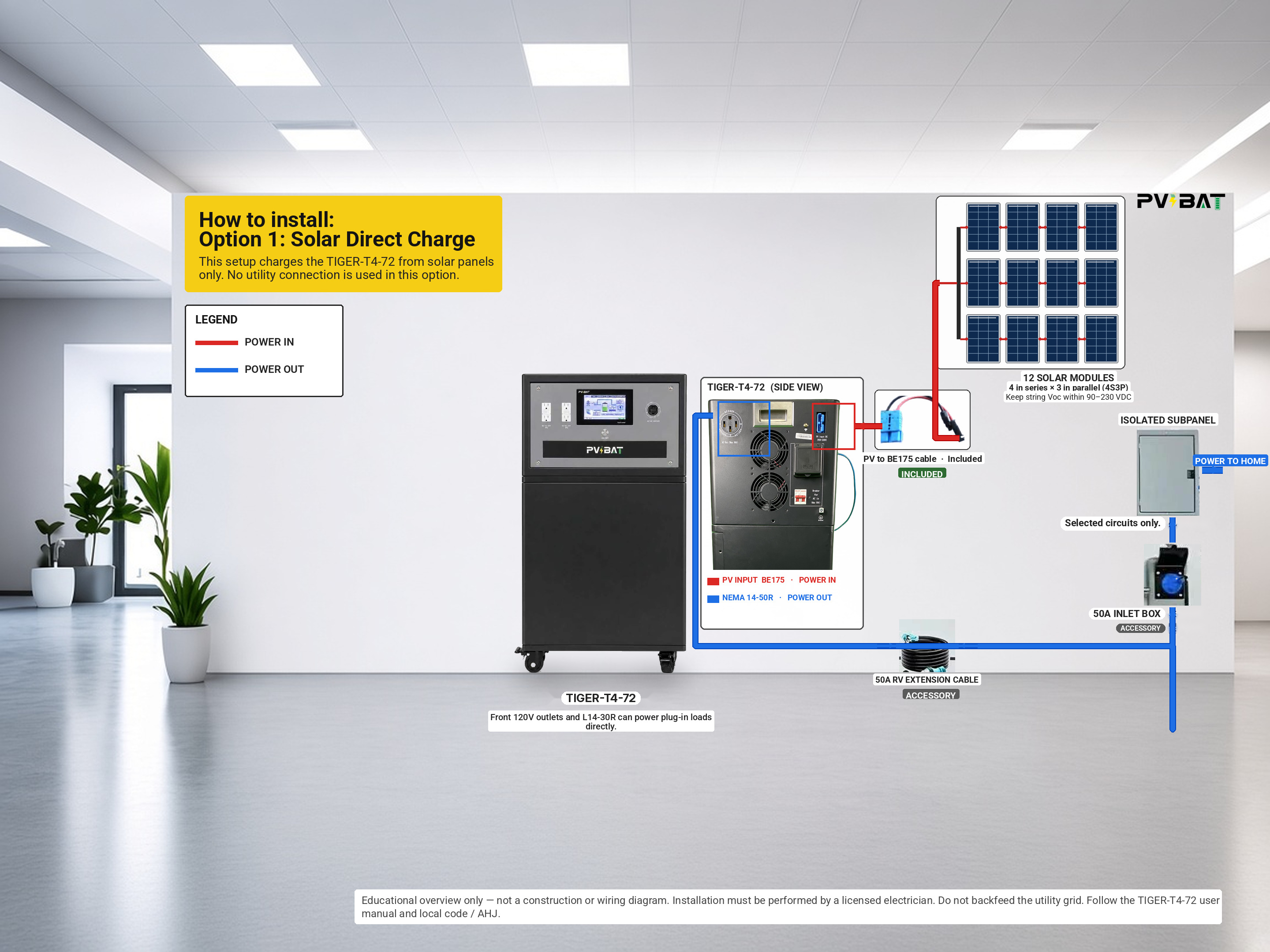
Compatible panels connect through the included PV-to-BE175 cable, into the BE175 PV input on the side of the unit. Keep each string’s open-circuit voltage (Voc) within 90–230 VDC. One example shown in the diagram is 12 modules in a 4-in-series × 3-in-parallel (4S3P) arrangement. That is an example, not the only valid array. Confirm your panel Voc, current, and string design before installation.
From the TIGER-T4-72, 120/240V output can supply compatible plug-in loads at the front outlets, and selected home circuits through an isolated subpanel when a licensed electrician installs that path. The diagrams show a 50A extension cable and a 50A inlet box as accessories on the output side.
Option 1 is a common starting point for off-grid or no-utility sites, or for users who want solar charging first. If you later add grid charging, the ports already on the unit support Option 3, subject to local code and a licensed electrician’s design.
Option 2: Grid charge, no solar
This setup charges the TIGER-T4-72 from the utility grid. No solar panels are used in this option.
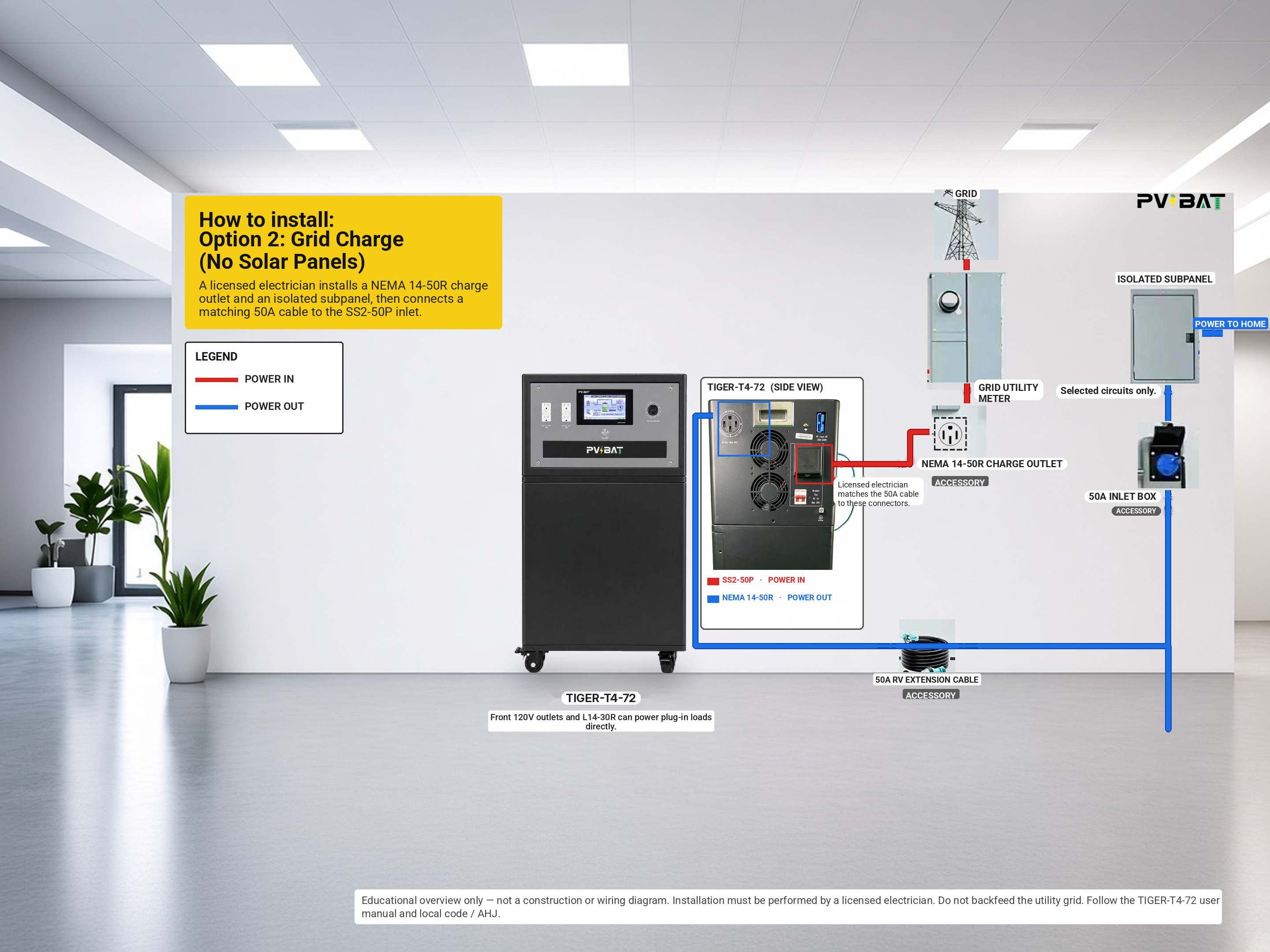
A licensed electrician installs a NEMA 14-50R charge outlet and an isolated subpanel, then connects a matching 50A cable to the SS2-50P inlet on the side of the TIGER-T4-72. The electrician must match the 50A cable to the connectors. The charge path is: utility / meter → NEMA 14-50R charge outlet → 50A cable → SS2-50P inlet.
Backup power to selected home circuits, when used, goes out from the unit’s side NEMA 14-50R, through a 50A extension cable and a 50A inlet box, into the isolated subpanel. That subpanel should feed selected outlets only. Front 120V outlets and the L14-30R can still power compatible plug-in loads directly.
If you want battery backup before you add solar, this is the option that matches a home battery backup without solar plan. Solar can be added later through the BE175 PV input, which becomes Option 3.
Option 3: Solar and grid charge
This setup can charge the TIGER-T4-72 from solar panels and from the utility grid.
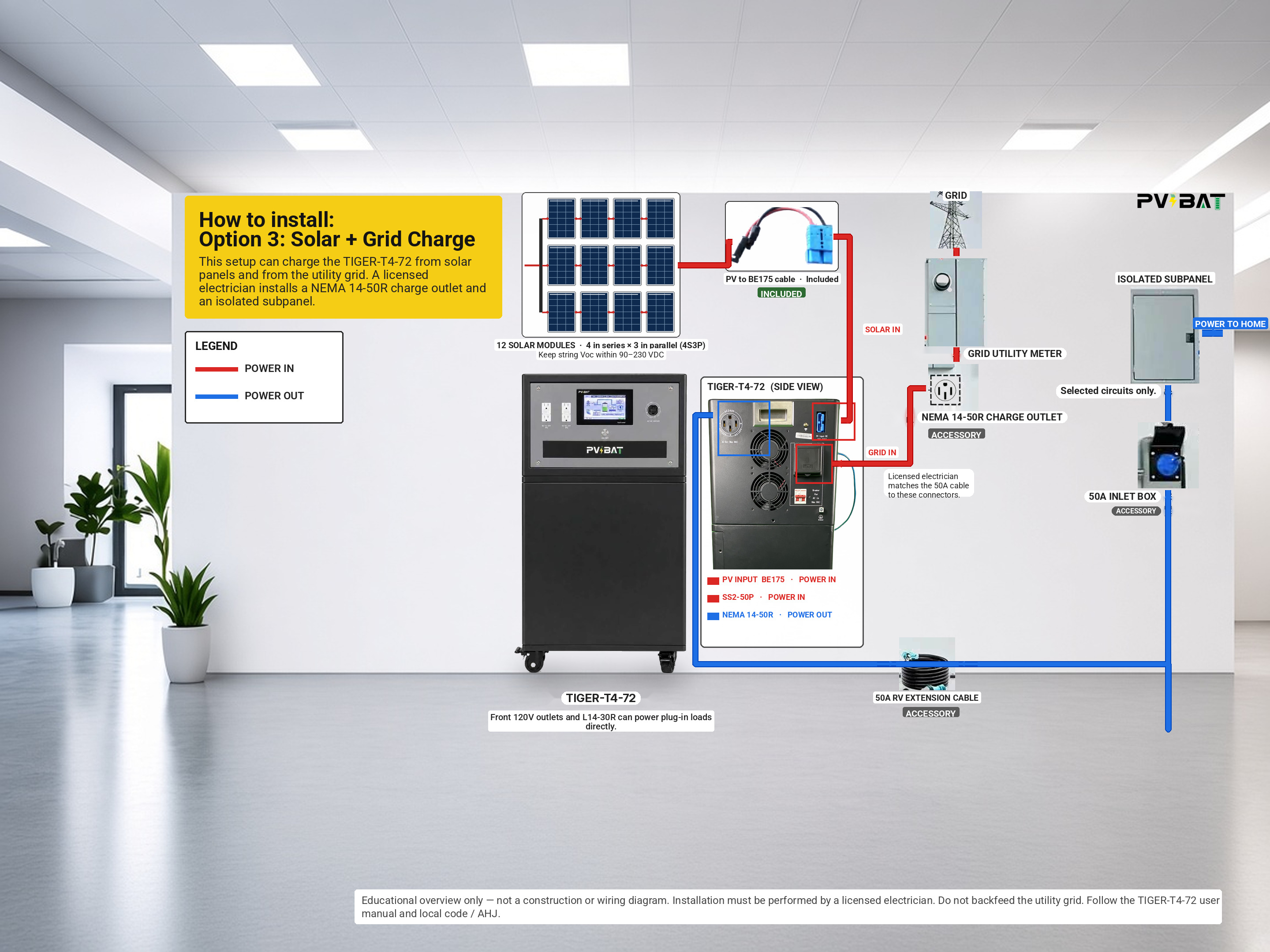
Solar input uses the same BE175 PV connection as Option 1, including the included PV-to-BE175 cable and the 90–230 VDC Voc limit. Grid charging uses the same licensed-electrician path as Option 2: a NEMA 14-50R charge outlet, a matching 50A cable, and the SS2-50P inlet. Output to selected home circuits still goes through the isolated subpanel and should cover selected outlets only.
Use Option 3 when you want solar to recharge the battery, including during an outage when the sun is available, and still want grid charging when solar is limited.
Ports used in these diagrams
| Connection | On the TIGER-T4-72 | Role in these options |
|---|---|---|
| PV input | BE175 | Solar charging; keep string Voc within 90–230 VDC |
| AC input (side) | NEMA SS2-50P, 120/240V, 50A | Grid charging inlet in Options 2 and 3 |
| AC output (side) | NEMA 14-50R, 120/240V, 50A | Output toward the 50A inlet box and isolated subpanel |
| Front outlets | Four 120V outlets and one L14-30R | Direct plug-in loads, after you confirm compatibility |
| Isolated subpanel | Installed by a licensed electrician | Selected home circuits only |
The 50A extension cable and 50A inlet box shown in the diagrams are accessories. Confirm the exact models with your electrician and with PVBAT before you order.
Plug-in loads and selected home circuits
You do not have to use an isolated subpanel to get power from the TIGER-T4-72. Compatible equipment can plug into the front 120V outlets or the L14-30R after you check voltage, running current, and startup surge. For 240V well pumps and other hardwired or high-surge loads, size the system before you connect anything; see battery backup for well pumps and what a 24kWh battery backup can run.
A 24kWh TIGER-T4-72 has about 18.4 kWh usable energy, based on 80% depth of discharge and at least 96% conversion efficiency. Runtime still depends on the loads you keep on, solar input, and operating conditions.
Any connection to a home electrical panel, transfer equipment, isolated subpanel, grid circuit, or other permanent building wiring requires a licensed electrician and must follow local code and the TIGER-T4 user manual. Never backfeed the utility grid.
FAQ
Can I install the TIGER-T4-72 without solar panels?
Yes. Option 2 charges from the utility grid through a NEMA 14-50R charge outlet and the SS2-50P inlet. Solar is not required. You can add compatible solar later through the BE175 PV input.
Do I need a licensed electrician?
For direct plug-in use at the built-in outlets, connect only compatible devices after you confirm the ratings. For a charge outlet, isolated subpanel, home panel, transfer equipment, or any permanent building connection, use a licensed electrician and follow local code.
Can the TIGER-T4-72 power a whole home?
These diagrams show an isolated subpanel for selected circuits only. Whether a given home’s selected loads will run — and for how long — depends on those loads, startup surge, and available energy. Do not treat this overview as a whole-home installation plan.
What is the isolated subpanel for?
It is a separate panel, installed by a licensed electrician, that feeds selected home outlets or circuits from the TIGER-T4-72. It is not a license to backfeed the main utility panel.
Which 14-50R is the charging connection?
The wall-mounted NEMA 14-50R in Options 2 and 3 is the charge outlet. The cable from that outlet goes to the SS2-50P inlet on the TIGER-T4-72. The NEMA 14-50R on the side of the unit is an output, used toward the inlet box and isolated subpanel.
How should solar panels be configured?
Use the BE175 PV input and keep string Voc within 90–230 VDC. The 12-module 4S3P layout in the diagram is one example. Confirm your panel ratings and string design before installation.
Can front outlets and the subpanel be used at the same time?
The front 120V outlets and L14-30R can power compatible plug-in loads directly. If a subpanel is also connected, a licensed electrician should confirm that the combined loads stay within the TIGER-T4-72’s 16.5kVA / 13kW output and the wiring design.
Will this backfeed the grid?
It must not. Follow the manual, local code, and the electrician’s isolation design. Do not connect the TIGER-T4-72 in a way that can send power back into the utility grid.
Next step
Review the TIGER-T4-72 24kWh battery backup for specifications, pricing, and configuration, and download the TIGER-T4 user manual before any installation. For a California-warehouse or U.S. load review, use the product page or home backup planning page.
Educational overview only — not a construction or wiring diagram. Installation must be performed by a licensed electrician. Do not backfeed the utility grid. Follow the TIGER-T4-72 user manual and local code / AHJ.