
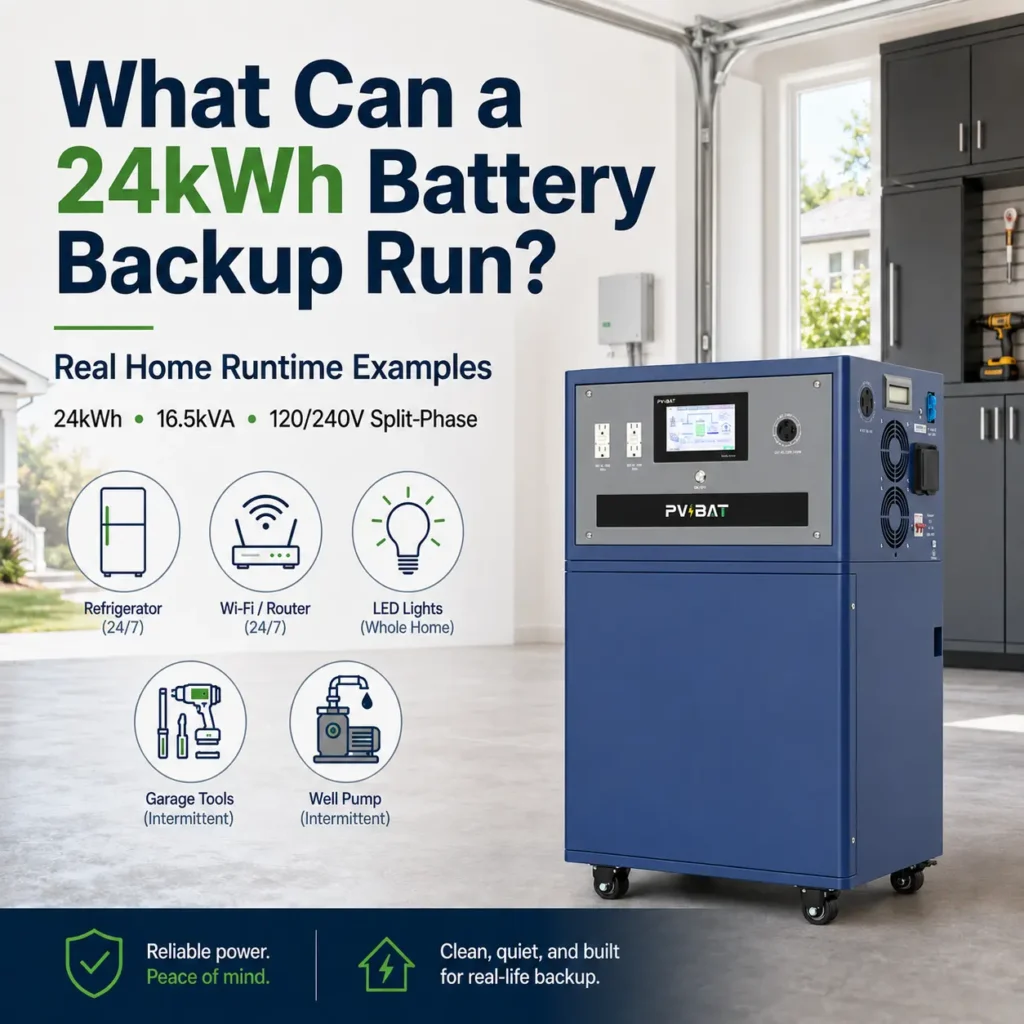
What Can a 24kWh Battery Backup Run? Real Home Runtime Examples for U.S. Homes
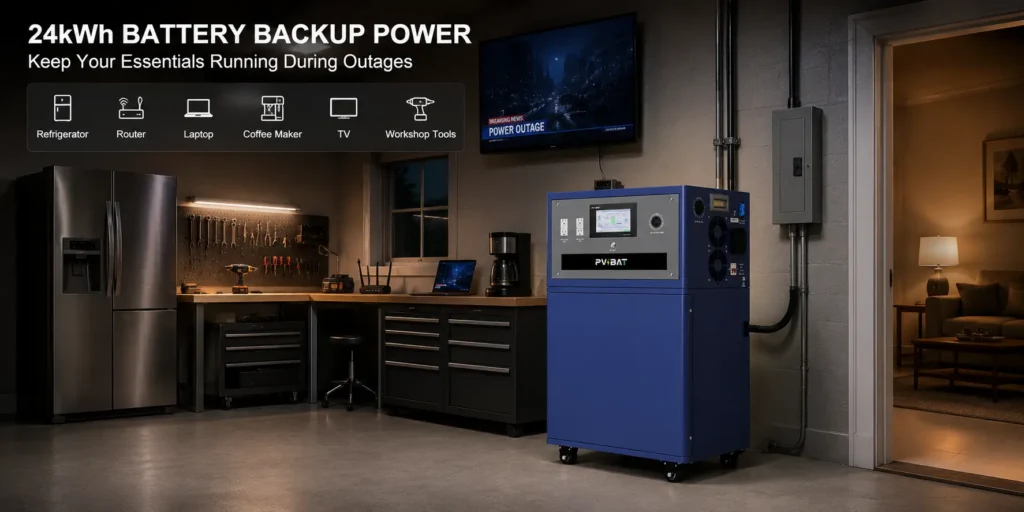
A 24kWh battery backup is not just a larger portable power station. When paired with a high-output inverter, it can support real household loads during outages, including refrigerators, freezers, lights, internet equipment, garage tools, and selected 240V appliances.
The key is understanding two numbers: battery capacity and inverter output.
Battery capacity, measured in kilowatt-hours, tells you how much energy is stored. Inverter output, measured in watts or kVA, tells you how much power the system can deliver at one time. A large battery with a small inverter may run low-power devices for a long time, but it may not start heavy loads. A strong inverter with too little battery capacity may start appliances but run out of energy quickly.
The PVBAT TIGER-T4-72 is built around that balance. It combines a 24kWh LiFePO4 battery system with a 16.5kVA low-frequency transformer inverter and 120/240V split-phase output, making it suitable for more demanding American home backup scenarios than small plug-in battery stations.
Typical Runtime Examples
Actual runtime depends on load size, battery condition, inverter efficiency, temperature, and how much reserve you want to keep. Still, the table below gives a practical starting point.
| Average Load | Estimated Runtime from 24kWh Battery |
| 300W | About 65–75 hours |
| 500W | About 38–45 hours |
| 1,000W | About 19–22 hours |
| 2,000W | About 9–11 hours |
| 3,000W | About 6–7 hours |
| 4,000W | About 4.5–5.5 hours |
A real home does not usually pull the same power all day. A refrigerator cycles on and off. Lights may only be used at night. A well pump may run for short bursts. This is why many homeowners can stretch a 24kWh battery much longer than a simple wattage calculation suggests.
What Household Loads Can It Support?
A properly sized 24kWh backup system can usually support essential home loads such as:
Refrigerator and freezer
Wi-Fi router and modem
LED lights
Phone and laptop charging
Garage door opener
Microwave for short use
Coffee maker
TV and basic electronics
Sump pump
Selected 120V tools
Some 240V loads, depending on starting surge and wiring setup
The TIGER-T4-72 is especially useful when the home needs both 120V and 240V power. Many smaller battery stations are limited to 120V output, which makes them less suitable for rural homes, workshops, farms, and properties with split-phase equipment.
Why 240V Matters in the U.S.
In the United States, many homes use 120/240V split-phase service. Standard outlets are usually 120V, while larger appliances may require 240V. Common 240V loads include well pumps, some water heaters, air compressors, larger power tools, and certain HVAC equipment.
A battery backup that only provides 120V may be fine for phones, lights, and refrigerators. But once you want to support a well pump or workshop equipment, 240V output becomes much more important.
The TIGER-T4-72 includes 120/240V split-phase output, which makes it a stronger fit for U.S. homes than many small portable batteries designed mainly for camping or light emergency use.
Can It Run Air Conditioning?
It depends. A central air conditioner can have a high starting surge and may consume several kilowatts while running. Some systems may be too large for battery backup unless paired with soft-start equipment and a carefully designed load panel.
However, a smaller mini-split, window AC, or selected high-efficiency HVAC load may be more realistic. For long outages, most homeowners get better results by backing up essential loads first: refrigeration, communication, lights, fans, pumps, and selected outlets.
Trying to run everything exactly as normal can drain even a large battery quickly. A good backup plan is not about powering the whole house blindly. It is about keeping the critical parts of the home working safely and predictably.
Battery Capacity vs Generator Runtime
A gas generator runs as long as fuel is available. A battery runs as long as stored energy lasts. That sounds like a limitation, but batteries have major advantages: no fuel storage, no exhaust fumes, lower noise, lower maintenance, and indoor-friendly operation when installed and used properly.
A 24kWh LiFePO4 system can also be recharged from solar or the grid, depending on the configuration. This makes it more flexible than a one-time emergency power source.
For homeowners who already have solar panels, adding battery backup can help keep power available after sunset or during grid outages. For homeowners without solar, a battery-only system can still provide clean backup power when charged from the grid before storm season.
When a 24kWh Battery Makes Sense
A 24kWh battery backup is a strong fit if you want to support essential home loads for many hours or even multiple days with careful load management. It also makes sense if you need 240V output for rural property, farm equipment, garage loads, or a well pump.
It may not be the right choice if you only need to charge phones and run one lamp. In that case, a small portable unit may be enough. But if you are protecting a home, garage, small business, cabin, or farm, 24kWh moves you into a much more capable class of backup power.
Recommended PVBAT Solution
The PVBAT TIGER-T4-72 is designed as an all-in-one mobile energy storage system for serious backup use. With 24kWh battery capacity, 16.5kVA inverter output, 120/240V split-phase power, solar/grid charging options, and heavy-duty mobility, it is built for homes, workshops, farms, cabins, and job sites that need more than a small emergency battery.
FAQ
Is 24kWh enough for a whole house?
It can support many essential home loads, but “whole house” depends on what you run. Refrigeration, lights, Wi-Fi, pumps, and selected outlets are realistic. Large HVAC, electric water heating, and high-power appliances require careful sizing.
How long will a 24kWh battery run a refrigerator?
A typical refrigerator may average far less than its peak wattage because it cycles on and off. In many cases, a 24kWh battery can support refrigeration for several days if other loads are managed.
Can a 24kWh battery run 240V appliances?
Only if the inverter supports 120/240V split-phase output and the appliance load is within system limits. The TIGER-T4-72 is designed with 120/240V split-phase output for U.S. applications.
Do I need solar panels?
Not always. A battery backup can be charged from the grid, but solar charging can extend runtime during longer outages.

Is this the biggest battery you have? How many server rack batteries does it equals.
The TIGER T4 is our largest all-in-one system currently available from our US stock. It includes a 24kWh LiFePO₄ battery.
Compared with standard 51.2V 100Ah server rack batteries (about 5.12kWh each), one TIGER T4 battery capacity is approximately equal to about 5 server rack batteries.
If you need a larger capacity system, we also have expandable battery solutions available. May I know your target battery capacity (kWh) or your expected backup time?