
Many homeowners think battery backup only makes sense with solar panels. That is not always true.
A home battery can be useful even without solar. It can be charged from the grid, kept ready for outages, and used to support essential loads when the power goes out. For some families, battery-only backup is the first practical step before adding solar later.
The real question is not “Do I need solar first?” The better question is “What problem am I trying to solve?”
What Is Battery-Only Backup?
Battery-only backup means the battery is charged from the electrical grid instead of solar panels. When the grid is available, the battery stores energy. When the grid goes down, the battery powers selected loads through a backup configuration.
This can be useful for homes in areas with storms, wildfire shutoffs, rural outages, or unreliable utility service.
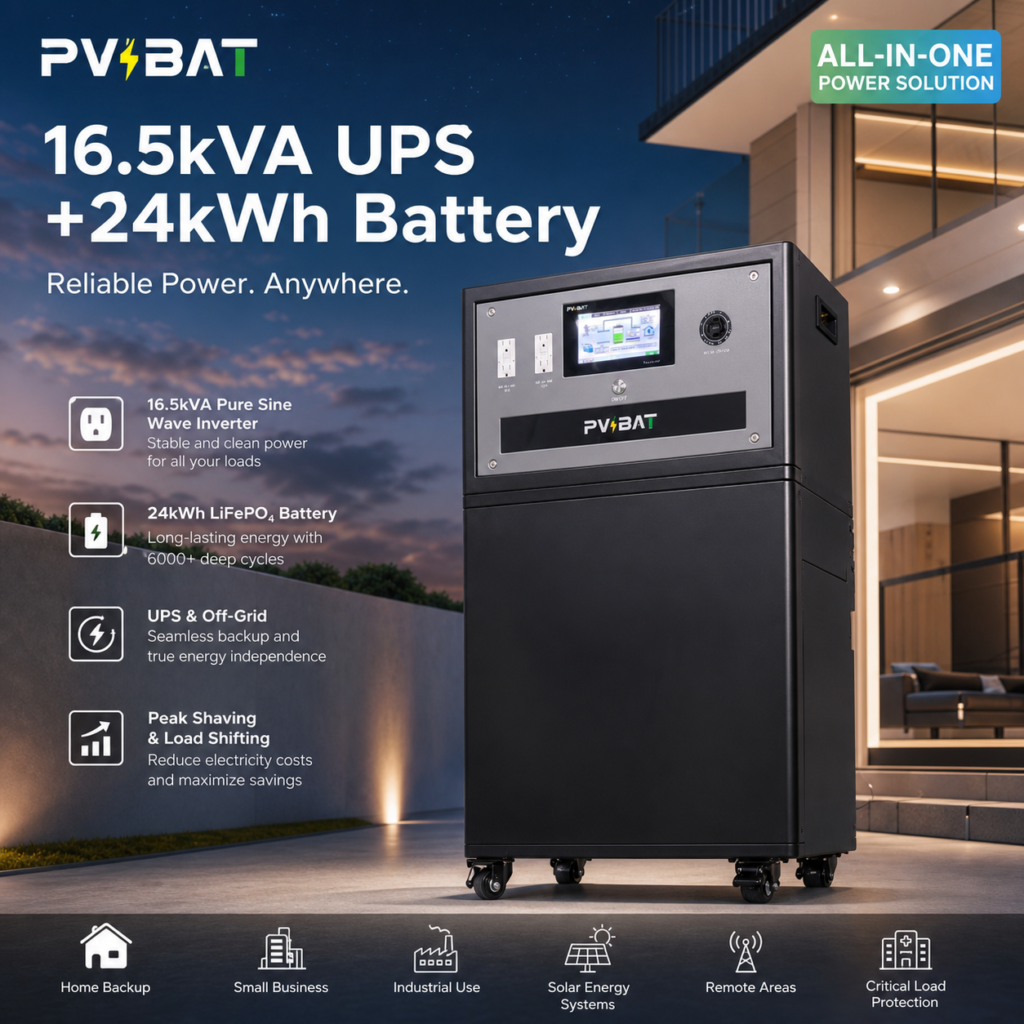
A system such as the PVBAT TIGER-T4-72 can be charged from the grid and used as a mobile backup power source. Because it includes 24kWh battery capacity and 120/240V split-phase output, it is designed for more serious backup than small emergency power stations.
Why Buy a Battery Without Solar?
There are several good reasons.
Some homeowners cannot install solar yet. The roof may need repairs, the budget may not allow it, or the property may have too much shade.
Others want backup power quickly. Solar permitting and installation can take time. A battery backup system may be a faster way to prepare for outage season.
Some users also want a flexible system for garages, workshops, farms, cabins, or temporary job sites where fixed rooftop solar is not the first priority.
What Can a Battery-Only System Do?
A battery-only system can power essential loads during an outage. Depending on the battery size and inverter output, it may support refrigerators, freezers, lights, Wi-Fi, phone charging, fans, garage equipment, well pumps, and selected 240V loads.
It can also reduce dependence on fuel-based generators. No gas storage. No exhaust. Less noise. Less maintenance.
Battery-only backup is especially attractive for short to medium outages. For long outages, solar charging or generator charging may be needed to replenish the battery.
What Battery-Only Backup Cannot Do
A battery is not magic. If there is no solar and no grid power, the battery cannot recharge itself. Once the stored energy is used, it must be recharged from another source.
This is why load management matters. During an outage, avoid running high-power appliances unnecessarily. Focus on refrigeration, communication, lights, pumps, medical devices if applicable, and comfort loads such as fans.
If you try to run electric heating, central air conditioning, electric dryers, and water heaters at normal levels, battery runtime will drop quickly.
Can Solar Be Added Later?
In many cases, yes. Starting with a battery-first strategy can make sense if the system is designed with future expansion in mind.
For example, a homeowner may begin with a TIGER-T4-72 for backup power, then later add solar charging. Another user may build a larger system using an Elephant 32.15kWh battery cabinet with compatible inverter equipment and solar input.
The important point is compatibility. If you plan to add solar later, choose equipment that can support your future design.
Battery-Only vs Generator
A generator is still useful for extended outages, but it comes with fuel, noise, exhaust, and maintenance. A battery system is cleaner and easier to operate for daily backup.
For many homes, the ideal setup may not be either-or. A battery can handle most outages quietly, while a generator can serve as a secondary charging source for very long emergencies.
But if your main concern is keeping essentials running overnight or through a short outage, battery-only backup may be enough.
Is It Worth It in 2026?
For many homeowners, yes. Severe weather, grid instability, and increasing dependence on home electronics make backup power more important than it used to be.
Battery-only backup is especially worth considering if:
You experience frequent short outages
You want quiet backup power
You cannot install solar yet
You need 120/240V output
You want backup for refrigeration, pumps, and essential circuits
You want a cleaner alternative to running a generator for every outage
It may not be worth it if you rarely lose power and only need to charge small devices. In that case, a smaller emergency battery may be enough.
Recommended PVBAT Options
For an all-in-one mobile system, the TIGER-T4-72 is the most direct choice. It combines 24kWh capacity, 16.5kVA inverter output, and 120/240V split-phase power.
For a larger custom installation, the Elephant 32.15kWh LiFePO4 battery cabinet can be paired with compatible inverter equipment to create a higher-capacity storage system.
FAQ
Can I use a home battery without solar panels?
Yes. A battery can be charged from the grid and used for backup during outages.
Is solar required for battery backup?
No, but solar can extend backup runtime by recharging the battery when the grid is down.
How long will a battery-only system last during an outage?
It depends on battery capacity and load usage. A 24kWh battery can support essential loads much longer than small portable batteries, especially with careful load management.
Can I add solar later?
Often yes, if the system is designed for future solar compatibility.