
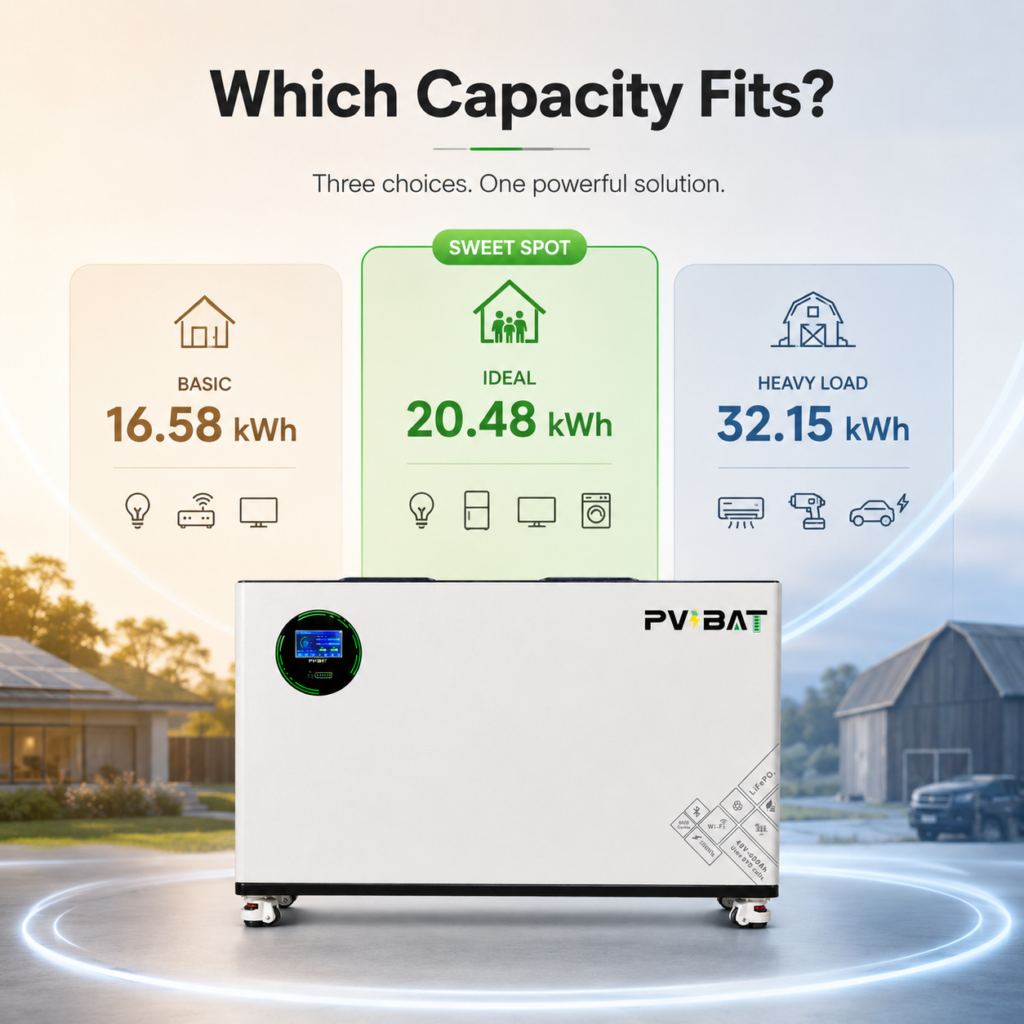
While the capacity figures for these three models may seem similar at first glance, their practical applications, runtime, and cost are completely different. In a nutshell: 16.58 kWh is sufficient, 20.48 kWh offers peace of mind, and 32.15 kWh can handle heavy-duty use.
16.58 kWh: The Essential Choice for Average Households
Suitable for: Standard urban homes, homes with solar panels, tight budgets, and those needing to cover only basic living needs. Can power: Refrigerator, lights, Wi-Fi, TV, smartphones, computers, and common outlets. Not suitable for: Air conditioning, electric stoves, or deep-well pumps—these won’t last long.
20.48kWh: The safe choice for most households
Suitable for: Areas with frequent power outages, those seeking reliability, homes with solar panels, and those wanting to use solar power at night. Advantages over the 16.58kWh model:
Longer backup time
Supports more devices: water pumps, small kitchen appliances, small air conditioners for short periods
Best balance of price and capacity—no waste, no regrets
32.15kWh: For Heavy Loads / Off-Grid Use Only
Suitable for: Large homes, farms, warehouses, small shops, long-term off-grid use, or locations with many water pumps, freezers, and tools. Features: No worries during extended power outages; run high-power devices freely; expand capacity by paralleling multiple units.
How to choose quickly?
Just want uninterrupted power: 16.58 kWh
Want stability and peace of mind: 20.48 kWh
Large homes / farms / off-grid: 32.15 kWh