pvbat_installation_example (1)

Power Your Business Smarter with the TIGER-T4 Integrated All-in-One Energy Storage System

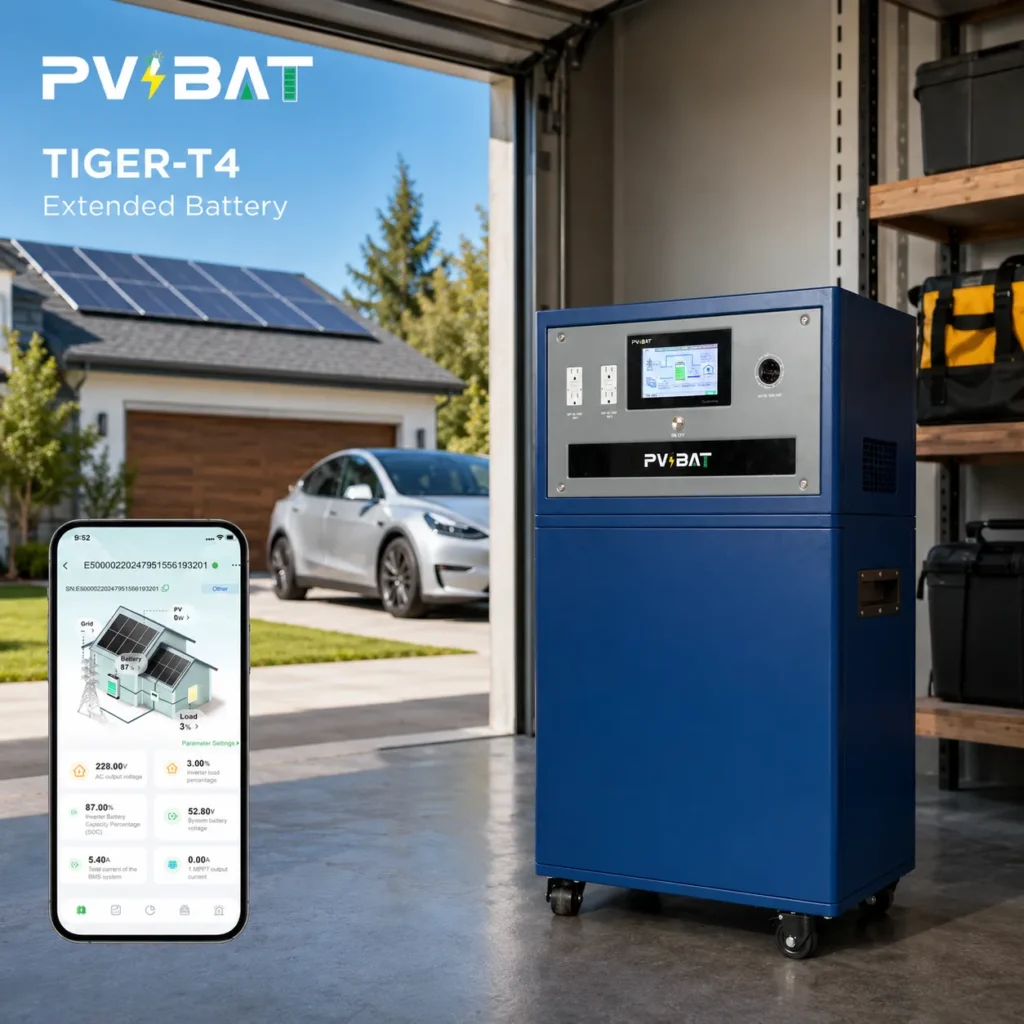
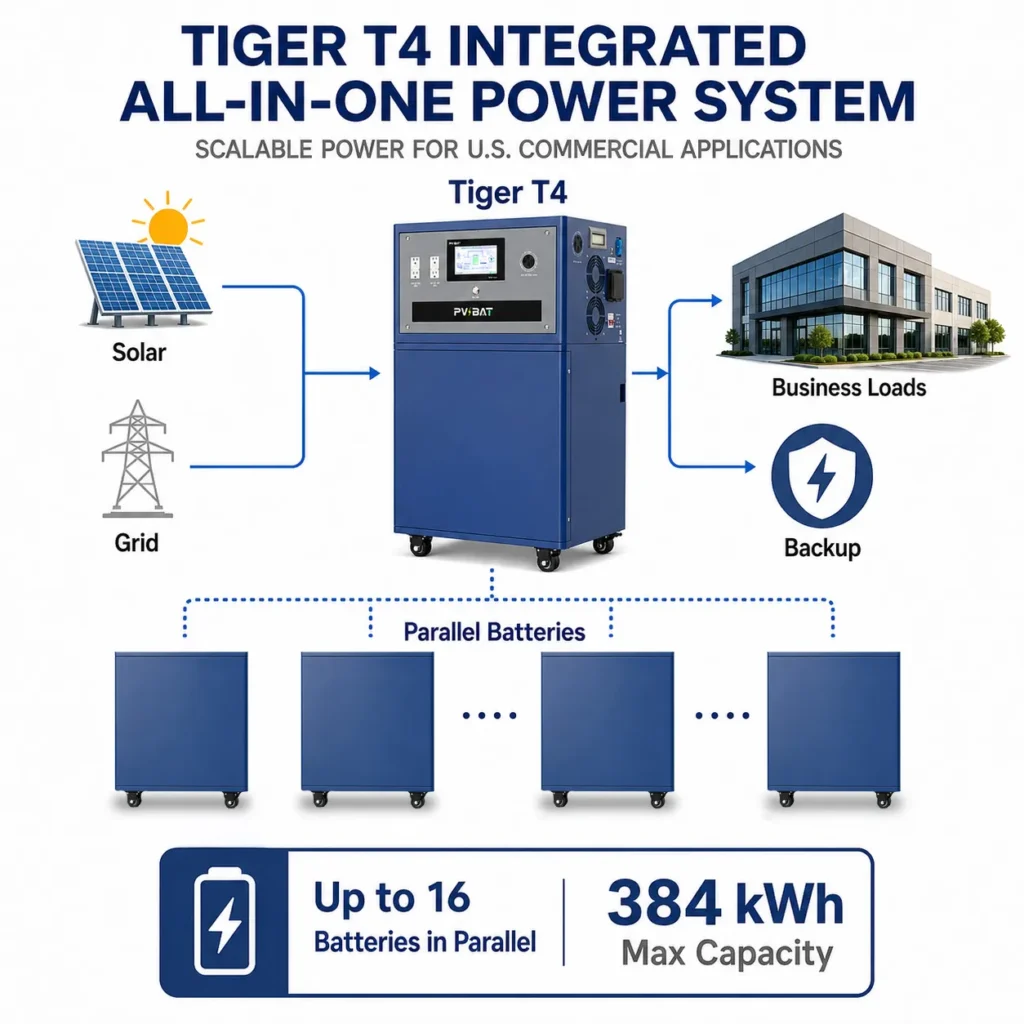
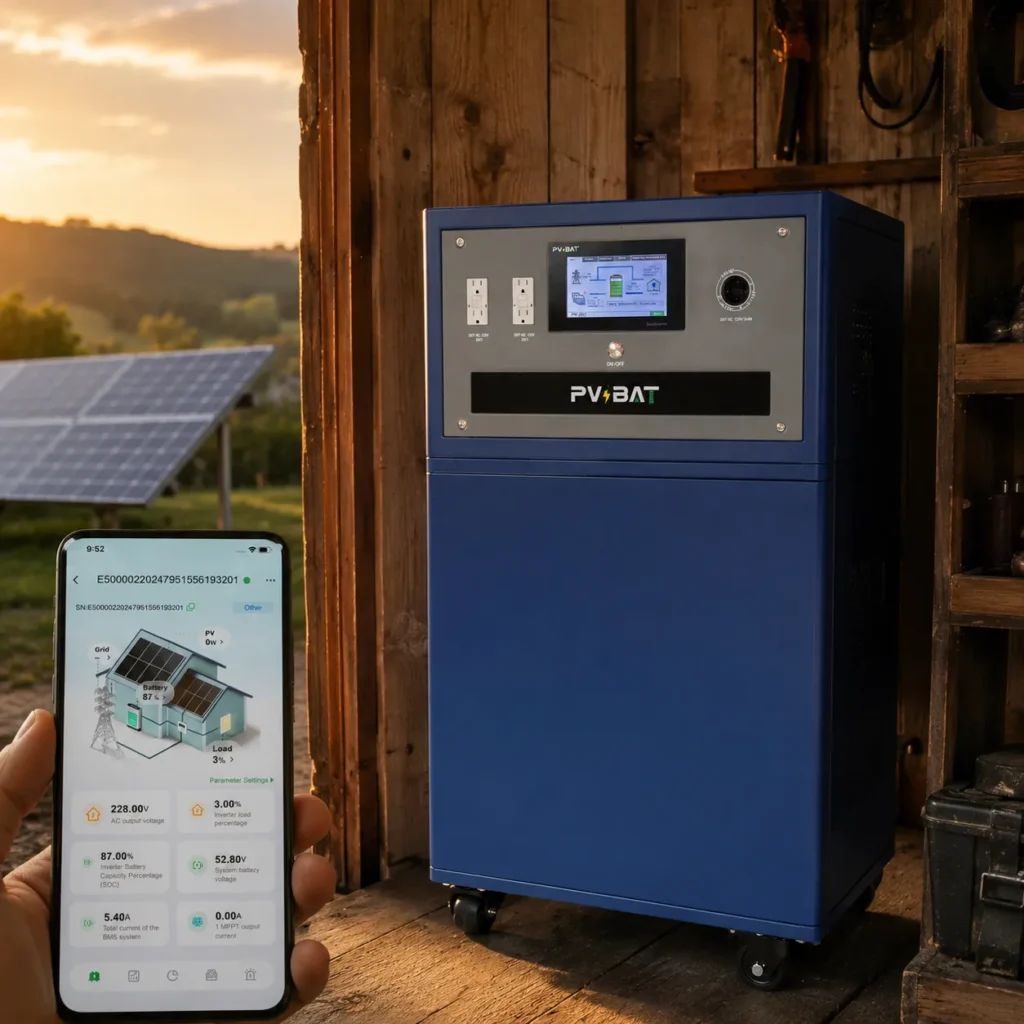
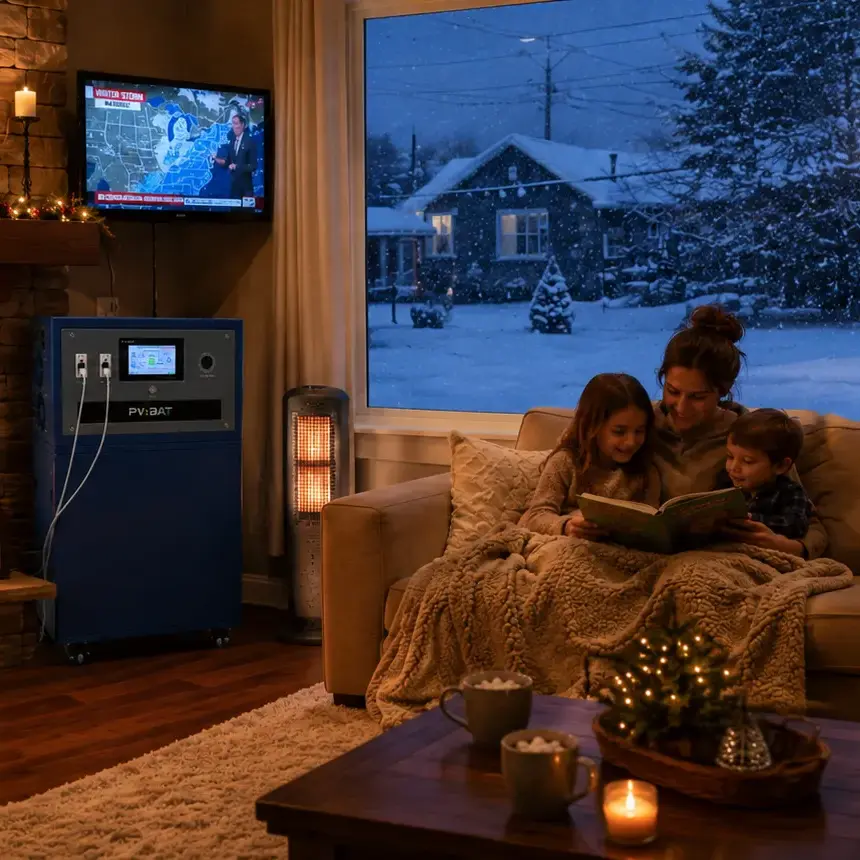
Power Your Business Smarter with the TIGER-T4 Integrated All-in-One Energy Storage System For many American business owners, reliable power isn’t optional—it’s essential. Whether you’re running a workshop, warehouse, farm, retail facility, office building, or remote job site, unexpected outages can lead to downtime, lost revenue, and operational headaches. The PVBAT TIGER-T4 Integrated All-in-One Power System is designed to give businesses greater energy independence, backup protection, and scalable energy storage in one compact solution. Flexible Charging: Solar Power or Grid Power The TIGER-T4 offers flexible charging options to fit different energy strategies. Charge with Solar Panels Connect the system to a photovoltaic (PV) solar array and store excess solar energy generated during the day. Benefits include: Lower electricity costs Greater energy independence Better utilization of renewable energy Reduced reliance on utility providers Charge from the Utility Grid The TIGER-T4 can also be charged directly from the electrical grid. This allows businesses to: Store energy during off-peak hours Use stored power during peak-rate periods Maintain backup power reserves Ensure reliable operation even when solar production is unavailable By supporting both solar and grid charging, the TIGER-T4 adapts to virtually any commercial energy setup. Power the Equipment That Keeps Your Business Running Once charged, the TIGER-T4 stores electricity and delivers reliable power to a wide range of loads. Typical applications include: Office equipment and computers Security systems and surveillance cameras Refrigeration and cold storage Farm equipment and water pumps Telecommunications equipment Lighting systems Power tools and workshop equipment Emergency backup circuits Whether you’re looking to reduce energy costs or prepare for outages, the TIGER-T4 provides dependable stored energy when you need it most. Reliable Backup Power During Outages Power interruptions can happen without warning. When utility power fails, the TIGER-T4 helps keep critical systems operating, reducing disruptions to your business. Ideal backup applications include: Business continuity protection Emergency lighting Network and communication systems Critical refrigeration loads Agricultural operations Essential production equipment Instead of shutting down operations, businesses can continue running through unexpected outages with stored energy ready to deploy. Scalable Energy Storage That Grows with Your Business One of the biggest advantages of the TIGER-T4 platform is its expandable battery architecture. Parallel Expansion Capability The system supports up to 16 battery units connected in parallel, allowing users to significantly increase total storage capacity as energy demands grow. Up to 384 kWh of Total Capacity Starting with a single system and expanding over time helps businesses avoid overspending on infrastructure upfront. With up to 384 kWh of total energy storage, the TIGER-T4 can support: Larger commercial facilities Agricultural operations Warehouses Manufacturing environments Remote work sites Multi-building properties This scalability provides a future-ready energy solution that can grow alongside your business. Smart Energy Management at Your Fingertips Modern energy storage should be more than just batteries. The TIGER-T4 includes intelligent monitoring capabilities through a mobile app, allowing users to manage their system anytime, anywhere. With the app, users can: Monitor battery charge level in real time View solar charging performance Track power consumption and output Check system status remotely Receive fault and warning notifications Review historical energy usage data Optimize charging and discharging schedules Whether you’re in the office, on the road, or managing multiple locations, you remain connected to your energy system at all times. Built for Modern Commercial Applications The TIGER-T4 combines: ✓ Solar and grid charging flexibility ✓ Reliable backup power protection ✓ Mobile app monitoring and management ✓ Expandable parallel battery architecture ✓ Up to 384 kWh total storage capacity ✓ Commercial-grade performance As energy costs continue to rise and power reliability becomes increasingly important, the PVBAT TIGER-T4 Integrated All-in-One Power System offers businesses a practical, scalable, and intelligent energy storage solution designed for today’s commercial energy challenges and tomorrow’s growth.
Power Your Business Smarter with the TIGER-T4 Integrated All-in-One Energy Storage System Read More »

pvbat_installation_example (7)

Why Farms Need Reliable Energy Storage More Than Ever

Why Farms Need Reliable Energy Storage More Than Ever Modern Farms Depend on Electricity Today’s farms rely heavily on electricity for daily operations. From water pumps and livestock equipment to security systems and refrigeration, a power outage can quickly become expensive. For farmers, every hour without power can mean: Lost productivity Animal welfare concerns Water supply interruptions Equipment downtime Spoiled produce The PVBAT TIGER-T4-72 Mobile Energy Storage System provides a dependable backup power solution that can be moved wherever it’s needed across the property. Water Pumps Must Keep Running Many farms rely on electric pumps for: Livestock watering Irrigation systems Storage tank refilling During outages, water access becomes a critical issue. With 24kWh of battery capacity and powerful 240V output, the TIGER-T4-72 can keep essential water systems operational until utility power returns. Protect Livestock and Produce Farm refrigerators, freezers, and ventilation systems often run continuously. Unexpected power loss can lead to: Spoiled dairy products Temperature-sensitive feed issues Livestock stress A reliable backup system helps protect valuable farm assets and maintain stable operating conditions during emergencies. Smart Monitoring from Anywhere Modern farm operations require more than just backup power—they require visibility and control. The TIGER-T4-72 supports intelligent monitoring through a mobile app, allowing farmers to stay informed whether they’re in the field, at home, or away from the property. Using the app, users can: Monitor battery state of charge in real time Track power consumption and output View system operating status and performance data Receive alerts and notifications for abnormal conditions Manage charging and discharging settings remotely Check system history and energy usage trends With remote monitoring capabilities, farmers can respond quickly to changing conditions and ensure critical equipment remains powered when it matters most. Move Power Anywhere on the Property Unlike permanently installed battery systems, the TIGER-T4-72 features: Heavy-duty wheels Mobile deployment Plug-and-play operation Move it from the barn to the workshop or equipment shed as needed. Its portable design allows a single energy storage unit to support multiple locations across the farm, maximizing flexibility and reducing infrastructure costs. Reliable Power for Modern Agriculture As farms become increasingly dependent on electrical equipment and automation, having a dependable backup energy solution is more important than ever. With portable deployment, powerful energy storage, and smart app-based monitoring and management, the PVBAT TIGER-T4-72 helps farmers maintain productivity, protect livestock and crops, and keep essential operations running during unexpected outages.

Why Farms Need Reliable Energy Storage More Than Ever Read More »

pvbat_installation_example (15)(1)

Protect Your Family From Blackouts With Whole-Home Backup Power

Protect Your Family From Blackouts With Whole-Home Backup Power The Growing Reality of Power Outages Across the United States, severe weather events are becoming more frequent. Hurricanes, winter storms, wildfires, and aging grid infrastructure have made power outages a common concern for homeowners. For families, losing power means more than sitting in the dark. It can mean: No internet No heating or cooling Food spoilage Medical device interruptions Security system failures Inability to work remotely The PVBAT TIGER-T4-72 was designed to provide homeowners with a simple and reliable backup power solution. What Happens During a Typical Outage? Most homeowners discover too late that portable generators have limitations. They require: Fuel storage Manual startup Outdoor placement Regular maintenance And many portable power stations cannot handle large household loads. The TIGER-T4-72 solves these problems with: 24kWh battery capacity 5kVA inverter power Automatic UPS switching 120V/240V split-phase output Solar and utility charging options Essential Appliances Stay Running A properly configured system can help support: Refrigerators Freezers Wi-Fi routers Home office equipment Televisions Sump pumps Air conditioners Well pumps Security systems This allows families to maintain normal daily activities even during extended outages. Energy Independence for Modern Families Beyond emergency backup, homeowners are increasingly interested in reducing dependence on utility companies. The TIGER-T4-72 can integrate with solar panels and store excess energy generated during the day. At night or during outages, that stored energy becomes available for household use. This helps homeowners: Lower electricity bills Increase energy independence Improve home resilience Maximize solar investment returns Why Homeowners Choose the TIGER-T4-72 Unlike permanent wall-mounted systems, the TIGER-T4-72 is mobile and ready to use. No complex installation. No costly electrical upgrades. No permanent modifications. Simply roll it into place and connect the loads you want to protect. Final Thoughts For American families, reliable backup power is no longer a luxury—it’s becoming a necessity. The PVBAT TIGER-T4-72 offers a practical way to prepare for outages, reduce energy costs, and gain greater control over household power needs without the complexity of traditional energy storage systems. Protect Your Family From Blackouts With Whole-Home Backup Power The Growing Reality of Power Outages Across the United States, severe weather events are becoming more frequent. Hurricanes, winter storms, wildfires, and aging grid infrastructure have made power outages a common concern for homeowners. For families, losing power means more than sitting in the dark. It can mean: No internet No heating or cooling Food spoilage Medical device interruptions Security system failures Inability to work remotely The PVBAT TIGER-T4-72 was designed to provide homeowners with a simple and reliable backup power solution. What Happens During a Typical Outage? Most homeowners discover too late that portable generators have limitations. They require: Fuel storage Manual startup Outdoor placement Regular maintenance And many portable power stations cannot handle large household loads. The TIGER-T4-72 solves these problems with: 24kWh battery capacity 5kVA inverter power Automatic UPS switching 120V/240V split-phase output Solar and utility charging options Essential Appliances Stay Running A properly configured system can help support: Refrigerators Freezers Wi-Fi routers Home office equipment Televisions Sump pumps Air conditioners Well pumps Security systems This allows families to maintain normal daily activities even during extended outages. Energy Independence for Modern Families Beyond emergency backup, homeowners are increasingly interested in reducing dependence on utility companies. The TIGER-T4-72 can integrate with solar panels and store excess energy generated during the day. At night or during outages, that stored energy becomes available for household use. This helps homeowners: Lower electricity bills Increase energy independence Improve home resilience Maximize solar investment returns Why Homeowners Choose the TIGER-T4-72 Unlike permanent wall-mounted systems, the TIGER-T4-72 is mobile and ready to use. No complex installation. No costly electrical upgrades. No permanent modifications. Simply roll it into place and connect the loads you want to protect. Final Thoughts For American families, reliable backup power is no longer a luxury—it’s becoming a necessity. The PVBAT TIGER-T4-72 offers a practical way to prepare for outages, reduce energy costs, and gain greater control over household power needs without the complexity of traditional energy storage systems.

Protect Your Family From Blackouts With Whole-Home Backup Power Read More »

pvbat_installation_example (3)

Warehouse Power Problems? Here’s a Smarter Alternative to Generators

Power Interruptions Cost More Than You Think Whether you operate a small warehouse, distribution center, inventory storage facility, or e-commerce fulfillment space, power reliability directly affects your business. Even a short outage can cause: Security system failures Lighting disruptions Lost productivity Delayed shipments Inventory management interruptions Network equipment downtime For many warehouse owners, the traditional solution has been a gasoline or diesel generator. But generators come with fuel costs, maintenance requirements, noise, and emissions. The PVBAT TIGER-T4-72 offers a cleaner and more flexible solution. Real Warehouse Challenges Security Systems Must Stay Online Modern warehouses rely heavily on: Surveillance cameras Access control systems Alarm systems Internet routers When utility power fails, these systems cannot go offline. With its built-in UPS functionality and rapid transfer time, the TIGER-T4-72 keeps critical systems operational automatically. Forklift and Equipment Charging Electric pallet jacks, battery-powered tools, scanners, and warehouse equipment require reliable charging. The TIGER-T4-72 provides a mobile power source that can be moved wherever energy is needed most. Reducing Energy Costs Many commercial users are increasingly looking for ways to reduce peak electricity costs. Because the TIGER-T4-72 supports both solar charging and grid charging, businesses can store energy during off-peak hours and use it during expensive peak-rate periods. Why Warehouse Managers Like Mobile Energy Storage Traditional battery systems are fixed to one location. The TIGER-T4-72 is different. Its built-in heavy-duty wheels allow users to move the system between: Warehouse zones Loading docks Maintenance areas Temporary workstations Outdoor operations This flexibility is particularly valuable for growing businesses. Key Benefits Lower operating costs than fuel generators No fuel storage requirements Silent operation 24kWh energy storage Supports heavy-duty equipment Mobile deployment Solar-ready design Expandable for future growth Final Thoughts Warehouse operations depend on reliable power. Instead of investing in noisy generators and ongoing fuel expenses, many business owners are turning to mobile energy storage systems like the TIGER-T4-72 to improve resilience and reduce operating costs.

Warehouse Power Problems? Here’s a Smarter Alternative to Generators Read More »

pvbat_installation_example (6)

Why Every American Garage Needs a Reliable Backup Power System

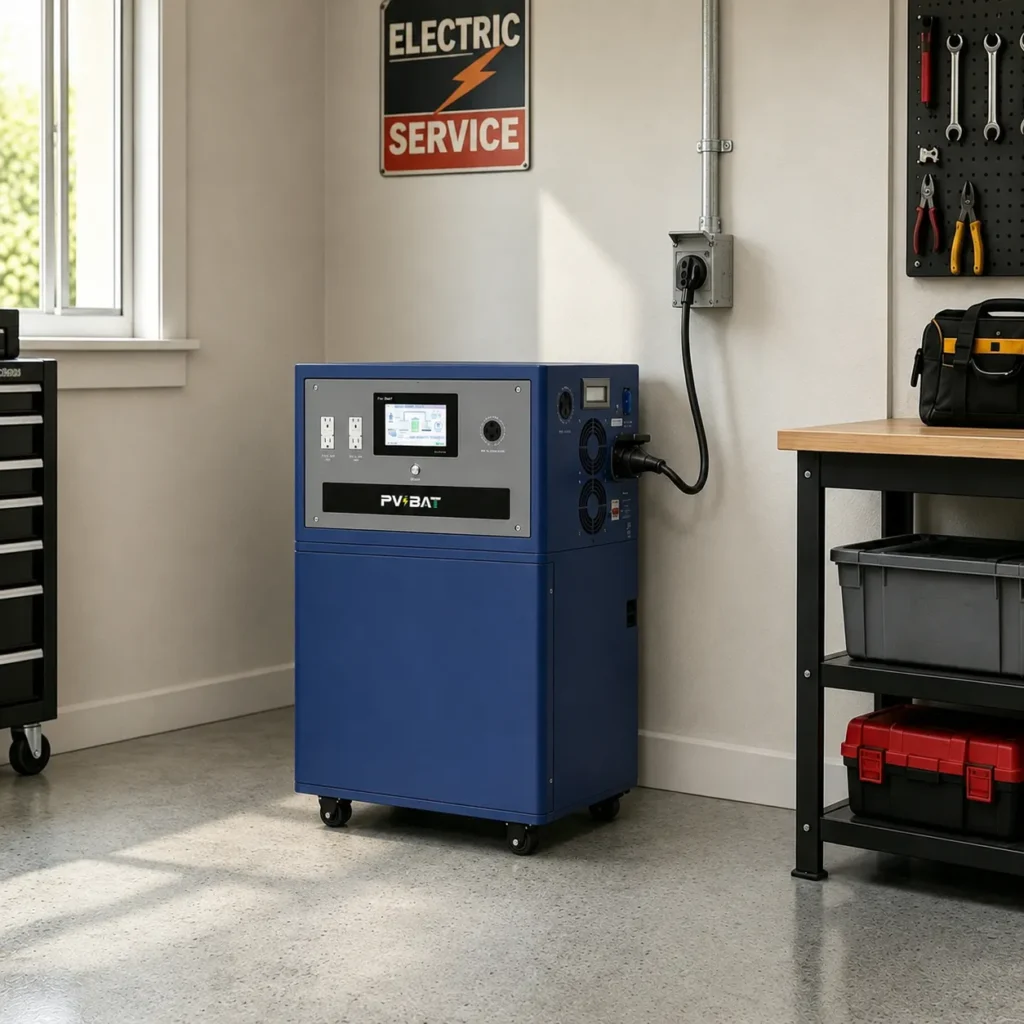
Your Garage Is More Important Than You Think For many American homeowners, the garage isn’t just a place to park a vehicle. It’s a workshop, a storage area, a charging station for power tools, and sometimes even a home gym. But when the power goes out, everything stops. Garage doors won’t open. Battery chargers stop working. Refrigerators and freezers stored in the garage begin warming up. Power tools become useless. If you own an EV, charging becomes impossible. This is exactly where the PVBAT TIGER-T4-72 24kWh Mobile Energy Storage System changes the game. The TIGER-T4-72 combines a large-capacity LiFePO4 battery, inverter, UPS backup function, and solar charging capability into one mobile unit that can be rolled directly into your garage. Unlike traditional wall-mounted battery systems, no permanent installation is required. Simply position it where you need power and start using it. Common Garage Problems During Power Outages 1. Frozen Food Spoilage Many American households keep an additional refrigerator or freezer in the garage. A prolonged outage can easily lead to hundreds of dollars in spoiled food. With 24kWh of storage capacity, the TIGER-T4-72 can keep refrigerators and freezers running for extended periods, helping families avoid unnecessary losses. 2. Garage Door Failure A powered garage door suddenly becomes a major inconvenience during an outage. The TIGER-T4-72 automatically switches to battery power in approximately 10 milliseconds, allowing critical devices to remain operational without interruption. Whether you’re arriving home during a storm or leaving for work in the morning, you’ll never have to worry about being locked in or out of your garage. 3. Lost Productivity Many homeowners use their garage as a workshop. Whether you’re woodworking, welding, repairing vehicles, or running compressors, power interruptions can halt projects immediately. Thanks to its powerful inverter and 120V/240V split-phase output, the TIGER-T4-72 can support demanding workshop equipment that smaller portable power stations simply can’t handle. For DIY enthusiasts and serious hobbyists, that means fewer interruptions and more time getting things done. Monitor and Control Your Power From Anywhere Today’s homeowners expect more than just backup power—they want visibility and control. The TIGER-T4-72 comes with smart APP monitoring, allowing you to check and manage your energy system directly from your smartphone. Using the mobile app, you can: View Real-Time Battery Status Monitor battery capacity, charging status, remaining runtime, and power consumption at a glance. Track Solar Energy Production See how much solar energy your system is generating and how much power is being stored for later use. Adjust System Settings Remotely Change charging priorities, optimize energy usage, and customize operating modes without touching the unit. Receive Instant Alerts Get notifications about system performance, charging conditions, or unusual events, helping you stay informed even when you’re away from home. Manage Backup Power More Efficiently Whether you’re inside the house, at work, or traveling, you can monitor your garage power system anytime and anywhere. This level of control gives homeowners greater confidence during storms, outages, and everyday energy use. Why Garage Owners Prefer the TIGER-T4-72 Large Energy Capacity 24kWh of LiFePO4 battery storage provides dependable backup power for critical garage and household loads. Plug-and-Play Convenience No complicated installation process or expensive electrical upgrades required. Mobility Built-in industrial-grade wheels allow you to move the system wherever backup power is needed. Smart APP Control Monitor performance, adjust settings, and manage energy usage directly from your smartphone. Solar Ready Pair with solar panels to create a clean and renewable energy solution. Quiet Operation Unlike generators, there are no loud engines, fuel smells, or harmful emissions. Future Expansion Expandable up to 384kWh for homeowners who want to scale their energy storage as needs grow. The Smart Garage Power Solution The modern garage has become much more than a place to store vehicles. It’s a workspace, charging hub, storage center, and essential part of daily life. When utility power fails, the PVBAT TIGER-T4-72 keeps your garage running while giving you complete visibility through its intelligent mobile APP. From protecting refrigerated food and powering workshop tools to monitoring battery performance remotely, the TIGER-T4-72 delivers a smarter, cleaner, and more flexible backup power experience for today’s homeowners. Stay powered. Stay connected. Stay in control. With the TIGER-T4-72, your garage is always ready for whatever comes next.

Why Every American Garage Needs a Reliable Backup Power System Read More »

TIGER-T4-72-user-guide

Introduction and Comparison of the PVBAT TIGER-T4-72

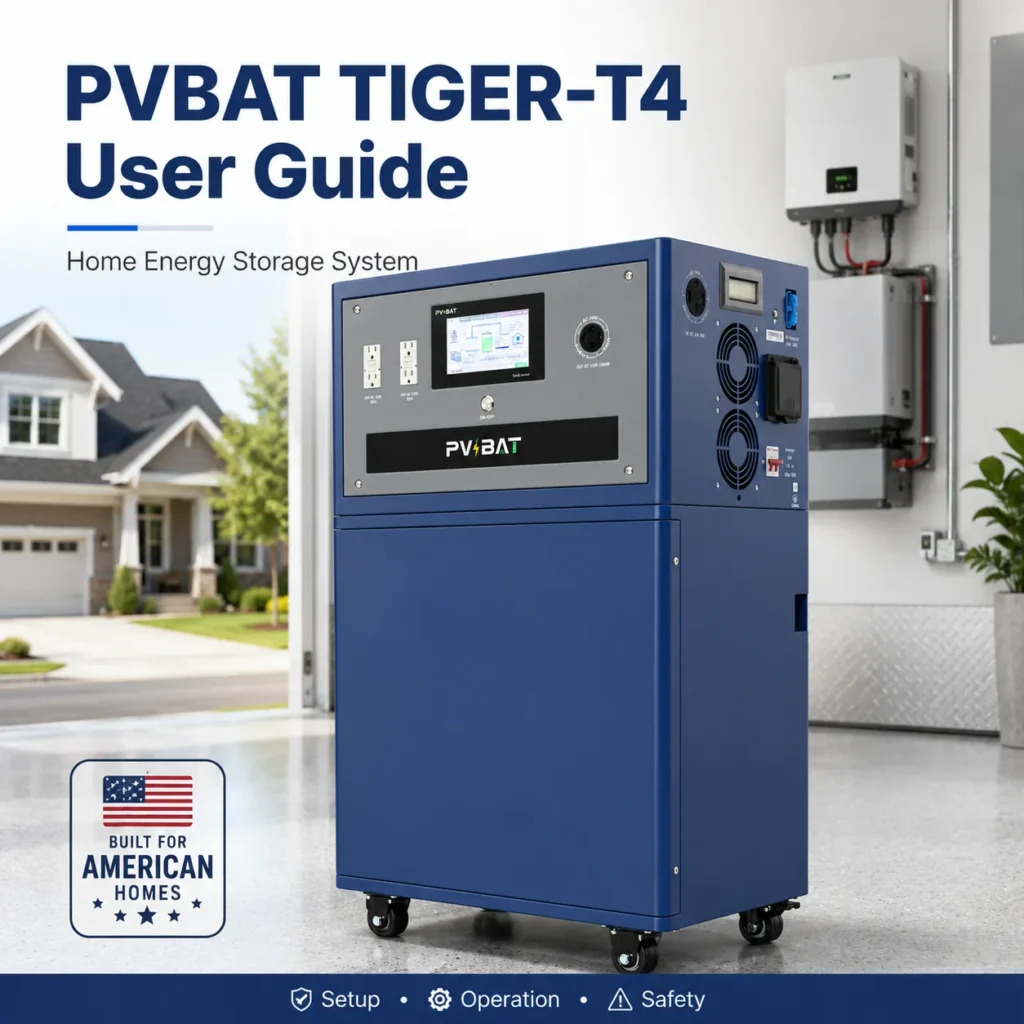
Introduction and Comparison of the PVBAT TIGER-T4-72 No Professional Installation Needed – Just Roll It Out, No Fear of Power Outages​ If you’ve ever looked into home energy storage, you probably know how much hassle and cost can come with installing a traditional battery system.Portable power stations work fine for camping or running small appliances outdoors. But if you need to power larger equipment, runtime tends to be short—and some devices won’t even start up.What about gas generators? They’re loud, they smell, and you’d better keep five gallons of fuel stored in your garage—hoping it doesn’t go bad.Then there’s the DIY battery route. Sure, if you’re an electrical engineer with plenty of time, give it a shot. But for most of us? That’s a stretch.That’s exactly how the PVBAT Tiger-T4-72​ stands apart from the rest. So what makes the Tiger-T4 different? Most home batteries are stationary. Once installed, they’re essentially fixed in place.Not the Tiger-T4.It’s mounted on heavy-duty locking casters, features plug-and-play connectors, and can be moved anywhere you need it—garage, basement, workshop, off-grid cabin, even beside a greenhouse or a well pump. No drilling, no wall mounting, and no electrician required.Plus, it packs a large 24kWh capacity. Typical wall-mounted units offer just 10–15kWh, while portable power stations rarely exceed 5kWh. A single Tiger-T4 can back up your entire home—no need to stack multiple units. And if that’s not enough, you can easily add more 24kWh battery packs, supporting up to 16 in parallel for a total of 384kWh.  It Can Actually Power Your Home—Not Just Charge Your Phone Many people make the same mistake: they buy a “backup power source,” only to find it can’t even start their fridge—let alone a sump pump, garage door, or window AC unit.The Tiger-T4 comes equipped with a 16.5kVA low-frequency transformer inverter​ and a 3:1 surge factor. In plain terms, that means it can handle the sudden power spike when large appliances kick on. Your fridge, well pump, power tools, even a 240V dryer or a mini-split AC unit? No problem.It includes both standard 120V and 240V outlets​ (split-phase), so you don’t need to modify your home’s electrical panel. Just plug the appliance you need right into the unit.If you want to connect it to your whole-house electrical system, you can do that too. But unlike permanent wall-mounted batteries, the Tiger-T4 uses plug-and-play cables—so you can set it up yourself and skip the expensive installation fees. Solar AND Grid Charging — This Is Where Tiger-T4 Really Pulls Away This is the part that actually separates Tiger-T4 from the pack.Solar:​ Hook up your panels straight to the unit — up to 8kW PV input, built-in MPPT, no external solar controller to buy, no extra box to wire in.Grid (wall outlet):​ Or just plug it into a regular wall outlet and charge from the grid. Simple as that.Mix & match:​ Use one, or use both together — whatever works that day.Translation: you’re not locked into one charging method.​Got roof or ground-mount solar? Let it soak up sun. No panels? Wait for off-peak hours, plug it into the wall, and top it up cheap.And yeah — with the mobile app​ you can schedule charge windows and discharge windows, so your power plan actually runs on autopilot instead of guesswork. Power Goes Out? It Switches in 10 Milliseconds. The moment utility power drops, Tiger-T4 automatically switches to battery in about 10 ms—faster than the blink of an eye. Lights don’t flicker, your TV doesn’t reboot, and sensitive essentials keep running like nothing happened.No dragging a generator out in the rain. No exhaust smell. No midnight dash for gasoline.You just keep living your life.(If you’re powering medical/lifesupport gear, always verify your device’s transfer-time requirement and follow local codes—but for everyday home essentials, that 10 ms handoff is the point of the design.) Who Is This Thing Actually For? Honest truth: the Tiger-T4 isn’t for everyone.​But if any of the following sounds like you, it’s probably a great fit.1) You live where the grid likes to quit on you​Hurricane alleys, ice/snow belts, wildfire zones—places where storms or public-safety shutoffs knock the power out again and again. You want a backup plan that doesn’t turn into a second job.2) You’ve got a garage, workshop, barn/stable, or warehouse​You need real 240V to run gear, but you don’twant to daisy-chain heavy extension cords from the house across the yard. Roll the Tiger-T4 where the work is.3) Off-grid (or semi-off-grid) cabin owners​With 24kWh​ onboard and up to 8kW of solar input, this is a setup you can actually build daily life around—not a toy you test once and forget.4) You looked at wall-mounted systems… and the electrician’s quote scared you off​If “permanent” feels like too much hassle and too much money, Tiger-T4 was made for exactly this situation—plug-and-play, no wall-penetrations, no calling in a pro just to get started. And yeah—it’ll absolutely pull duty as a whole-home backup in a typical suburban house.But its real edge is the part nobody else talks about: it rolls on heavy-duty casters.​ One unit, wherever you actually need power today. Look, We Gotta Be Honest — It’s Not Perfect. 1. It’s Heavy. Physics is Physics.We’re talking 24kWh of battery here. The heavy-duty locking casters make it easy to roll around the garage or driveway, but trying to lift this thing into the back of your SUV by yourself? Yeah, not happening. It stays on the ground, and that’s exactly why it’s stable and safe.2. Do the math on extreme startup loads.For 99% of normal homes — fridges, well pumps, power tools, even a mini-split — it handles the surge like a champ. But if you’ve got a massive five-ton central AC unit, plus the well pump, plusthe shop air compressor all trying to kick on at the exact same second? You’d have to check the numbers. Under real-world household conditions, though, you’ll almost never hit that wall.3. If you’re already “that guy” with a fully built-out system…Look, if you’ve already dropped the coin on a custom solar

Introduction and Comparison of the PVBAT TIGER-T4-72 Read More »

How Home Batteries Work LFP, Split-Phase Power, Inverters & Monitoring

How Home Batteries Work: LFP, Split-Phase Power, Inverters & Monitoring

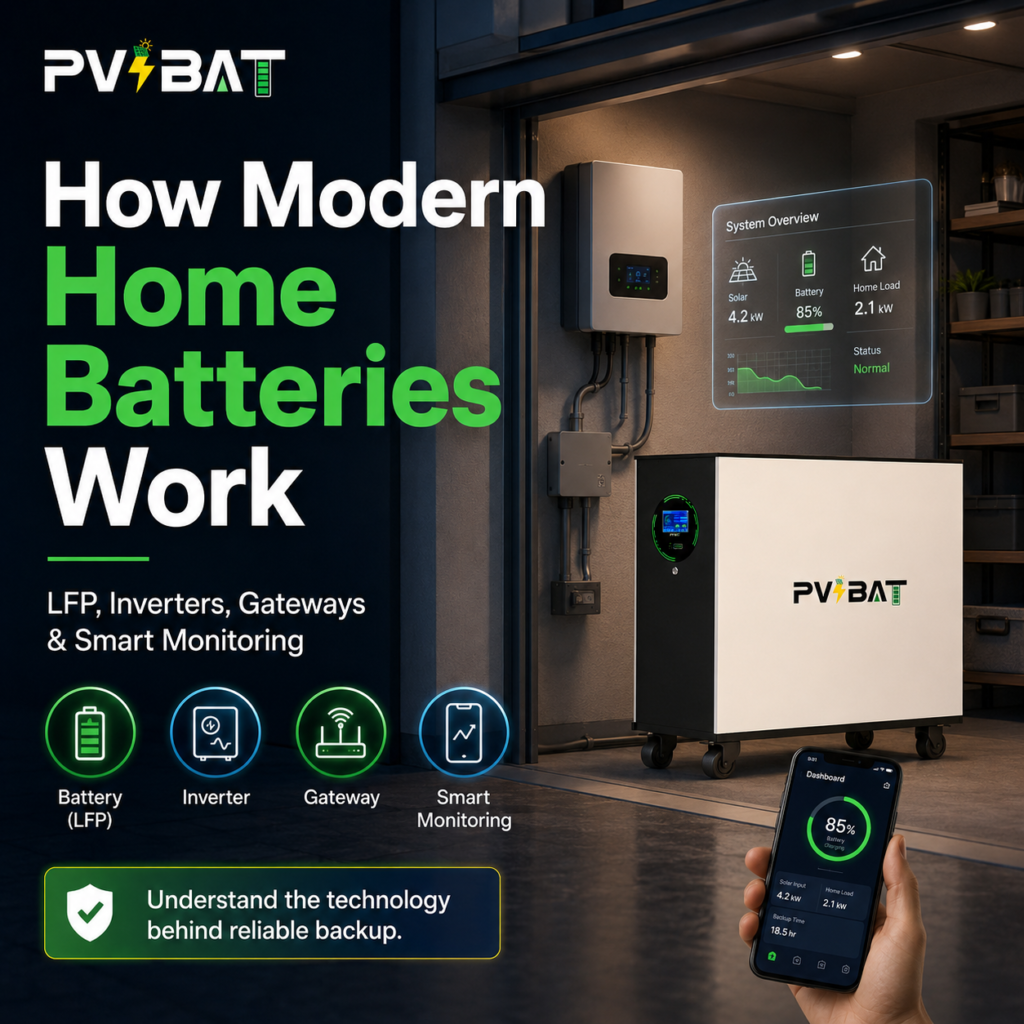
How Modern Home Batteries Work: LFP Chemistry, 120/240V Split-Phase Power, Inverters, Gateways, and Smart Monitoring A Home Battery Is More Than a Battery When people say “home battery,” they usually picture a single box mounted on a wall. In reality, a modern battery backup system is a combination of energy storage, power electronics, controls, and safety equipment. A complete system usually includes: Battery cells Battery Management System, or BMS Inverter or inverter/charger Backup gateway or transfer equipment Monitoring app and controls Disconnects, labels, wiring, and protective equipment The battery stores energy. The rest of the system makes that energy usable, safe, automatic, and visible. Why LFP Chemistry Is Popular for Home Storage Many stationary home storage systems use lithium iron phosphate, often called LFP or LiFePO₄. LFP is popular because it is known for: Strong thermal stability Long cycle life Good performance for stationary storage Lower risk profile compared with some other lithium chemistries Reliable daily charge and discharge use That said, chemistry is only one part of safety. Enclosure design, fusing, BMS quality, installation practices, and code compliance all matter. What the Inverter Does Batteries store DC power. Homes use AC power. The inverter is the equipment that converts battery energy into usable household electricity. In some systems, it also manages charging from solar, the grid, or another energy source. A good inverter must manage: Voltage Frequency Continuous output Surge loads Charging and discharging Grid interaction Backup operation This is why kW ratings matter. The inverter determines how much load the system can support at one time. What the Gateway or Transfer Switch Does During a grid outage, your home battery must disconnect from the utility grid. This is called anti-islanding, and it helps protect utility workers and equipment. The gateway or transfer switch manages that separation. It detects the outage, isolates the home from the grid, and allows the battery to power backed-up loads. When grid power returns, the gateway reconnects the home safely. A well-designed transfer system is what makes backup power feel automatic. Why U.S. Homes Need 120/240V Split-Phase Support Most U.S. homes use split-phase power. Some loads use 120V, such as lights, outlets, routers, and many small appliances. Larger loads often use 240V, including dryers, ranges, well pumps, central AC units, and many heat pumps. A whole-home-ready battery system must be able to feed both legs of the electrical panel properly. If it cannot, you may run into tripped equipment, unsupported loads, or voltage issues. That is why system design should always consider your actual panel and load profile. kW, kWh, and Surge Power There are three performance numbers homeowners should understand. kWh = stored energyThis affects runtime. kW = continuous power outputThis affects how much the battery can run at once. Surge power = short startup capabilityThis matters for motors, compressors, pumps, and HVAC equipment. A system that looks large on paper may still struggle if its power output or surge capability does not match your home’s loads. Soft-starters can help with some motor loads, but they are not magic. They are one part of good engineering. Smart Monitoring and App Control Modern battery systems usually include an app or online dashboard. Depending on the system, you may be able to see: Battery charge level Solar production Home energy use Grid import and export Backup reserve settings Alerts and system status Operating mode Historical performance Monitoring is not just a convenience feature. It helps you understand how your home uses energy and how your backup system is performing. Safety and Code Details That Matter Professional installation should include: Correct neutral-ground bonding Proper disconnects and emergency shutoff labeling Clear circuit directories and placards Code-compliant wiring and conduit Anti-islanding protection Proper battery location and clearance Permit and inspection approval These details may not be exciting, but they protect your home, your family, and the people working on the grid. FAQ Is LFP safer than other lithium batteries?LFP is widely used for stationary storage because of its stability and cycle life. However, overall safety still depends on the full system design and installation quality. Can I expand my battery later?Many modular systems can be expanded, but you should plan for expansion from the beginning. Breaker space, feeder sizing, wall space, and gateway capacity all matter. Can a home battery work without solar?Yes. A battery can be installed without solar for backup or energy shifting, but without solar or generator support, it will not recharge itself during a long outage.

How Home Batteries Work: LFP, Split-Phase Power, Inverters & Monitoring Read More »

Power Outage Backup Essentials vs Whole-Home Battery vs Generator Hybrid

Power Outage Backup: Essentials vs Whole-Home Battery vs Generator Hybrid

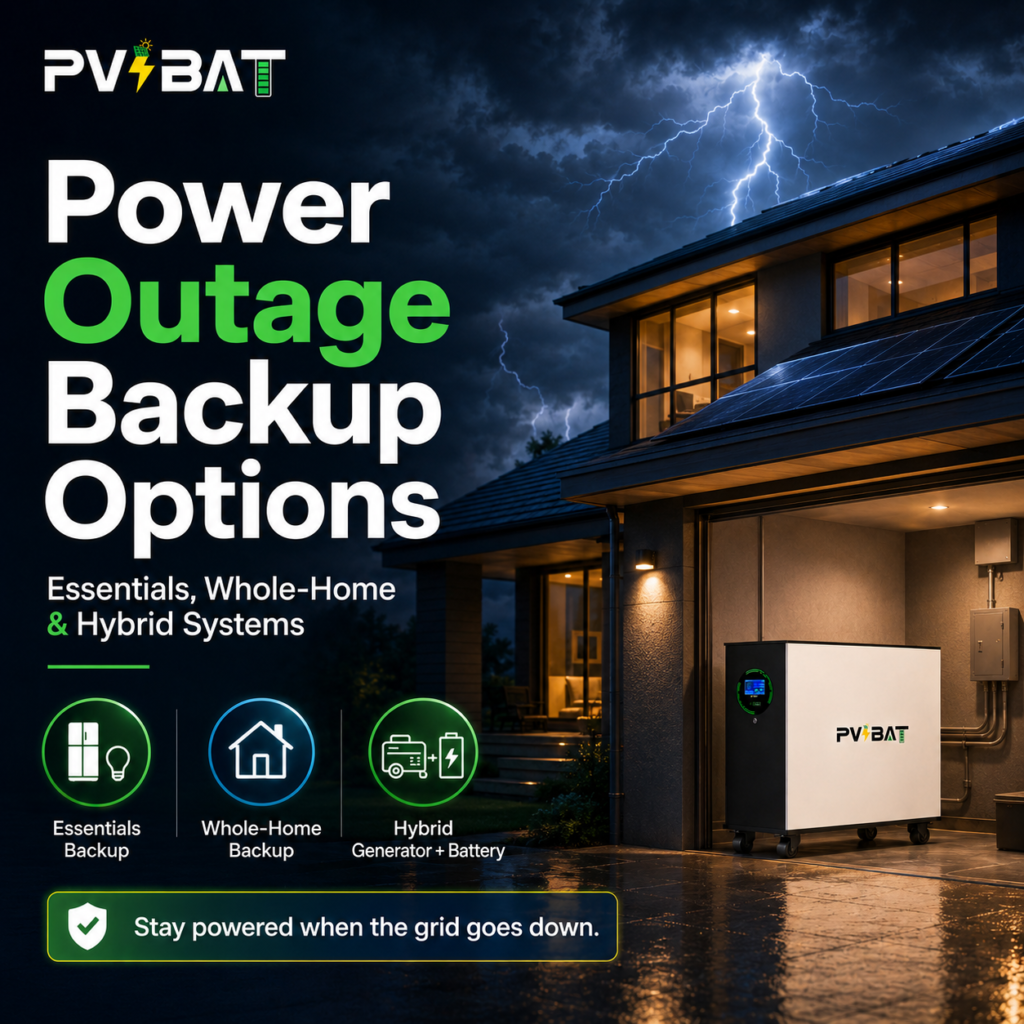
Power Outage Backup Options: Essentials Backup vs Whole-Home Backup vs Hybrid Generator + Battery Systems What Most Families Actually Need During a Blackout During an outage, most families do not need every appliance running at once. They usually need: Fridge and freezer protection Wi-Fi and phones charged Lights in key rooms Garage door access Security system power A furnace blower, fan, window AC, mini-split, or heat pump in some cases That is exactly where a battery backup system performs well. It is quiet, automatic, and does not require fuel storage or manual startup. For many homes, a well-designed essentials or comfort backup system is enough to make an outage feel manageable. Option 1: Critical-Loads Subpanel A critical-loads subpanel backs up selected circuits only. An electrician moves important circuits, such as the refrigerator, Wi-Fi, lights, and a few outlets, into a smaller backed-up panel. When the grid goes down, the battery powers those selected loads. Pros: Lower cost than whole-home backup Smaller battery can last longer Easier to control what the battery powers Good for budget-conscious outage preparation Cons: Only selected circuits are backed up Missed circuits require future electrical work Less flexible than whole-home backup This is a strong option for homeowners who care most about essentials. Option 2: Whole-Home Backup Whole-home backup uses a gateway or transfer device to power most or all of the main panel during an outage. This feels more convenient because you do not have to think as much about which circuits are backed up. However, the battery still has limits. The real constraint is not just battery capacity. It is also continuous power output and surge capability. Large loads such as central air conditioning, well pumps, electric ranges, and compressors may need load management or automatic shedding so the system does not try to power everything at once. Pros: More convenient Fewer decisions during an outage Can support a near-normal home experience Works well with smart load management Cons: Higher installed cost Often requires more battery capacity More electrical design work Heavy loads must be managed carefully Whole-home backup is best for homeowners who want comfort, convenience, and fewer limitations. Option 3: Hybrid Generator + Battery A hybrid setup combines battery backup with a generator input or generator support strategy. The battery handles short outages automatically and quietly. If the outage lasts longer, a generator can recharge the battery or support selected loads through a properly installed and isolated connection. This can be especially useful for rural homes, storm-prone areas, or locations where multi-day outages are realistic. Pros: Excellent for long-duration outages Battery handles short outages silently Generator can extend runtime when needed Can reduce generator use compared with generator-only backup Cons: Requires careful electrical design Must be installed with proper isolation Generator still requires fuel and maintenance Not every battery system supports every generator setup A hybrid system is often the best choice when you want both daily convenience and extended emergency resilience. Red-Flag Questions to Ask Any Installer Before signing a contract, ask: Can you show me the one-line diagram for the permit submission? Will my AC, well pump, or other motor load be supported, or will it be automatically shed? What reserve setting do you recommend so the battery does not drain too low overnight? Who pulls the permit and schedules inspection? Who handles utility approval or Permission to Operate? Who do I call if the system alarms at 2 a.m.? A professional installer should be able to answer these questions clearly. FAQ Is a battery quieter than a generator?Yes. A battery system is usually silent during operation, while a generator produces engine noise and exhaust. Can a battery power my whole house?Sometimes, but it depends on your loads, battery power output, battery capacity, and load management design. Do I still need a generator?Not always. For short outages, a battery may be enough. For multi-day outages, a hybrid system may be worth considering.

Power Outage Backup: Essentials vs Whole-Home Battery vs Generator Hybrid Read More »

Solar + Battery vs Battery-Only Retrofit Options, Costs & When You Do Not Need Solar

Solar + Battery vs Battery-Only: Retrofit Options, Costs & When You Do Not Need Solar

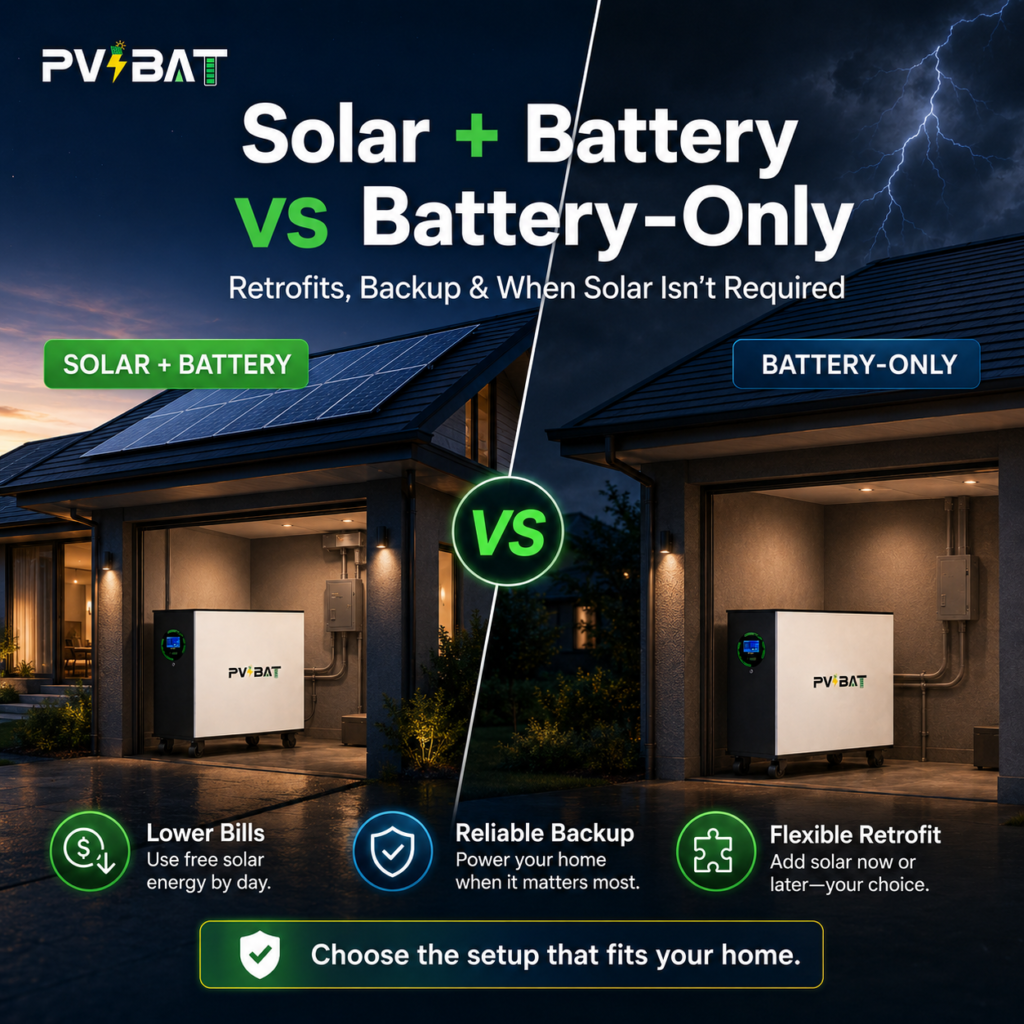
Solar + Battery vs Battery-Only: Which One Makes Sense for Your Home and How Retrofits Actually Work The Short Answer Solar + battery is usually the strongest long-term setup. Your home makes energy, stores energy, and uses that energy when it matters most. During an outage, solar can help recharge the battery during the day, which can stretch backup from hours into days when conditions are right. Battery-only can still be a smart choice if your main goal is outage protection, your roof is shaded or poorly oriented, or you want backup now while planning solar later. The best option depends on your roof, your utility rates, your outage risk, and how much independence you want from the grid. If You Already Have Solar If you already have panels, the key phrase to understand is: AC-coupled retrofit. Many existing solar systems can add storage without removing the current inverter. An AC-coupled battery and gateway can be installed alongside your existing system to manage charging, discharging, and backup transfer. That makes battery retrofits possible for many homes that already have solar. What Your Installer Should Check First Before promising a retrofit, your installer should review: Your inverter brand, model, and firmware age Whether your current system supports battery integration or export controls Main panel capacity, busbar rating, and available breaker space Utility interconnection requirements Whether backup will cover selected circuits or the whole home Whether additional electrical upgrades are needed A good retrofit starts with your existing equipment, not with a generic battery recommendation. If You Do Not Have Solar Yet You can still install a home battery without solar. A battery-only system can help with: Backup protectionIt can keep essentials running when the grid goes down. Time-of-Use energy shiftingIn some utility territories, a battery can charge during lower-cost periods and discharge during expensive peak periods. Future solar readinessYou can plan conduit, wall space, and electrical layout now so adding solar later is easier. The important limitation is simple: without solar or a generator input, a battery does not refill itself during a long blackout. It can protect you for shorter outages, but it will eventually run down. When Solar + Battery Is Usually Better Solar + battery is often the better choice if you want: Lower long-term utility bills More control over your energy use Better resilience during longer outages Greater use of your own solar production Less dependence on buying power from the grid during peak hours This setup is especially valuable in areas where export rates are low and self-consumption is more valuable than sending energy back to the grid. When Battery-Only Still Makes Sense Battery-only can be a practical choice if: Your roof is heavily shaded You are not ready for a full solar project Your main concern is outage protection You want a lower upfront project than solar + battery Your utility rates make battery operation attractive You plan to add solar later For many homeowners, battery-only is a first step toward energy resilience. FAQ Will adding a battery affect my net metering?It can. Battery settings may change how your system exports power or limits export. Your installer should model this before you sign anything. Can I install a battery now and add solar later?Yes, in many cases. The smartest approach is to plan the electrical layout so future solar expansion does not require major rework. Is a battery-only system worth it?It can be, especially if you value automatic backup power and quiet operation during outages.

Solar + Battery vs Battery-Only: Retrofit Options, Costs & When You Do Not Need Solar Read More »

Home Battery Backup Buying Guide 2026 Sizing, Costs & Backup Tiers

Home Battery Backup Buying Guide 2026: Sizing, Costs & Backup Tiers

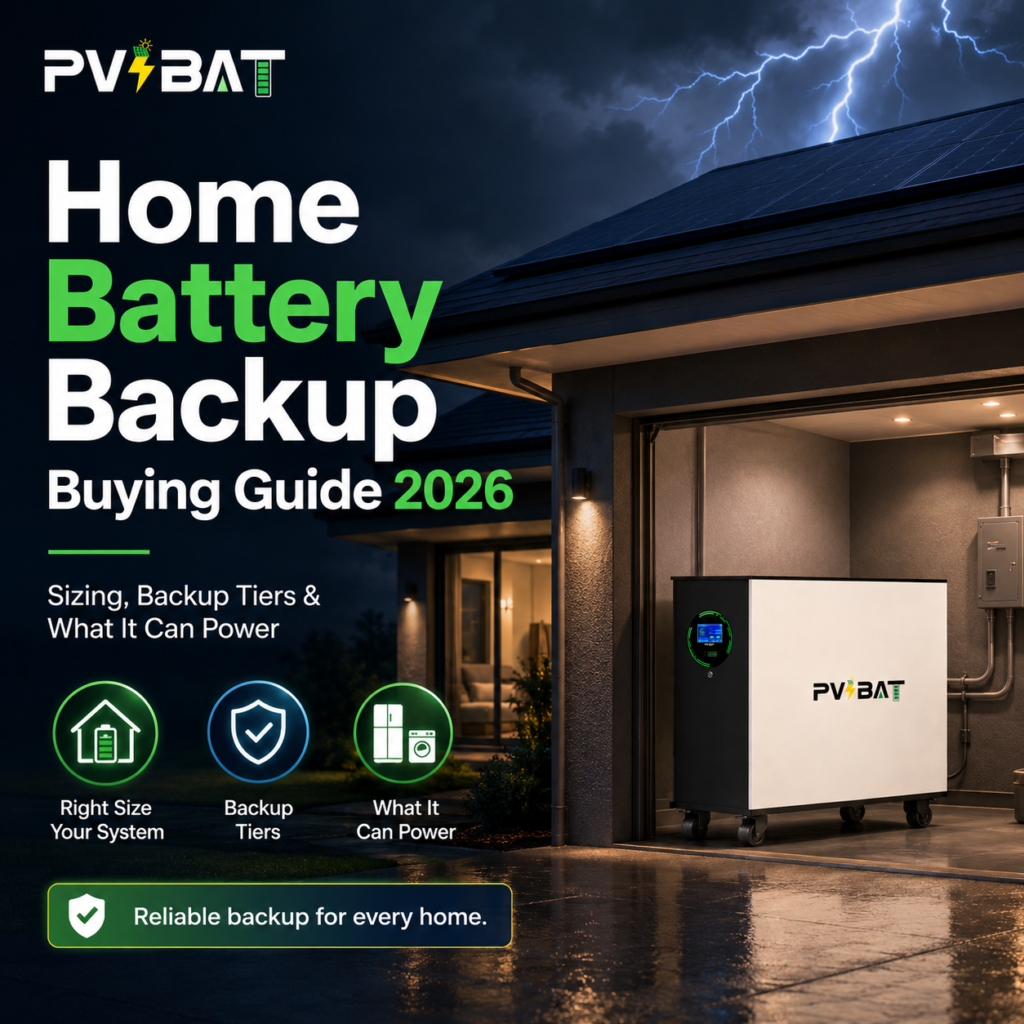
Home Battery Backup Buying Guide 2026: What Size Battery You Actually Need, What It Can Power, and How to Avoid Overbuying Start With the Three Questions That Actually Matter A lot of homeowners start the buying process by asking, “Do I need a 10 kWh battery or a 13.5 kWh battery?” That is understandable, but it is usually the wrong place to begin. Before choosing a battery size, you need to answer three practical questions: What do you want to keep running during an outage?Are you only trying to keep essentials online, or do you want the house to feel close to normal? Do you already have solar?If yes, your inverter type matters. It helps determine whether your battery will be an AC-coupled retrofit, a DC-coupled system, or part of a hybrid setup. What does your utility rate plan look like?If you are on a Time-of-Use rate plan, your battery may help outside of outages by storing lower-cost energy and using it during expensive peak hours. The right battery is not always the biggest one. It is the one that matches your home, your loads, your outage goals, and your budget. kW vs kWh: The Sizing Mistake Most Shoppers Make Home battery specs can be confusing because two numbers matter at the same time: kWh = energy capacityThis tells you how much energy the battery can store. Think of it as runtime. kW = power outputThis tells you how much load the battery can handle at once. Think of it as lifting capacity. A battery can have plenty of stored energy and still shut down if its power output is not strong enough for the loads you are trying to run at the same time. Central air conditioning, well pumps, induction cooktops, and other 240V loads can demand more power than homeowners expect, especially at startup. A simple way to remember it: kWh tells you how long it can run. kW tells you what it can run. Three Practical Backup Tiers Instead of starting with a random battery size, start by choosing the level of backup you actually want. Backup Tier What Usually Stays On Typical Starting Point* Best For Tier 1: Essentials Backup Fridge/freezer, Wi-Fi router, selected lights, garage door, a few outlets, gas furnace blower or small fan About 5–10 usable kWh plus a critical-loads subpanel Storm and fire outage preparation on a budget Tier 2: Comfort Essentials Everything in Tier 1, plus more kitchen outlets, microwave, and often a window AC, mini-split, or small heat pump About 10–14 usable kWh Families who want food, lights, internet, and some heating or cooling Tier 3: Whole-Home or Near-Whole-Home Backup Most or all of the main panel, with load management for heavy appliances About 20–27+ usable kWh Homes with central AC, electric heat pumps, well pumps, medical needs, or a “don’t make me think about it” goal *These are general starting points. The right system depends on your electrical panel, 240V loads, HVAC equipment, load management, and whether soft-start equipment is needed. What a Complete Home Battery Quote Should Include If a proposal only gives you a battery price, it is not a complete quote. You are buying an installed backup system, not just a box on the wall. A clear quote should show: Battery model, usable kWh, continuous kW, chemistry, and warranty terms Backup method: critical-loads subpanel, service-entrance gateway, or hybrid system Main panel evaluation, including amperage, breaker space, grounding, and feeder sizing Exterior disconnects, labels, and required safety equipment Permit, inspection, and utility Permission to Operate handling Monitoring app setup, firmware updates, and service responsibility Whether future expansion is possible without major rework This is how you compare proposals fairly. Two quotes can look similar at first glance but include very different scopes of work. Quick FAQ Can I add a battery to my existing solar system?Often, yes. Many existing solar systems can add a battery through AC coupling, but it depends on your inverter, main panel, available space, and local utility rules. Do I need whole-home backup?Not always. Many homeowners are happier with a well-designed essentials or comfort backup system because it costs less and can run longer during an outage. Is bigger always better?No. Oversizing can add cost without improving your real experience. The goal is to size the system around the loads you truly care about.

Home Battery Backup Buying Guide 2026: Sizing, Costs & Backup Tiers Read More »