
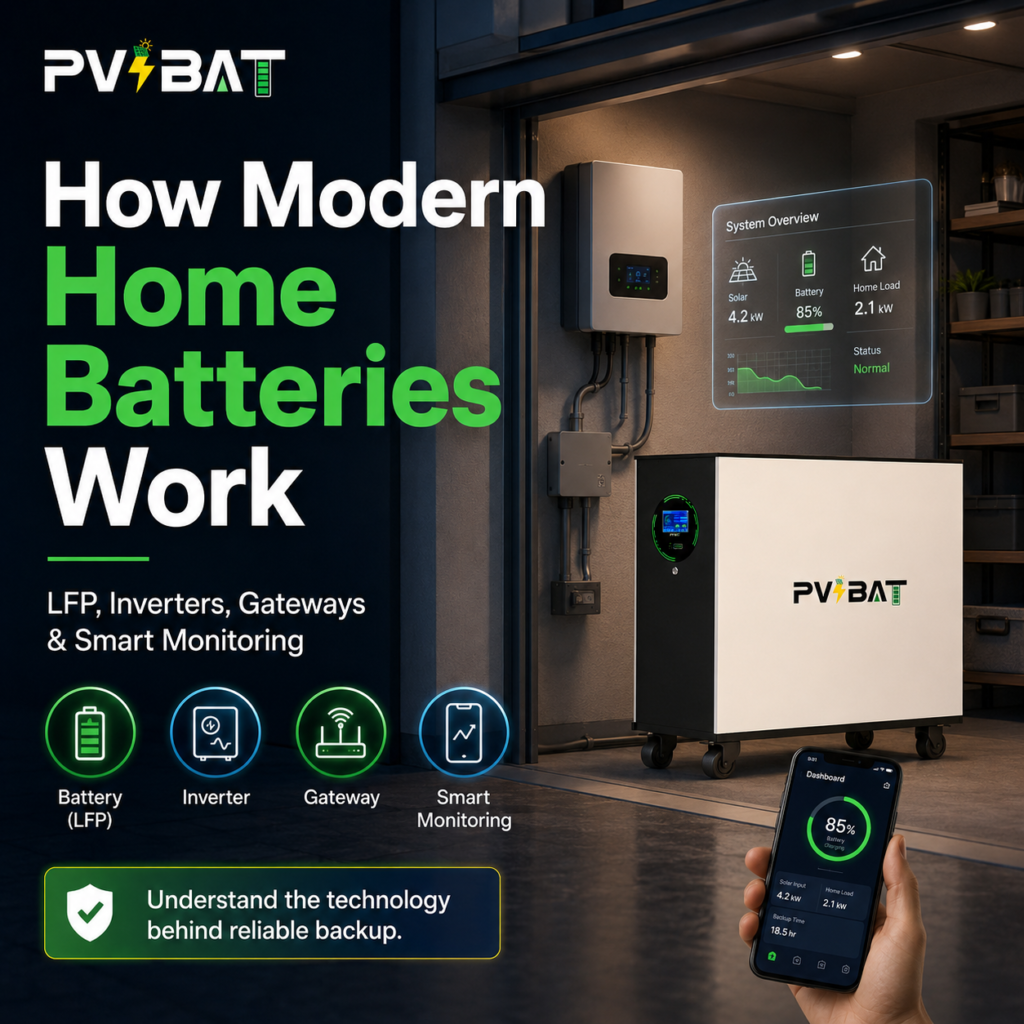
How Modern Home Batteries Work: LFP Chemistry, 120/240V Split-Phase Power, Inverters, Gateways, and Smart Monitoring
A Home Battery Is More Than a Battery
When people say “home battery,” they usually picture a single box mounted on a wall. In reality, a modern battery backup system is a combination of energy storage, power electronics, controls, and safety equipment.
A complete system usually includes:
- Battery cells
- Battery Management System, or BMS
- Inverter or inverter/charger
- Backup gateway or transfer equipment
- Monitoring app and controls
- Disconnects, labels, wiring, and protective equipment
The battery stores energy. The rest of the system makes that energy usable, safe, automatic, and visible.
Why LFP Chemistry Is Popular for Home Storage
Many stationary home storage systems use lithium iron phosphate, often called LFP or LiFePO₄.
LFP is popular because it is known for:
- Strong thermal stability
- Long cycle life
- Good performance for stationary storage
- Lower risk profile compared with some other lithium chemistries
- Reliable daily charge and discharge use
That said, chemistry is only one part of safety. Enclosure design, fusing, BMS quality, installation practices, and code compliance all matter.
What the Inverter Does
Batteries store DC power. Homes use AC power.
The inverter is the equipment that converts battery energy into usable household electricity. In some systems, it also manages charging from solar, the grid, or another energy source.
A good inverter must manage:
- Voltage
- Frequency
- Continuous output
- Surge loads
- Charging and discharging
- Grid interaction
- Backup operation
This is why kW ratings matter. The inverter determines how much load the system can support at one time.
What the Gateway or Transfer Switch Does
During a grid outage, your home battery must disconnect from the utility grid. This is called anti-islanding, and it helps protect utility workers and equipment.
The gateway or transfer switch manages that separation. It detects the outage, isolates the home from the grid, and allows the battery to power backed-up loads.
When grid power returns, the gateway reconnects the home safely.
A well-designed transfer system is what makes backup power feel automatic.
Why U.S. Homes Need 120/240V Split-Phase Support
Most U.S. homes use split-phase power.
Some loads use 120V, such as lights, outlets, routers, and many small appliances. Larger loads often use 240V, including dryers, ranges, well pumps, central AC units, and many heat pumps.
A whole-home-ready battery system must be able to feed both legs of the electrical panel properly. If it cannot, you may run into tripped equipment, unsupported loads, or voltage issues.
That is why system design should always consider your actual panel and load profile.
kW, kWh, and Surge Power
There are three performance numbers homeowners should understand.
kWh = stored energy
This affects runtime.
kW = continuous power output
This affects how much the battery can run at once.
Surge power = short startup capability
This matters for motors, compressors, pumps, and HVAC equipment.
A system that looks large on paper may still struggle if its power output or surge capability does not match your home’s loads.
Soft-starters can help with some motor loads, but they are not magic. They are one part of good engineering.
Smart Monitoring and App Control
Modern battery systems usually include an app or online dashboard.
Depending on the system, you may be able to see:
- Battery charge level
- Solar production
- Home energy use
- Grid import and export
- Backup reserve settings
- Alerts and system status
- Operating mode
- Historical performance
Monitoring is not just a convenience feature. It helps you understand how your home uses energy and how your backup system is performing.
Safety and Code Details That Matter
Professional installation should include:
- Correct neutral-ground bonding
- Proper disconnects and emergency shutoff labeling
- Clear circuit directories and placards
- Code-compliant wiring and conduit
- Anti-islanding protection
- Proper battery location and clearance
- Permit and inspection approval
These details may not be exciting, but they protect your home, your family, and the people working on the grid.
FAQ
Is LFP safer than other lithium batteries?
LFP is widely used for stationary storage because of its stability and cycle life. However, overall safety still depends on the full system design and installation quality.
Can I expand my battery later?
Many modular systems can be expanded, but you should plan for expansion from the beginning. Breaker space, feeder sizing, wall space, and gateway capacity all matter.
Can a home battery work without solar?
Yes. A battery can be installed without solar for backup or energy shifting, but without solar or generator support, it will not recharge itself during a long outage.