
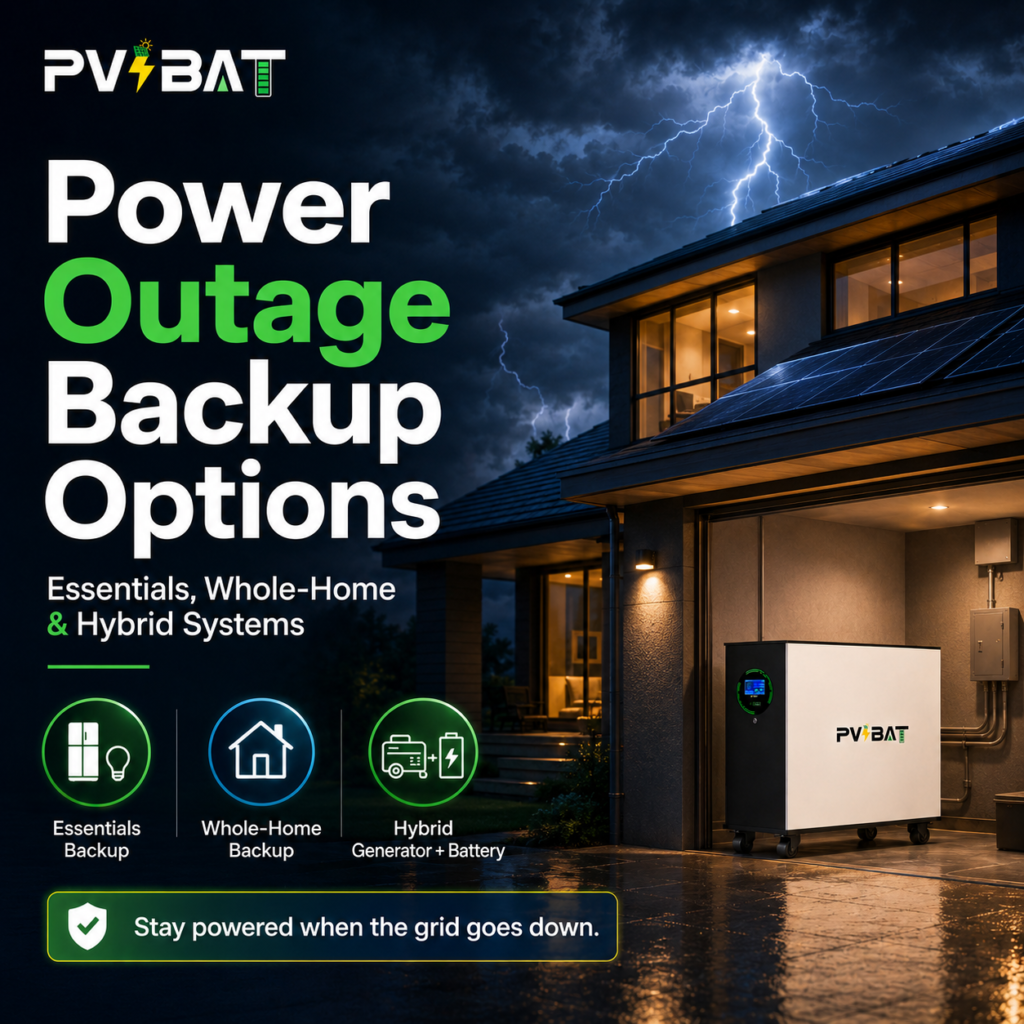
Power Outage Backup Options: Essentials Backup vs Whole-Home Backup vs Hybrid Generator + Battery Systems
What Most Families Actually Need During a Blackout
During an outage, most families do not need every appliance running at once.
They usually need:
- Fridge and freezer protection
- Wi-Fi and phones charged
- Lights in key rooms
- Garage door access
- Security system power
- A furnace blower, fan, window AC, mini-split, or heat pump in some cases
That is exactly where a battery backup system performs well. It is quiet, automatic, and does not require fuel storage or manual startup.
For many homes, a well-designed essentials or comfort backup system is enough to make an outage feel manageable.
Option 1: Critical-Loads Subpanel
A critical-loads subpanel backs up selected circuits only.
An electrician moves important circuits, such as the refrigerator, Wi-Fi, lights, and a few outlets, into a smaller backed-up panel. When the grid goes down, the battery powers those selected loads.
Pros:
- Lower cost than whole-home backup
- Smaller battery can last longer
- Easier to control what the battery powers
- Good for budget-conscious outage preparation
Cons:
- Only selected circuits are backed up
- Missed circuits require future electrical work
- Less flexible than whole-home backup
This is a strong option for homeowners who care most about essentials.
Option 2: Whole-Home Backup
Whole-home backup uses a gateway or transfer device to power most or all of the main panel during an outage.
This feels more convenient because you do not have to think as much about which circuits are backed up. However, the battery still has limits.
The real constraint is not just battery capacity. It is also continuous power output and surge capability.
Large loads such as central air conditioning, well pumps, electric ranges, and compressors may need load management or automatic shedding so the system does not try to power everything at once.
Pros:
- More convenient
- Fewer decisions during an outage
- Can support a near-normal home experience
- Works well with smart load management
Cons:
- Higher installed cost
- Often requires more battery capacity
- More electrical design work
- Heavy loads must be managed carefully
Whole-home backup is best for homeowners who want comfort, convenience, and fewer limitations.
Option 3: Hybrid Generator + Battery
A hybrid setup combines battery backup with a generator input or generator support strategy.
The battery handles short outages automatically and quietly. If the outage lasts longer, a generator can recharge the battery or support selected loads through a properly installed and isolated connection.
This can be especially useful for rural homes, storm-prone areas, or locations where multi-day outages are realistic.
Pros:
- Excellent for long-duration outages
- Battery handles short outages silently
- Generator can extend runtime when needed
- Can reduce generator use compared with generator-only backup
Cons:
- Requires careful electrical design
- Must be installed with proper isolation
- Generator still requires fuel and maintenance
- Not every battery system supports every generator setup
A hybrid system is often the best choice when you want both daily convenience and extended emergency resilience.
Red-Flag Questions to Ask Any Installer
Before signing a contract, ask:
Can you show me the one-line diagram for the permit submission?
Will my AC, well pump, or other motor load be supported, or will it be automatically shed?
What reserve setting do you recommend so the battery does not drain too low overnight?
Who pulls the permit and schedules inspection?
Who handles utility approval or Permission to Operate?
Who do I call if the system alarms at 2 a.m.?
A professional installer should be able to answer these questions clearly.
FAQ
Is a battery quieter than a generator?
Yes. A battery system is usually silent during operation, while a generator produces engine noise and exhaust.
Can a battery power my whole house?
Sometimes, but it depends on your loads, battery power output, battery capacity, and load management design.
Do I still need a generator?
Not always. For short outages, a battery may be enough. For multi-day outages, a hybrid system may be worth considering.