
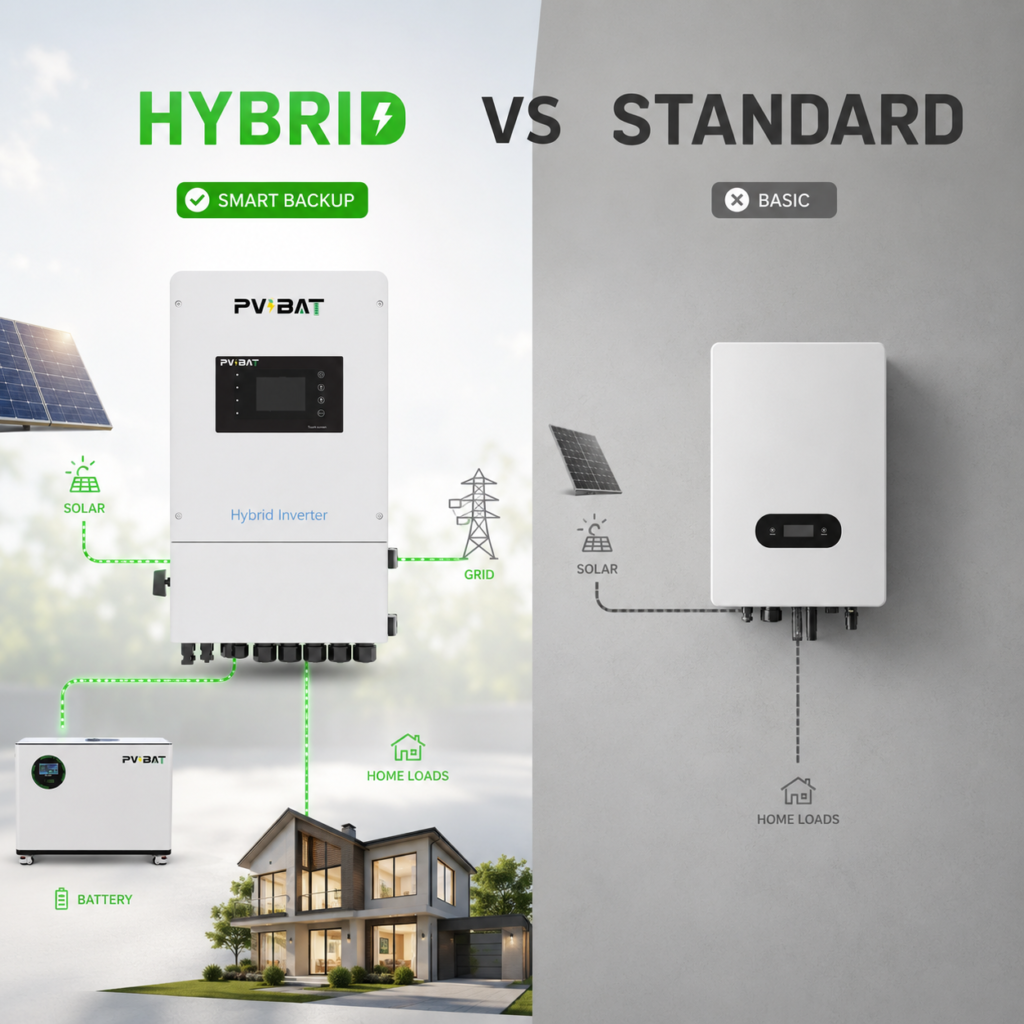
Many people can’t tell the difference between these two types of inverters, which leads to buying the wrong one, rendering it unusable and wasting money. Simply put:
Standard Inverter: Converts power only (DC to AC)
Hybrid Inverter: Manages the entire home energy system (solar + batteries + grid + loads)
Standard Inverter: Simple and affordable, suitable only for pure solar systems
What it does: Converts DC power from solar panels or batteries into AC power for household use.
Suitable for: Systems with only solar panels, no batteries, tight budgets, and simple setups.
Disadvantages: Cannot manage batteries, cannot automatically switch to backup power, and cannot optimize electricity costs.
Hybrid Inverter: A must-have for home energy storage—a one-stop solution
What it does:
Prioritizes solar power for household use → charges batteries → sells excess to the grid
Intelligent battery charge/discharge management
Automatic switchover to backup during power outages, with millisecond-level switching
Saves money with peak-off-peak electricity rates
Supports off-grid operation
Key Differences (At a Glance)
Standard Inverter: Only converts power; does not manage batteries; weak backup; inexpensive
Hybrid Inverter: All-in-one management, battery-friendly, robust backup, slightly more expensive but worth it
Which one should you choose for home energy storage?
Solar only, no battery: Standard inverter
Installing a battery, need backup, want to save money: Must choose a hybrid inverter
What to look for when buying a hybrid inverter?
Voltage compatibility (48V/51.2V)
Communication protocols (CAN/RS485)
120V/240V phase separation (essential for U.S. homes)
Continuous power + peak power
Supports parallel operation, off-grid mode, and generator input