第6

Unveiling the PVBAT Lithium-Ion Battery BMS System: Why Does It Ensure Safe and Long-Lasting Battery Performance?

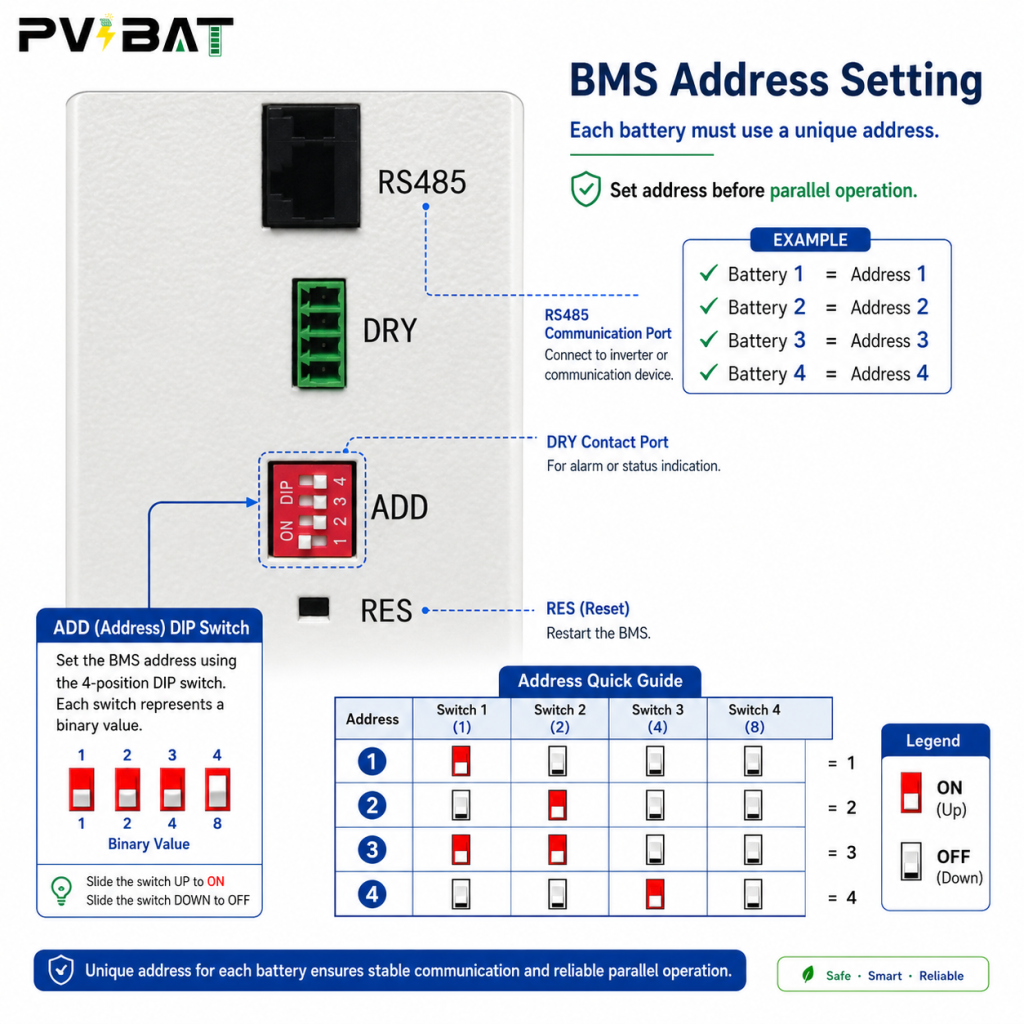
The safe operation of lithium-ion batteries relies heavily on the core BMS (Battery Management System)—it acts as the “brain” of the battery, responsible for real-time monitoring of battery status, adjusting charge and discharge parameters, and preventing safety hazards. When selecting lithium-ion batteries, many users often focus solely on capacity and price, overlooking the importance of the BMS system. This can ultimately lead to issues such as overcharging, over-discharging, and swelling, shortening the battery’s lifespan and even causing safety incidents. The intelligent BMS system built into PVBAT lithium-ion batteries, with its precise monitoring and comprehensive protection features, serves as the cornerstone of safe battery operation. It is also one of PVBAT’s core technologies, highlighting the advantages of the intelligent BMS battery management system. The core advantage of the PVBAT lithium-ion battery BMS system is first and foremost its “comprehensive monitoring.” It collects key data such as battery voltage, current, temperature, and SOC (State of Charge) in real time to accurately assess the battery’s operational status. Upon detecting any abnormalities (such as excessive voltage or temperature), it immediately triggers protective mechanisms to halt charging or discharging, thereby preventing battery damage. Taking a 48V 628Ah lithium-ion battery as an example, its BMS system can monitor the status of each individual cell in real time, ensuring voltage balancing among cells and preventing overcharging or over-discharging of any single cell. This effectively extends the overall battery life and enables long-term, reliable operation of the lithium-ion battery. Secondly, it features “intelligent adjustment.” The BMS system automatically adjusts the charging and discharging currents and voltages based on the battery’s operating status and ambient temperature, ensuring the battery operates under optimal parameters. For example, in low-temperature environments, it automatically reduces the charging current to prevent damage caused by charging at low temperatures; when the battery is nearly fully charged, it automatically switches to float charging mode to prevent overcharging, while compensating for self-discharge to maintain stable battery capacity, demonstrating the advantages of intelligent BMS regulation. Furthermore, the PVBAT lithium-ion battery BMS system also features “communication compatibility” and “fault alarm” functions. It supports mainstream communication protocols such as CAN and RS485, enabling seamless integration with PVBAT inverters and inverters from other brands to achieve coordinated system operation. When a battery fault occurs (such as a short circuit or cell failure), it sends alarm signals via LED indicators and the app, promptly alerting users to address the issue, thereby preventing safety hazards from escalating and ensuring the safety of the energy storage lithium-ion batteries. From an industry perspective, the well-designed PVBAT BMS system not only enhances the safety and service life of lithium-ion batteries but also drives the standardization of the energy storage battery industry. By providing users with more reliable energy storage solutions, it has become a benchmark for lithium-ion battery BMS systems.

Unveiling the PVBAT Lithium-Ion Battery BMS System: Why Does It Ensure Safe and Long-Lasting Battery Performance? Read More »

第5

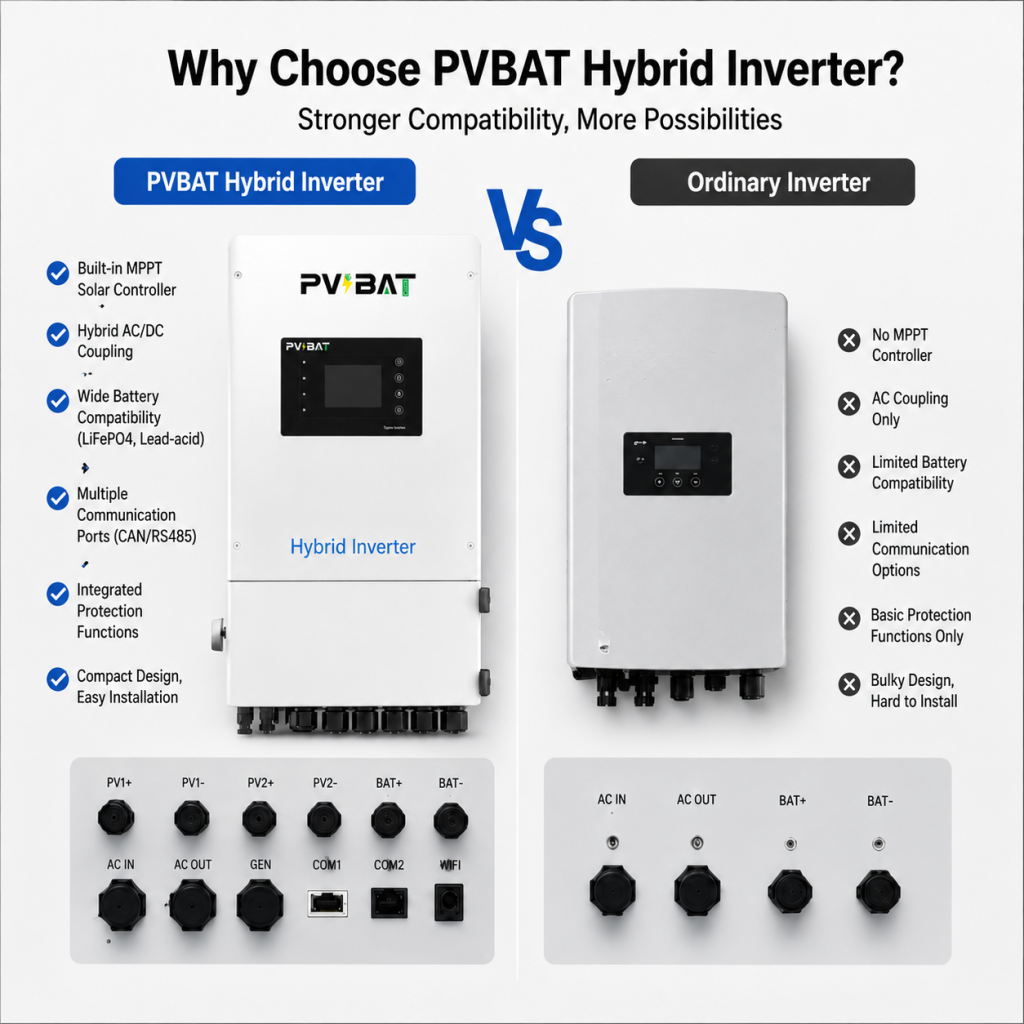
Why Are More and More Households Choosing PVBAT Hybrid Inverters? 3 Key Advantages That Meet Their Needs

With the growing popularity of photovoltaic storage, hybrid inverters—as core components—have become a top choice for residential users. Among the many brands available, PVBAT hybrid inverters have won the favor of an increasing number of households thanks to their outstanding product advantages. Unlike some products on the market that are “overloaded with specifications but lack substance,” every aspect of the PVBAT hybrid inverter’s design addresses the core needs of residential users, truly delivering “practicality, efficiency, and peace of mind.” This has made it the top choice for residential hybrid inverters and one of PVBAT’s core energy storage solutions. Advantage 1: Strong compatibility, suitable for a variety of scenarios. The PVBAT hybrid inverter (3kW–12kW series) is compatible with multiple battery types, including lead-acid and lithium batteries, and supports parallel operation of multiple units. It can be flexibly scaled up according to the size of the home and electricity needs; It also supports solar panels of varying power ratings, seamlessly adapting to both small-scale residential PV systems (3kW) and medium-to-large-scale systems (12kW) without requiring additional equipment replacement, thereby reducing upgrade costs for users. It stands as a benchmark for highly compatible PV inverters. Advantage 2: Smart and Efficient, Reducing Electricity Costs. Equipped with built-in intelligent MPPT (Maximum Power Point Tracking) technology, it maximizes the capture of solar power generation, significantly improving efficiency. It also features multiple operating modes (such as “Selling First” and “Zero Export To Load”), allowing users to choose flexibly based on their needs. For example, the “Selling First” mode feeds excess solar power into the grid to generate additional revenue from electricity sales; the “Zero Export To Load” mode ensures that solar power is supplied exclusively to household loads, preventing reverse power flow into the grid. This aligns with grid policies in certain regions, making it the preferred choice for smart, energy-efficient inverters. Advantage 3: Safe and Reliable, with Guaranteed After-Sales Support. The PVBAT hybrid inverter is equipped with multiple built-in protection mechanisms, including overcurrent, overvoltage, overheat, and short-circuit protection, as well as a ground fault detection circuit, and complies with international safety standards such as IEC 62109. The product undergoes rigorous quality testing to ensure a long service life and is backed by comprehensive after-sales support. Professional engineers provide full-process assistance, from installation guidance to fault repair, ensuring worry-free use and highlighting the core characteristics of a safe and reliable inverter. For residential users, choosing the PVBAT hybrid inverter means more than just selecting a high-efficiency power supply device; it means opting for a hassle-free, worry-free home energy management solution. This is the key reason why it stands out in the residential inverter market.

Why Are More and More Households Choosing PVBAT Hybrid Inverters? 3 Key Advantages That Meet Their Needs Read More »

第四

A Guide to Avoiding Pitfalls When Installing PV Storage Systems: PVBAT Engineers Walk You Through the Process Step by Step

The quality of a photovoltaic energy storage system’s installation directly determines the equipment’s operational efficiency, safety, and service life. Many users experience equipment malfunctions, low power generation efficiency, and even safety hazards during installation due to non-standard procedures and neglect of details. As a professional brand with deep expertise in the energy storage sector, PVBAT has drawn upon years of experience in installing photovoltaic energy storage systems to compile a practical guide to avoid common pitfalls. Our professional engineers will walk you through the correct procedures step-by-step, helping you steer clear of industry-wide mistakes to ensure your home photovoltaic energy storage system is installed properly, guaranteeing stable operation and helping you avoid common installation pitfalls. First, pre-installation preparations must not be overlooked. Verify that the installation environment meets requirements: keep the system away from flammable, explosive, or corrosive materials; avoid direct sunlight and exposure to rain; ensure the installation surface is level and secure; and allow sufficient space for heat dissipation (e.g., the TIGER-T4-72 requires a clearance of at least 4 inches). Additionally, ensure you have all necessary specialized tools on hand, such as insulated gloves, insulated boots, a multimeter, and wire strippers. Avoid using non-specialized tools, which can lead to loose connections or short circuits, thereby laying a solid foundation for a compliant PV storage installation. Secondly, the wiring process is the core of the installation and also the stage most prone to errors. Whether connecting the hybrid inverter to the battery or the grid, or connecting the solar panels to the inverter, it is essential to strictly distinguish between positive and negative terminals to prevent reverse connection (which can directly damage the inverter and battery); When wiring, terminal screws must be tightened to the torque specified in the manual (e.g., 24.5 Nm for a 3kW inverter battery connection) to prevent overheating caused by poor contact; simultaneously, relevant cables must be threaded through ferrite rings and wound as required (e.g., four turns for battery communication cables) to effectively reduce electromagnetic interference and ensure the safety of the PV inverter wiring. Finally, post-installation commissioning is critical. After installation is complete, first verify that all wiring is correct and secure; only then should power be connected. During commissioning, focus on checking the equipment’s communication status, power generation efficiency, and energy storage functionality to ensure all components are working together properly. Additionally, users should be trained in basic operating procedures and daily inspection points—such as how to view data on the LCD display and how to respond to simple fault alarms—to empower them to independently commission their PV storage systems. All PVBAT products come with detailed installation manuals, and professional technical support is available. Users can contact engineers at any time for one-on-one installation guidance to ensure that every system is installed according to standards and operates safely, providing professional solutions to PV storage installation challenges.

A Guide to Avoiding Pitfalls When Installing PV Storage Systems: PVBAT Engineers Walk You Through the Process Step by Step Read More »