
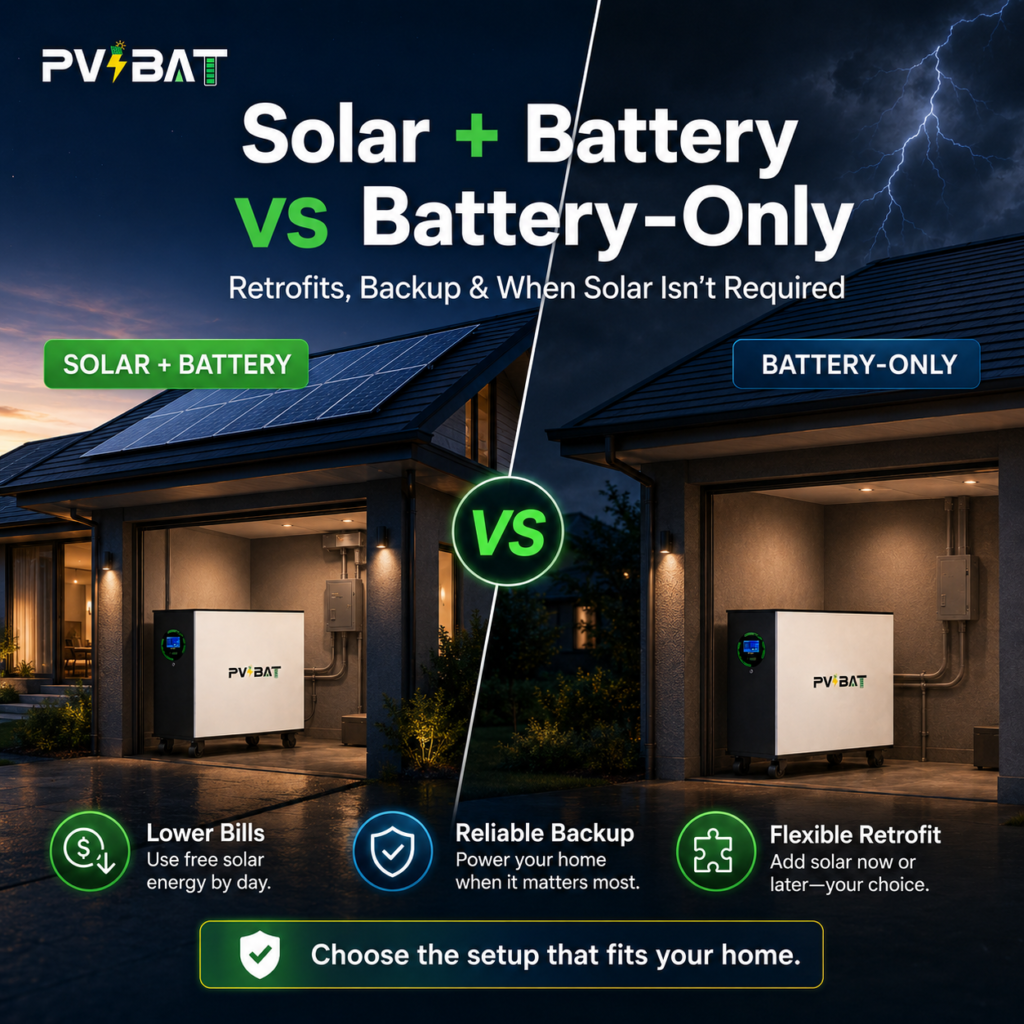
Solar + Battery vs Battery-Only: Which One Makes Sense for Your Home and How Retrofits Actually Work
The Short Answer
Solar + battery is usually the strongest long-term setup. Your home makes energy, stores energy, and uses that energy when it matters most. During an outage, solar can help recharge the battery during the day, which can stretch backup from hours into days when conditions are right.
Battery-only can still be a smart choice if your main goal is outage protection, your roof is shaded or poorly oriented, or you want backup now while planning solar later.
The best option depends on your roof, your utility rates, your outage risk, and how much independence you want from the grid.
If You Already Have Solar
If you already have panels, the key phrase to understand is:
AC-coupled retrofit.
Many existing solar systems can add storage without removing the current inverter. An AC-coupled battery and gateway can be installed alongside your existing system to manage charging, discharging, and backup transfer.
That makes battery retrofits possible for many homes that already have solar.
What Your Installer Should Check First
Before promising a retrofit, your installer should review:
- Your inverter brand, model, and firmware age
- Whether your current system supports battery integration or export controls
- Main panel capacity, busbar rating, and available breaker space
- Utility interconnection requirements
- Whether backup will cover selected circuits or the whole home
- Whether additional electrical upgrades are needed
A good retrofit starts with your existing equipment, not with a generic battery recommendation.
If You Do Not Have Solar Yet
You can still install a home battery without solar.
A battery-only system can help with:
Backup protection
It can keep essentials running when the grid goes down.
Time-of-Use energy shifting
In some utility territories, a battery can charge during lower-cost periods and discharge during expensive peak periods.
Future solar readiness
You can plan conduit, wall space, and electrical layout now so adding solar later is easier.
The important limitation is simple: without solar or a generator input, a battery does not refill itself during a long blackout. It can protect you for shorter outages, but it will eventually run down.
When Solar + Battery Is Usually Better
Solar + battery is often the better choice if you want:
- Lower long-term utility bills
- More control over your energy use
- Better resilience during longer outages
- Greater use of your own solar production
- Less dependence on buying power from the grid during peak hours
This setup is especially valuable in areas where export rates are low and self-consumption is more valuable than sending energy back to the grid.
When Battery-Only Still Makes Sense
Battery-only can be a practical choice if:
- Your roof is heavily shaded
- You are not ready for a full solar project
- Your main concern is outage protection
- You want a lower upfront project than solar + battery
- Your utility rates make battery operation attractive
- You plan to add solar later
For many homeowners, battery-only is a first step toward energy resilience.
FAQ
Will adding a battery affect my net metering?
It can. Battery settings may change how your system exports power or limits export. Your installer should model this before you sign anything.
Can I install a battery now and add solar later?
Yes, in many cases. The smartest approach is to plan the electrical layout so future solar expansion does not require major rework.
Is a battery-only system worth it?
It can be, especially if you value automatic backup power and quiet operation during outages.