


Start with the loads you care about in an outage, not a random kilowatt-hour number. Home battery backup sizing in 2026 still comes down to two specs: kWh (how long energy lasts) and kW / kVA (how much you can run or start at once). Pick an essentials, comfort, or near-whole-home tier first; solar is optional if the battery can charge from the grid. Permanent panel or transfer-switch work belongs with a licensed electrician. PVBAT provides product options, U.S. support and installation guidance, and California warehouse coordination—not installation services.
Ask three questions before you shop
Many shoppers open a tab and ask, “Do I need 10 kWh or 13.5 kWh?” That question is understandable—and usually premature.
Answer these first:
- What must stay on during an outage? Fridge and Wi-Fi only, or something closer to normal life (more kitchen circuits, some cooling, a well pump)?
- Do you already have solar? If yes, inverter type and coupling path matter. If no, a battery-only (grid-charged) system can still be a solid first step—see Home Battery Backup Without Solar.
- How do you pay for electricity? On a time-of-use plan, storage may help with peak shifting when the grid is up. For pure emergency prep, outage goals matter more than rate arbitrage.
The right battery is not always the biggest one. It is the one that matches your loads, your panel realities, your outage goals, and your budget.
kW vs kWh: the sizing mistake that causes most surprises
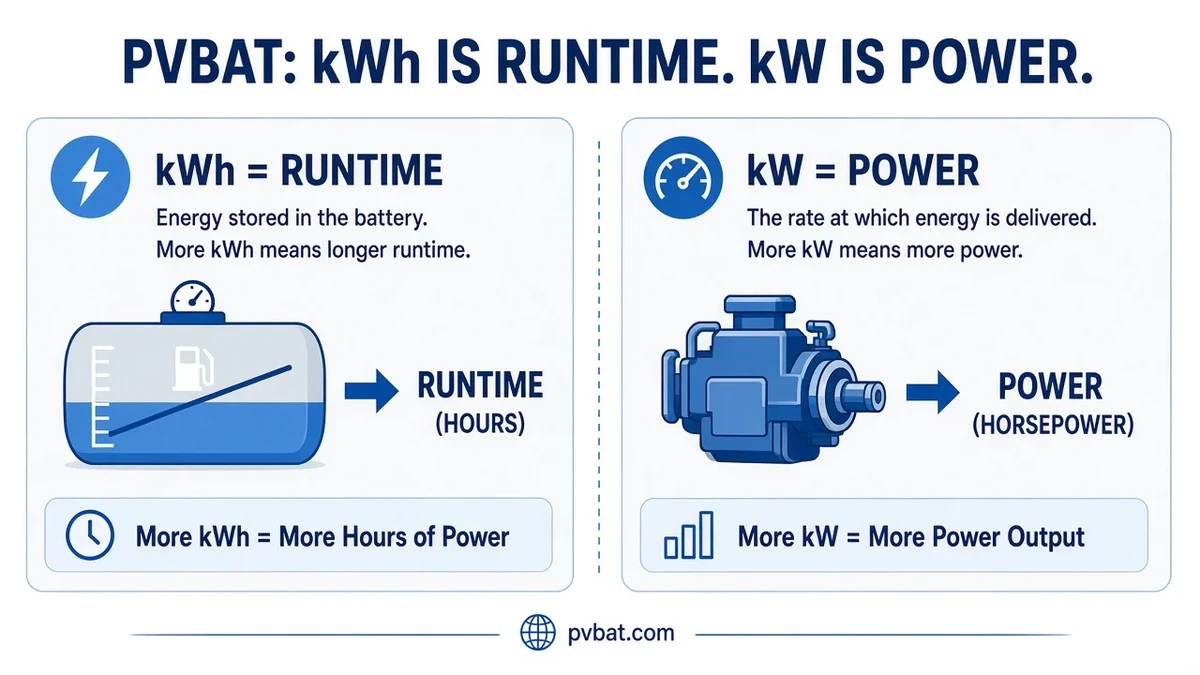
Home battery marketing often highlights one big number. You need two:
| Spec | What it means | Think of it as |
|---|---|---|
| kWh | Stored energy | How long the system can run |
| kW / kVA | Power output | What it can run—or start—at once |
A battery can have plenty of kWh and still shut down if kW / kVA is too low for the loads you turn on together. Central air, well pumps, induction cooktops, compressors, and other 240V loads can demand more power than people expect—especially at startup surge.
Quick memory aid: kWh tells you how long. kW / kVA tells you what.
For a deeper look at how capacity behaves with real household loads, see What Can a 24kWh Battery Backup Run?.
Three practical backup tiers
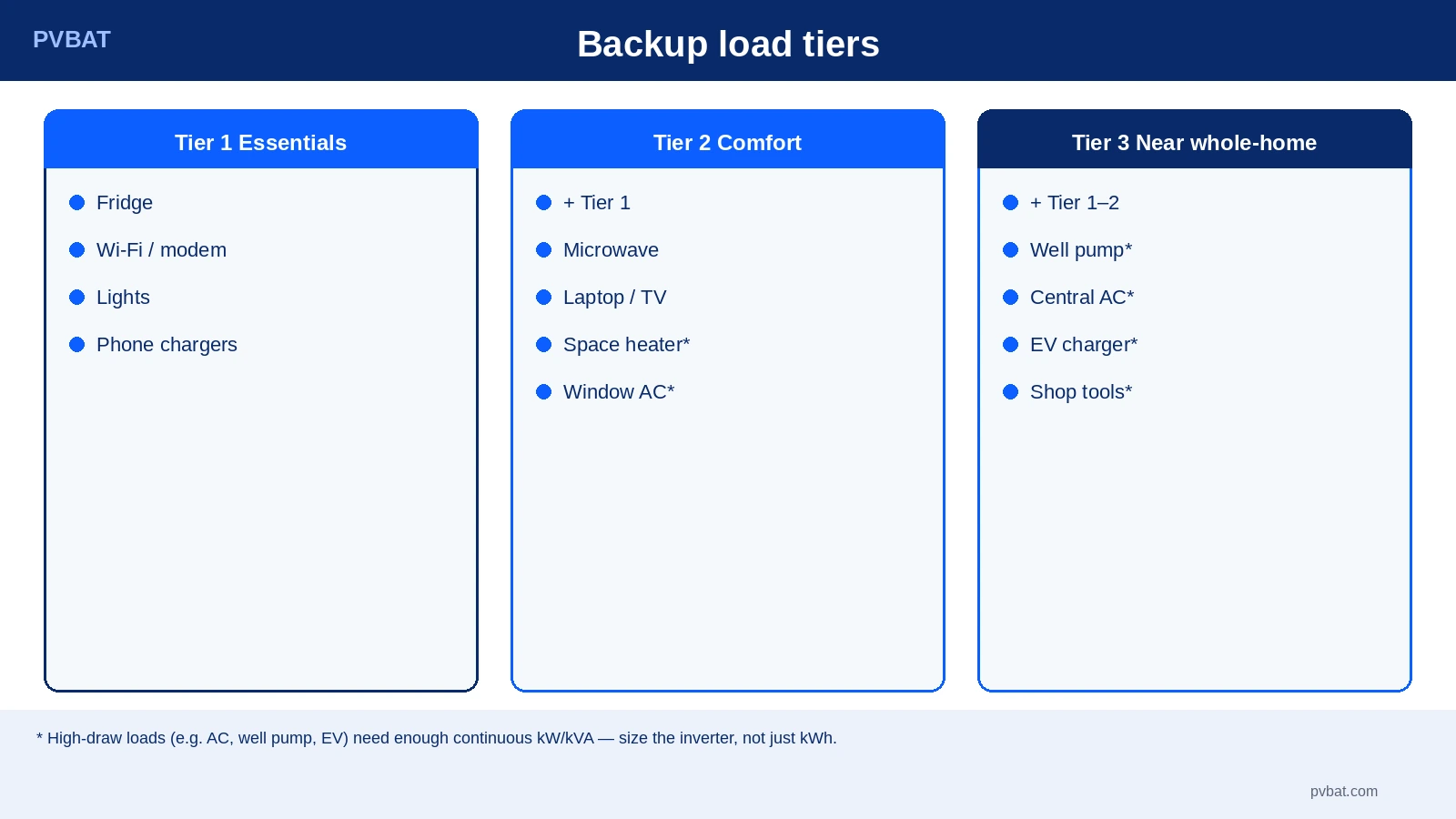
Instead of starting with a random battery size, choose the level of backup you actually want. The numbers below are general starting points, not quotes.
| Backup tier | What usually stays on | Typical starting point* | Best for |
|---|---|---|---|
| Tier 1: Essentials | Fridge/freezer, Wi-Fi/modem, selected lights, garage door, a few outlets; gas furnace blower or small fan if applicable | About 5–10 usable kWh + critical-loads approach | Storm / shutoff prep on a tighter budget |
| Tier 2: Comfort essentials | Tier 1 + more kitchen outlets, microwave, often a window AC, mini-split, or small heat pump | About 10–14 usable kWh | Families who want food, lights, internet, and limited heating/cooling |
| Tier 3: Near whole-home | Most or all of a managed main-panel experience, with load control for heavy appliances | About 20–27+ usable kWh | Homes with larger HVAC, well pumps, medical needs, or “don’t make me think” goals |
*Depends on your panel, 240V loads, HVAC equipment, load management, soft-start devices, and whether you need split-phase (120/240V) output.
If your property includes a private well, read Battery Backup for 240V Well Pumps and the scenario page 240V Well Pump Battery Backup before you lock a tier.
Critical-loads panel vs near whole-home backup
At a high level, U.S. homes usually land in one of these paths:
- Critical-loads / subpanel approach: An electrician moves must-run circuits to a backup subpanel. You get predictable essentials coverage and often better runtime because heavy loads stay off the battery by design.
- Service-entrance / gateway-style whole-home path: More of the home can stay energized, usually with load management so the battery is not asked to start everything at once.
- Hybrid / solar-coupled systems: Battery works with an existing or new solar inverter architecture. Compatibility and utility rules vary—treat this as a design conversation with your electrician or solar contractor.
None of these paths is “more premium” in the abstract. The better path is the one that matches your outage goals without forcing you to buy capacity you will never use.
What a fair quote or proposal should list (buyer checklist)
If a proposal only shows a battery sticker price, it is not a complete comparison—especially when a contractor will touch your panel. Use this as a buyer checklist for any electrician, installer, or equipment seller you evaluate:
- Battery model, usable kWh, continuous kW / kVA, chemistry (for example LiFePO4), and warranty terms
- Backup method: critical-loads subpanel, service-entrance equipment, mobile/all-in-one direct-load use, or hybrid coupling
- Main panel notes: amperage, breaker space, grounding, feeder concerns
- Required disconnects, labels, and protection devices called out by code in your area
- Who pulls permits, inspections, and utility permission-to-operate (if applicable)—and who pays for them
- Monitoring app / firmware ownership and who supports troubleshooting
- Whether expansion later is realistic without ripping out the first design
Important: PVBAT sells energy storage equipment and provides U.S. support and installation guidance. We do not provide installation services. Permanent connections to a home electrical panel, transfer switch, solar array, generator circuit, or utility service must be designed and installed by a qualified electrician under local codes and equipment instructions. For U.S. fulfillment questions, ask about California warehouse coordination and current lead times.
Battery-only vs solar-ready: you do not have to do everything at once
Solar is valuable, but it is not a prerequisite for backup value.
- Battery-only (grid-charged): Charge when the grid is up; discharge when it is down. Strong fit for outage prep, rural blips, and households that cannot add roof solar yet.
- Solar later: Many owners start with backup, then add PV when the roof, budget, or shade situation improves—if the equipment path supports that future design.
- Solar + battery together: Makes the most sense when you already know you want both production and backup in one project.
For the battery-first path, keep reading Home Battery Backup Without Solar.
When a 24 kWh all-in-one class fits
Some homes need more than a small wall module and want a clearer power story than “battery only—inverter sold separately.”
An all-in-one class such as the PVBAT TIGER-T4-72 combines roughly:
- 24 kWh LiFePO4 storage
- 16.5 kVA inverter rating with 13 kW continuous active output
- 120/240V split-phase output for many U.S. home and shop loads (after load and connection review)
That class is often a candidate for Tier 2–3 style goals, rural properties, workshops, and sites that care about split-phase output—not for charging a phone and one lamp. Architecture tradeoffs (all-in-one vs modular wall batteries) will be covered in depth in All-in-One 24 kWh ESS vs Modular Wall Batteries: When TIGER Fits.
Always treat motor loads (pumps, compressors, HVAC) as a nameplate + surge review—not a brochure assumption. Farm and workshop owners may also want Farm Workshop Backup Power and Rural Home Off-Grid Backup Power.
Quick FAQ
How do I choose between 10 kWh and 24 kWh?
Choose based on which loads you will run and for how long, not on a round number that sounds safe. About 5–10 usable kWh often covers essentials for shorter events; ~20–27+ kWh is a more common starting conversation for near-whole-home or multi-day essentials with heavier loads. Confirm both kWh and continuous / surge kW–kVA.
Do I need whole-home backup or a critical-loads panel?
Not always whole-home. Many households are happier with a well-designed essentials or comfort setup: lower cost, clearer priorities, and often longer runtime because big loads stay off the battery. Whole-home or near-whole-home makes more sense when you need broad coverage and accept load management.
Can I start with battery-only and add solar later?
Often yes, if you choose equipment and a wiring path that leave room for future PV. Battery-only backup charged from the grid is a valid 2026 strategy for outage resilience. Confirm solar-input limits and coupling options before you buy if PV is on your roadmap.
Why can a battery with enough kWh still trip on AC or a well pump?
Because startup surge and simultaneous kW / kVA demand can exceed what the inverter can deliver, even when stored energy remains. Capacity (kWh) does not create surge headroom by itself.
What should I ask an electrician before buying?
Ask how backup will connect (subpanel, transfer equipment, or other), which circuits move first, whether your 240V loads are realistic on the proposed inverter, and what permits or utility steps apply locally. Bring appliance and pump nameplates when you can.
Next step
Map your must-run loads, pick a tier, then compare equipment on both energy and power—not price alone.
- Product example: TIGER-T4-72 24 kWh all-in-one mobile ESS
- Related reading: 24 kWh runtime examples · Battery backup without solar · 240V well pump backup
Contact: pvbat.com · +1 (626) 341-8963 · City of Industry, CA · service@pvbat.com
U.S. support & installation guidance. California warehouse coordination available—ask for current stock and pickup/shipping options.