
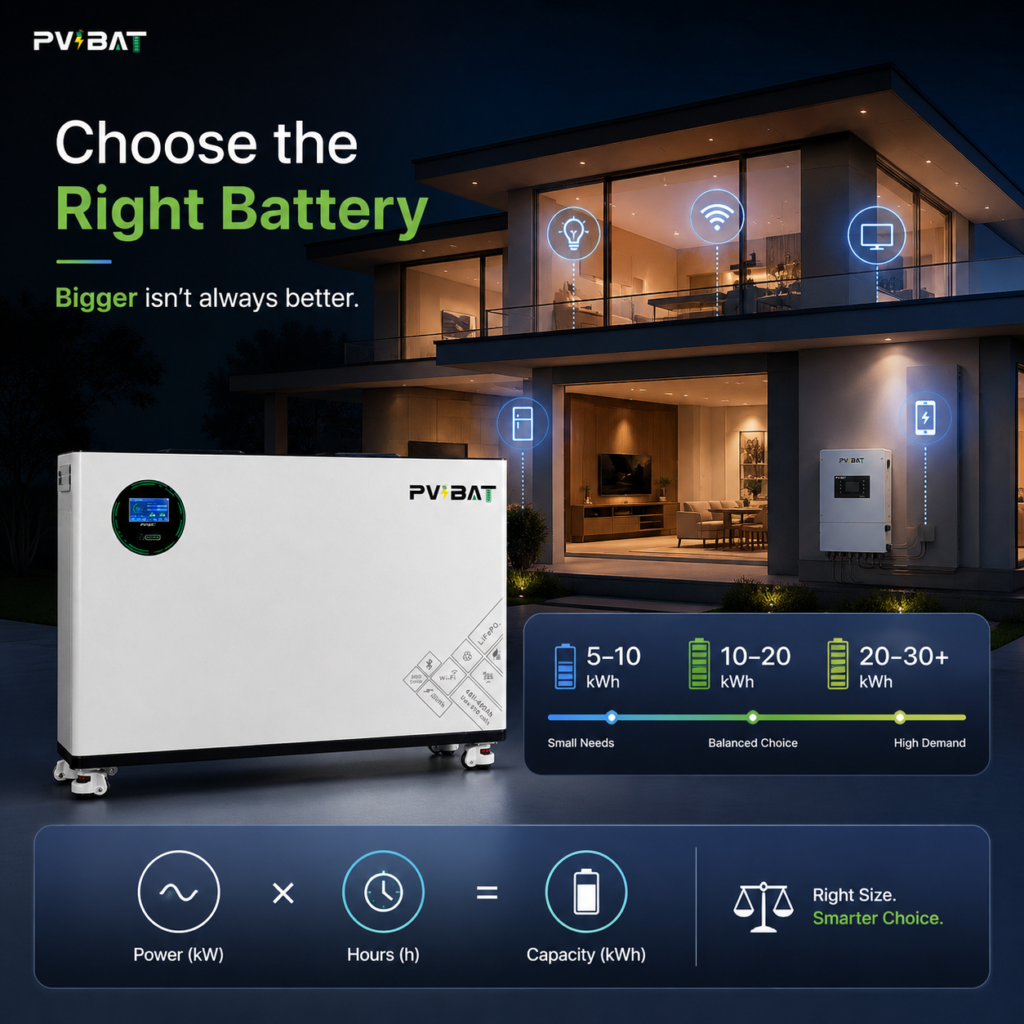
When many people choose a home energy storage battery, their first instinct is: the bigger, the better. But that’s not how it works in reality. There are only three factors that truly determine the capacity you need: the devices you must keep running during a power outage, how long you want to last, the battery’s actual discharge capacity, and inverter efficiency.
A simple, practical formula (easy for anyone to use)
Battery Capacity ≈ Total Power of Critical Devices × Backup Duration ÷ Actual Discharge Efficiency ÷ Inverter Efficiency
Example: You want to power your refrigerator, lights, Wi-Fi, TV, and charge your phone, with a total power of about 1000W (1kW), and you want to last for 12 hours. Theoretical capacity: 1kW × 12h = 12kWh
However, lithium iron phosphate (LiFePO4) batteries have a safety margin, so only 80%–90% of the rated capacity is usable. Factoring in inverter losses, you’ll need to purchase at least 15 kWh to ensure reliability.
How to Choose Based on Household Needs (Pick the Category That Fits)
Basic Backup (5–10 kWh): Refrigerator, lights, Wi-Fi, and phone charging—sufficient for short power outages.
Standard Household (10–20 kWh): Supports most daily appliances; the most common and well-balanced option.
Whole-House Backup (20–30 kWh+): Supports air conditioners, water pumps, and kitchen appliances; suitable for areas with frequent power outages.
Off-Grid / Farm (30 kWh+): For long-term off-grid use with multiple high-power devices; parallel connection of multiple units is recommended.
How to Choose Among PVBAT’s Three Popular Capacities
16.58kWh (FALCON-48G2): Sufficient for average households; suitable for solar energy storage and electricity cost optimization.
20.48kWh (BEAR-48G1): The ideal capacity for most households—long runtime, high load capacity, and moderate price.
32.15kWh (ELEPHANT-48628): The top choice for large homes, farms, small businesses, and off-grid applications; remains stable even under heavy loads.
Quick Summary
Not sure how to choose? Start by listing the equipment you must use during a power outage, calculate the total power consumption and runtime, then select the capacity. Bigger isn’t always better—the most cost-effective approach is to choose a capacity that meets your needs with a little extra margin.