
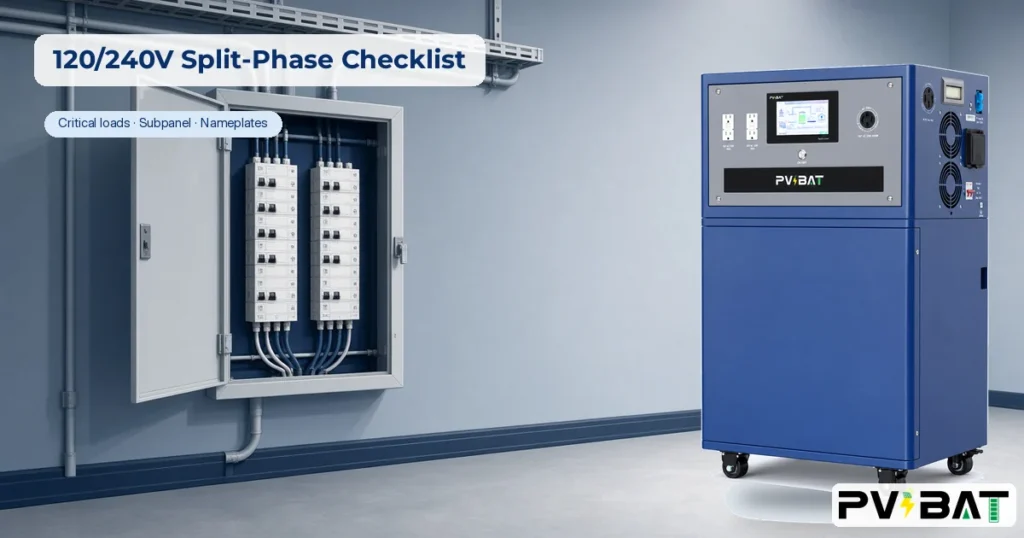
Short answer: Before buying a 120/240V split-phase battery backup, confirm five things: (1) which 240V loads you must run — well pump, dryer, HVAC, shop tools; (2) the startup surge of the largest motor; (3) how the system connects to your panel — critical-loads subpanel, transfer switch or whole-home; (4) the inverter’s continuous and surge ratings at both 120V and 240V; and (5) how you will recharge it during a long outage. If any of these is unclear, get the nameplate data and talk to a licensed electrician before you order.
What “120/240V split-phase” actually means
Most U.S. homes are fed with split-phase power: two 120V legs that together provide 240V. Everyday outlets use one leg (120V). Large appliances — well pumps, electric dryers, ranges, water heaters, many HVAC systems and some shop tools — use both legs (240V).
A battery system with only 120V output can run lights, fridges and outlets, but it cannot directly run a 240V well pump. A split-phase system provides both, which is why it matters for rural homes and farms.
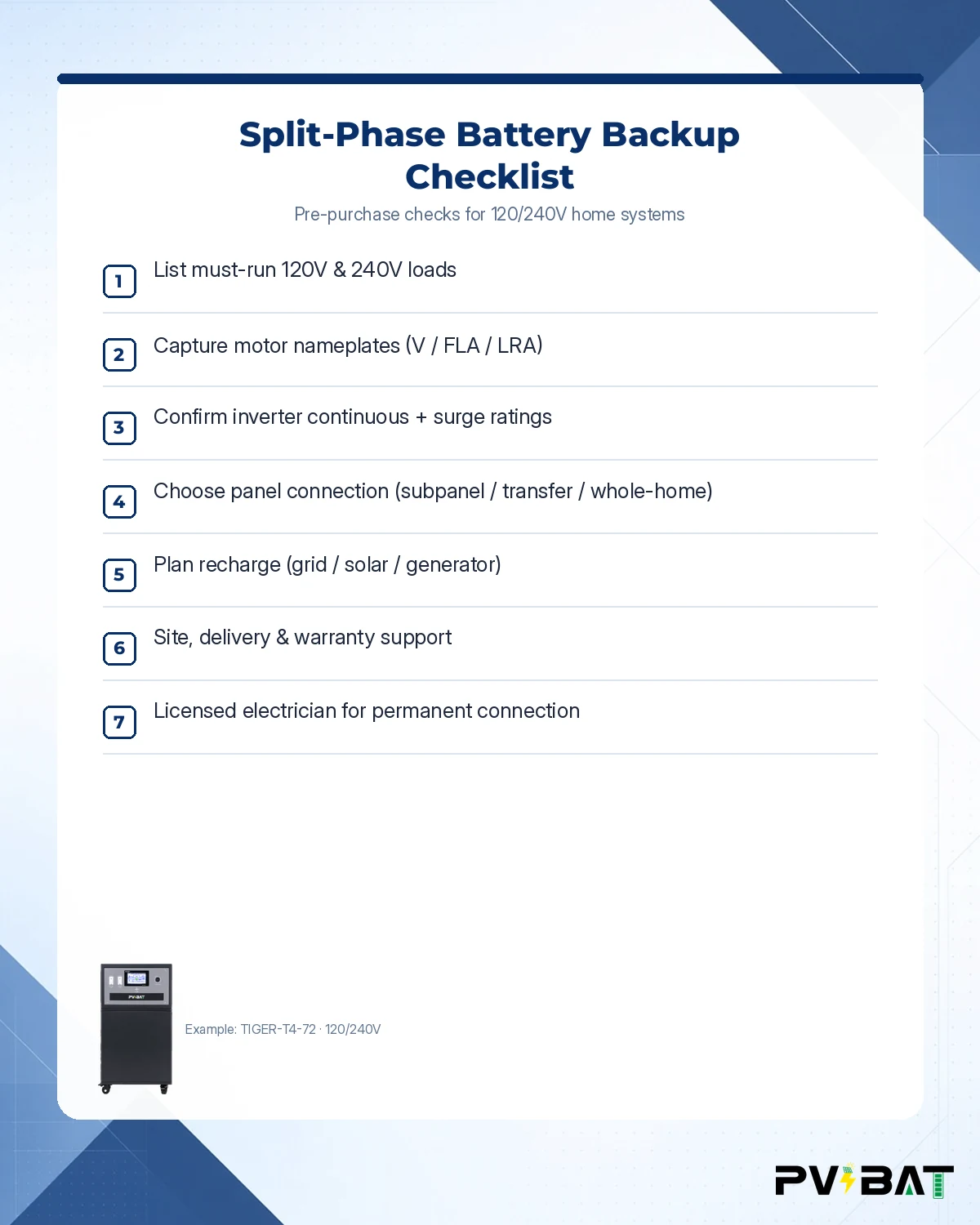
Checklist step 1: list the loads you actually need
Walk through the house and outbuildings and write down what must keep running. Separate them by voltage.
Typical 120V loads
- Refrigerator and freezer
- Lights, Wi-Fi router, phone and laptop charging
- Gas furnace blower, sump pump (often 120V)
- Medical devices
Typical 240V loads
- Submersible or jet well pump
- Central AC or heat pump
- Electric water heater, dryer, range
- Welders, air compressors, larger shop tools
Be selective with 240V resistive loads like water heaters and dryers: they draw a lot of power for a long time and can drain a battery quickly.
Checklist step 2: find the startup surge of your biggest motor
Motors pull a short inrush when they start, often several times their running current. The largest motor — usually the well pump or AC compressor — decides whether a system can carry your home.
- Read the pump or compressor nameplate: voltage, running amps (FLA/RLA), and locked-rotor amps (LRA) if listed.
- Note horsepower and whether it is a 2-wire or 3-wire pump (control box).
- Remember other loads may already be running when the motor starts.
For the math, see well pump startup surge: how to size a battery inverter. For the well-pump scenario in depth, read battery backup for 240V well pumps.
Checklist step 3: check the inverter ratings, not just battery kWh
Battery capacity (kWh) tells you how long you can run. The inverter rating (kW / kVA) tells you how much you can run at once and whether motors will start.
- Continuous output: must exceed your combined running load with some margin.
- Surge / peak output: must cover the largest motor’s start while other loads run.
- Per-leg limits: some split-phase systems limit how much each 120V leg can carry; unbalanced loads can trip them.
- Inverter type: low-frequency (transformer-based) inverters generally tolerate motor inrush better than many compact high-frequency designs.
Ask the seller for these numbers in writing. If a spec sheet lists only battery kWh, ask again.
Checklist step 4: decide how it connects to your panel
This choice affects cost, code compliance and what stays on during an outage.
Critical-loads subpanel
Move only essential circuits (fridge, well pump, lights, furnace) to a subpanel fed by the battery system. Easiest to size and protect.
Transfer switch
A manual or automatic transfer switch selects grid or battery for chosen circuits and prevents backfeeding the utility line.
Whole-home backup
Backs up the full panel. Requires a larger system and load management so big appliances do not all start at once.
Any panel or permanent-circuit connection should be done by a licensed electrician, with permits where required. Never backfeed a panel through an outlet.
Checklist step 5: plan how you will recharge
- Grid: recharges between outages — fine for short events.
- Solar: extends runtime during multi-day outages; check the system’s PV input limits.
- Generator: a compatible generator can top up the battery a few hours a day. Confirm the charging input supports your generator.
Not planning solar yet? See home battery backup without solar.
Checklist step 6: site, delivery and support
- Where will the unit sit? Shade, ventilation, temperature range, and clearance for service.
- Delivery access: driveway, liftgate, floor load for heavy cabinets.
- Communication and monitoring: app or BMS visibility of state of charge.
- Warranty terms and U.S.-based support or warehouse pickup.
For farms and shops, our farm & workshop backup power checklist covers outbuilding loads.
Printable pre-purchase checklist
- List of must-run 120V and 240V loads with running watts
- Nameplate photos of well pump, AC and largest tools (voltage, FLA, LRA, HP)
- Inverter continuous kW, surge rating and per-leg limits — in writing
- Battery usable kWh and target backup hours
- Connection method chosen with your electrician (subpanel, transfer switch, whole-home)
- Recharge plan: grid, solar, generator
- Install location, delivery access, warranty and support contact
Where PVBAT TIGER fits
The PVBAT TIGER-T4-72 provides 120/240V split-phase output from a 16.5 kVA low-frequency transformer inverter (13 kW continuous) with 24 kWh of LiFePO4 storage, solar and grid charging, and pickup or shipping from our California warehouse. It is built for homes and farms with loads such as well pumps, refrigerators and compressors — subject to each load’s rated power and startup surge. Comparing formats? Read all-in-one 24 kWh ESS vs modular wall batteries.
Send us your checklist for a free load review
Frequently asked questions
Do I need split-phase 120/240V battery backup?
You need it if you want to back up any 240V load, such as a well pump, central AC, or shop tools. If you only need 120V outlets and lights, a 120V system may be enough.
Can a 120V-only battery run a 240V well pump?
Not directly. A 240V pump needs a 240V source; use a split-phase system or a properly rated solution specified by an electrician.
What matters more: battery kWh or inverter kW?
Both. Inverter kW and surge rating decide what can run and start at once; battery kWh decides how long it runs.
What information should I give a seller before buying?
Your must-run loads, nameplate data for the largest motors, desired backup hours, how it will connect to your panel, your recharge plan and your ZIP code.
Can I plug a battery system into a dryer outlet to power my house?
No. Backfeeding through an outlet is dangerous and usually illegal. Use a transfer switch or subpanel installed by a licensed electrician.
Will a split-phase battery run my central AC?
Possibly, if the inverter’s continuous and surge ratings cover the compressor’s running and locked-rotor amps. Check the nameplate and consider a soft starter with your HVAC technician.