
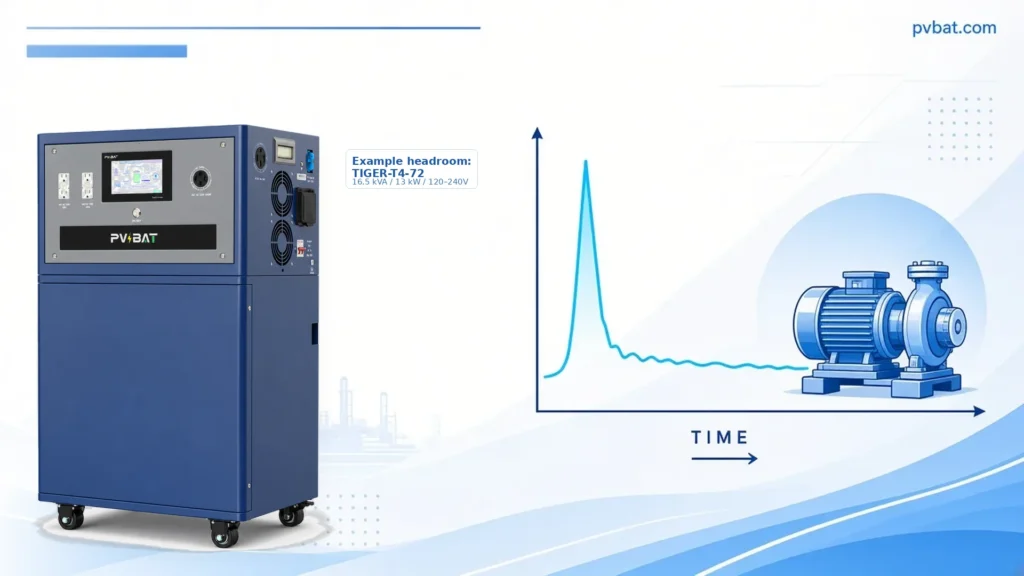
Running watts are not enough to judge well-pump battery backup. Induction motors draw a short startup surge far above their running load—often discussed as LRA (locked-rotor amps) on a nameplate. Your inverter must clear that surge and the continuous kW / kVA while other loads share the system; battery kWh mainly sets how long the pump can cycle. Photograph voltage, HP or FLA, LRA (if listed), Hz, and phase before anyone promises a match. Soft-start devices and a healthy pressure tank can reduce harsh starts in some designs, but they are not magic. A high-output split-phase class such as TIGER-T4-72 (16.5 kVA · 13 kW continuous · 120/240V) is only a headroom example—still case-by-case. Do not DIY backfeed a panel. Use a licensed electrician for building ties. PVBAT provides guidance and California warehouse coordination—not installation.
Running watts vs startup surge (plain language)
Think of three moments:
- Start — brief high demand (surge / LRA territory)
- Run — lower continuous demand while water is moving
- Idle between cycles — pump off; other house loads may still draw
A brochure that only quotes “running watts” can look fine and still fail at step 1.
kWh answers a different question: after successful starts, how long can you keep cycling the pump and run fridge, lights, and Wi-Fi?
For the broader well-pump story, read Battery Backup for 240V Well Pumps and 240V Well Pump Battery Backup.
What to photograph on the nameplate
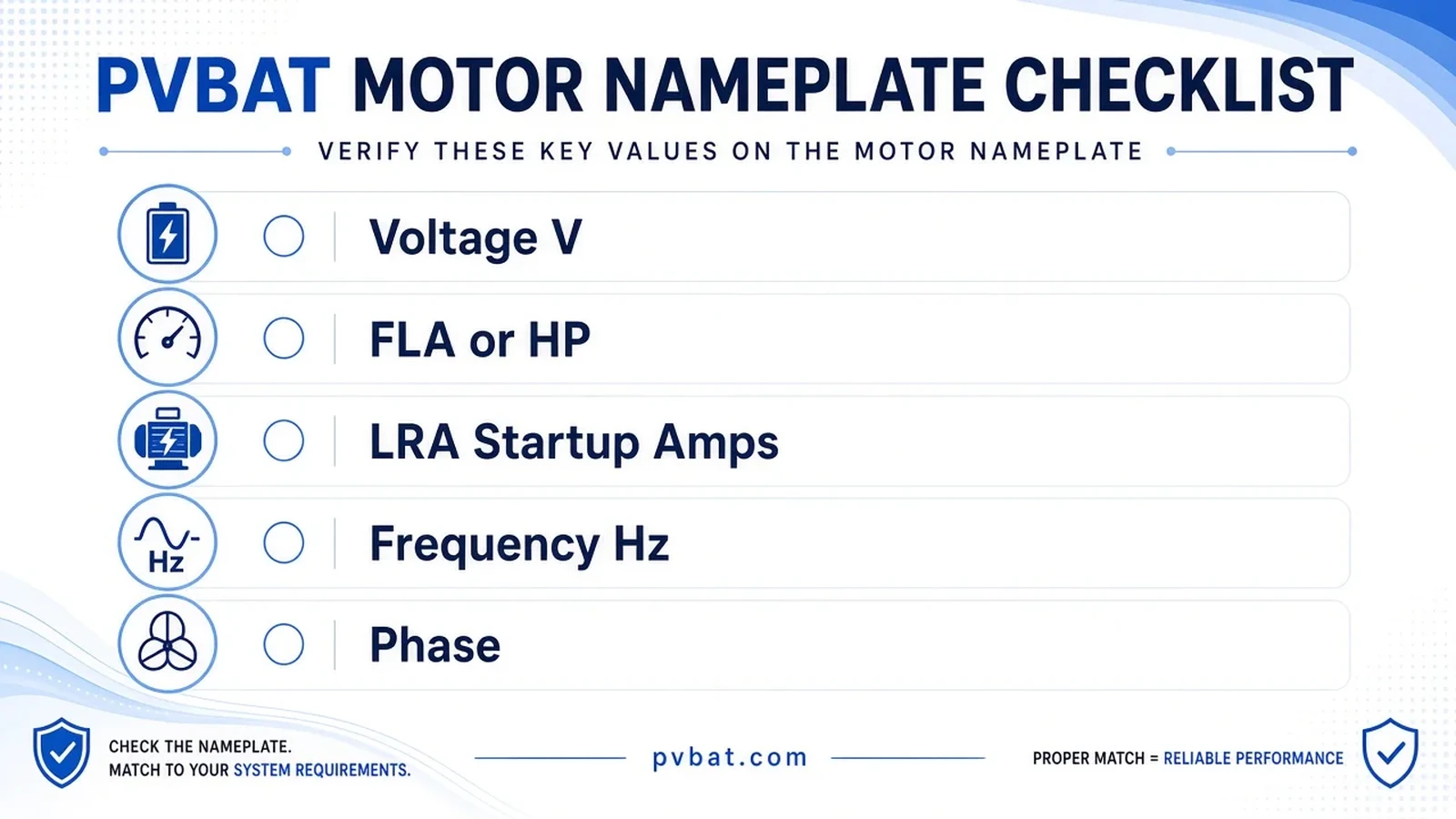
Before sizing talk, capture clear photos of:
| Field | Why it matters |
|---|---|
| Voltage | Many U.S. residential well pumps need 240V / split-phase capable backup |
| Phase | Single-phase vs other—must match the inverter architecture |
| HP or FLA | Helps estimate continuous running demand |
| LRA (if listed) | Best common clue for startup surge |
| Hz | Usually 60 Hz in the U.S.—confirm |
| Breaker / disconnect labels | Extra context for the electrician |
If LRA is missing, do not invent a universal table from the internet and call it your pump. Ask the manufacturer, a pump contractor, or your electrician for a defensible approach.
Illustrative sizing logic (ranges, not fake brands)
Use this as a conversation framework, not a calculator that replaces a professional review:
- Confirm voltage class (120V-only stations usually fail here for 240V pumps).
- Estimate continuous demand from FLA/HP and add the other loads you will run at the same time.
- Check whether the inverter’s surge / peak behavior can absorb the start event with margin.
- Choose kWh for outage length and water-use behavior (showers, livestock, irrigation raise cycle counts).
- Re-check after adding soft-start or pressure-tank improvements—those change the system, not only the battery brochure.
Example headroom class (not a HP guarantee): an all-in-one such as TIGER-T4-72 publishes 16.5 kVA inverter rating with 13 kW continuous active output and 120/240V split-phase. That class is often discussed for demanding rural backup candidates—it still requires nameplate review for your pump and simultaneous loads.
Why 120V portable stations usually fail this job
Most compact stations:
- Output 120V only
- Advertise peak watts that still may not clear a 240V motor start
- Lack a clear path to code-compliant building connection
They can still be useful for lights and phones. They are usually the wrong tool for a residential 240V well pump.
Soft start and pressure tank tips (educational)
- Pressure tank: A healthy, adequately sized tank stores pressurized water and can reduce how often the pump starts—fewer surge events for the inverter.
- Soft-start / soft-stop devices: In some professional designs, these reduce starting severity. They must be specified for the motor and installed correctly—this is not a casual add-on tip for untrained wiring.
- Short-cycling today: Fix plumbing/tank/pressure-switch issues as part of resilience. Backup power does not heal a failing tank.
Where a TIGER-class spec fits in the decision tree
Ask, in order:
- Do I need 120/240V?
- Do continuous + surge limits clear the nameplate with margin while other essentials share the inverter?
- Is 24 kWh enough for my water-use and outage-length goals?
- Is the connection method plug-compatible review vs transfer equipment designed by an electrician?
If those answers point to an integrated high-output ESS, TIGER-class specs become relevant. If you already standardized on a hybrid inverter ecosystem, a modular battery path may fit better—see All-in-One vs Modular.
Hand-off: what to send for a guided review
- Nameplate photos
- Approximate water use during outages
- Other must-run loads (fridge, medical, shop)
- Preferred connection style (and who your electrician is)
PVBAT can help with product guidance and California warehouse logistics questions. We do not install or energize building-tied systems.
Quick FAQ
What is LRA on a well pump?
LRA means locked-rotor amps—the high current a motor can draw at startup when the rotor has not yet begun turning normally. It is a key clue for surge demand. If LRA is not printed, ask the pump maker or a qualified electrician for guidance; do not invent a number.
Can soft start reduce the battery inverter size needed?
Sometimes soft-start devices or a healthier pressure tank that reduces short-cycling can lower how often and how harshly the inverter sees surge events. They do not remove the need to check voltage, continuous power, and a realistic surge margin. Treat soft start as a design option reviewed by a professional—not a DIY guarantee.
Is kWh or kVA more important for pump start?
For the start event itself, inverter power (kW / kVA and surge capability) matters more than kWh. kWh decides how long the pump can keep cycling after it starts, especially alongside other essential loads.
What happens if surge exceeds inverter rating?
The inverter may overload, fold back, trip, or shut down—leaving the pump unstarted and sometimes dropping other backed-up loads. That is why nameplate review beats brochure optimism.
Do I still need an electrician for well pump backup?
Yes for any building-tied panel, transfer switch, or utility-related connection. Even plug-in paths need voltage, connector, and surge checks. PVBAT provides guidance, not installation.
Next step
- Photograph the nameplate.
- Read the overview: 240V well pump battery backup blog.
- Compare power first, then capacity—see 24 kWh runtime examples.
- Scenario: Well pump battery backup
- Product example: TIGER-T4-72
Contact: pvbat.com · +1 (626) 341-8963 · City of Industry, CA · service@pvbat.com
U.S. support & installation guidance. Ask about California warehouse coordination for current stock and logistics.