
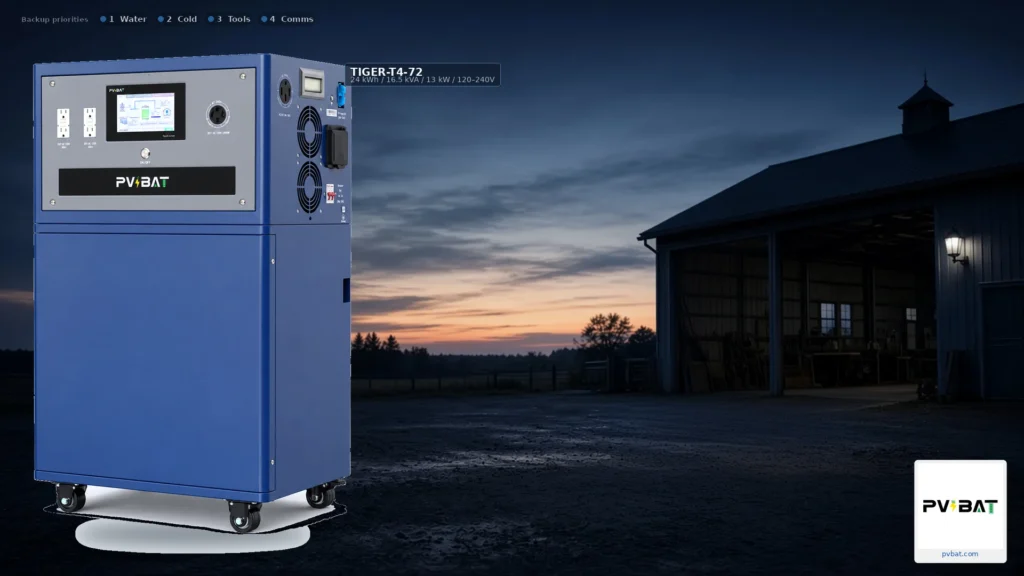
Farms and workshops usually fail first on water, cold chain, and tools—not on decorative lighting. Before you shop battery kWh, map 120V vs 240V, continuous vs surge, and must-run vs deferrable loads. Size power for compressors, welders, and pumps; size energy for the hours or days you must cover. A quiet battery handles many short events; a generator can remain the long-duration charger. Mobile all-in-one systems (TIGER class) and fixed modular cabinets solve different site problems—see architecture notes below and All-in-One vs Modular. PVBAT provides equipment, U.S. support, installation guidance, and California warehouse coordination—not installation. Building ties need a licensed electrician.
Priority load tiers (start here)
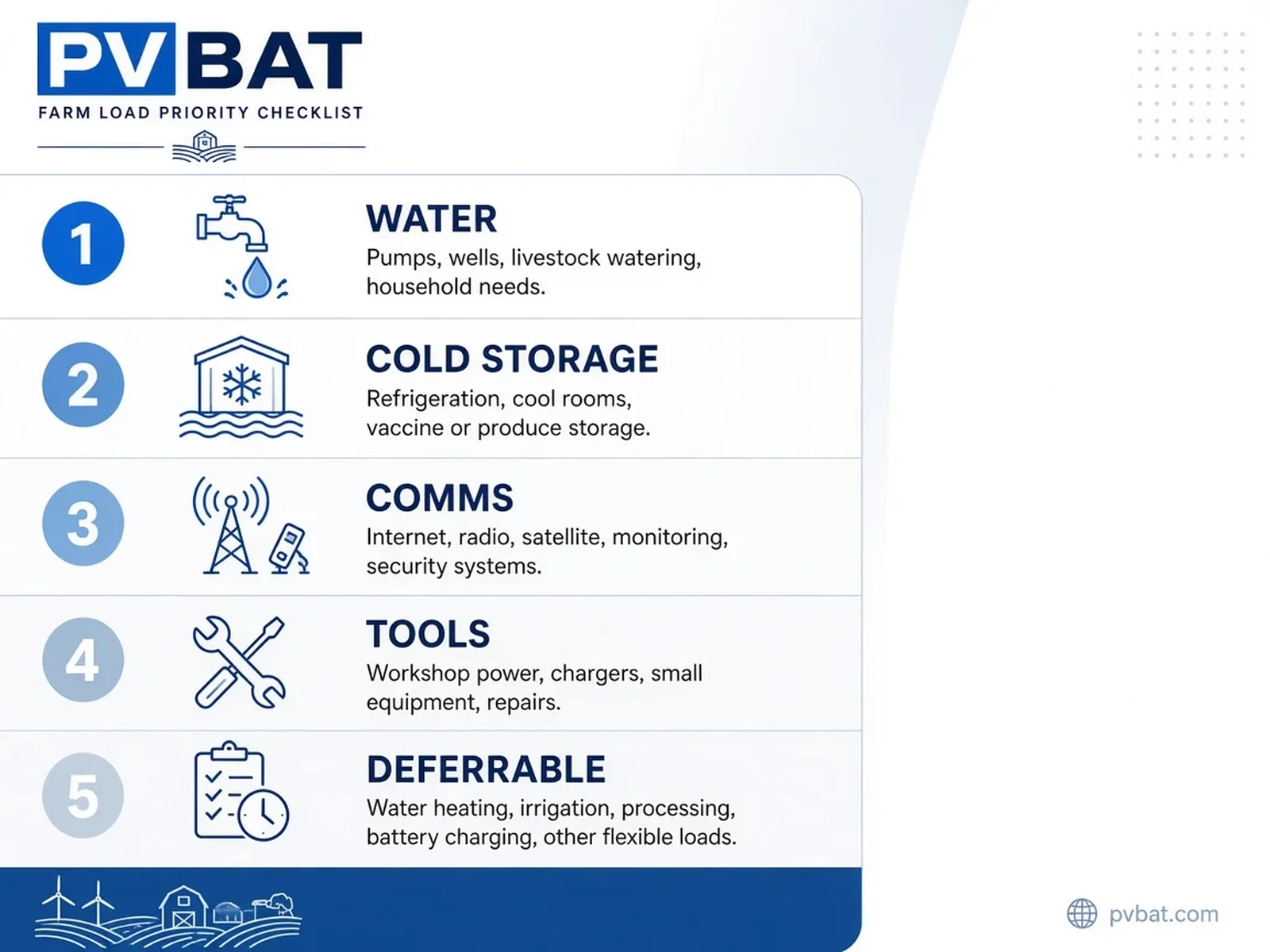
| Priority | Examples | Why first |
|---|---|---|
| 1 — Water | Livestock water, domestic well, critical irrigation controllers | Animals and household health |
| 2 — Cold storage | Walk-in / freezer / milk or produce coolers, controllers | Spoilage risk compounds hourly |
| 3 — Communications & safety | Modem, phones, selected lights, gate/security if critical | Coordination during outages |
| 4 — Selected shop tools | Needed repairs, feed equipment, limited 240V tools | Keep operations from cascading failures |
| 5 — Deferrable | Welders for non-urgent jobs, large compressors, convenience loads | Bring online only with spare headroom |
Scenario overview: Farm Workshop Backup Power.
Water: wells, livestock, irrigation
If the property uses a private well, treat it as a 240V + surge problem first. Read Battery Backup for 240V Well Pumps and Well Pump Startup Surge & Inverter Sizing (publish N1, then this relative link is live).
Checklist prompts:
- ☐ Pump voltage / HP or FLA / LRA photographed
- ☐ Pressure tank condition known
- ☐ Livestock water vs domestic priority documented
- ☐ Irrigation: which zones are truly critical vs deferrable
Do not claim a battery will run an entire pivot or large agricultural pumping plant without a dedicated engineering review.
Cold storage and controllers
Freezers and coolers are often cycling loads—good candidates for battery coverage—but door openings, ambient heat, and simultaneous compressor starts matter.
Checklist prompts:
- ☐ Which coolers must stay cold for 24 / 48 / 72 hours?
- ☐ Controllers and alarms on the backup list?
- ☐ Can noncritical circuits be shed automatically or manually?
For rough household-scale energy math, see What Can a 24kWh Battery Backup Run?—farm coolers may draw more; treat tables as orientation only.
Shop tools and 240V gotchas
Workshops frequently hide the hard loads: air compressors, welders, plasma cutters, dust collectors, and large motors.
Checklist prompts:
- ☐ List every tool you might use in an outage (honest list beats wish list)
- ☐ Mark 120V vs 240V
- ☐ Note startup behavior (compressors)
- ☐ Decide which tools are repair-critical vs wait-until-grid
A 120V-only portable station rarely carries a serious shop plan.
Fuel vs battery vs hybrid
| Mode | Best for | Notes |
|---|---|---|
| Battery ESS | Quiet short–medium coverage of prioritized loads | Finite without recharge path |
| Diesel / PTO / standby generator | Multi-day energy when fuel exists | Noise, maintenance, placement, transfer design |
| Hybrid idea | Battery daily resilience + generator as charger | Electrician-designed interlocks required |
Battery-only first steps: Home Battery Backup Without Solar.
Site practicalities
- Placement: weather, ventilation, theft risk, forklift/tractor clearance
- Mobility: wheeled all-in-one helps multi-building tasking after connector checks—not a free pass to skip transfer equipment for building feeds
- Monitoring: who gets the low-battery alert at 2 a.m.?
- Spare connectors / labeled cords: reduce chaos during real outages
- Training: one page for family/staff on what is allowed on backup
One-page printable checklist
- ☐ Priority tier list agreed (water → cold → comms → tools → defer)
- ☐ Nameplates photographed for pumps and big motors
- ☐ 120V vs 240V map drafted
- ☐ Continuous vs surge notes for top 5 loads
- ☐ Outage duration goal (overnight / 24h / multi-day)
- ☐ Recharge path chosen (grid only / solar later / generator charger)
- ☐ Electrician identified for any panel or transfer work
- ☐ Storage placement and weather plan
- ☐ Product architecture choice: all-in-one vs modular + inverter
When TIGER-class vs cabinet + inverter
- All-in-one (example TIGER-T4-72): 24 kWh · 16.5 kVA · 13 kW continuous · 120/240V — candidate when you want integrated output and serious capacity for prioritized farm/workshop loads after review.
- Modular cabinet + hybrid inverter: better when you already standardized on a fixed inverter ecosystem or need stacked wall/cabinet energy with a designed install.
Deep comparison: All-in-One vs Modular. Rural homes: Rural Home Off-Grid Backup Power.
Quick FAQ
What should I back up first on a farm during an outage?
Usually water (livestock, domestic well, critical irrigation controllers), then cold storage and controllers, then communications, then selected shop tools. Defer welders, large compressors, and convenience loads until essentials are stable.
Do farm shops need 240V battery output?
Often yes for compressors, larger tools, and some pumps. Confirm each nameplate. A 120V-only station is rarely enough for a serious workshop plan.
Is a mobile battery useful for multiple buildings?
A wheeled all-in-one can help when you must move backup between a shop, barn, or temporary task—after voltage and connector checks. Building-tied panels still need electrician-designed transfer methods; mobility is not a substitute for code-compliant switching.
Can I combine a battery with an existing PTO or diesel generator?
Many farms already have generators. A common resilience idea is battery for quiet short coverage and generator as a longer-duration charging source. The charging and transfer design must be reviewed by a qualified electrician—do not improvise interlocks.
Next step
Complete the one-page checklist, then match power first, energy second.
- Scenario: Farm workshop backup power
- Product example: TIGER-T4-72
- Related: Buying guide · 24 kWh runtime
Contact: pvbat.com · +1 (626) 341-8963 · City of Industry, CA · service@pvbat.com
U.S. support & installation guidance. Ask about California warehouse coordination for current stock and logistics.