
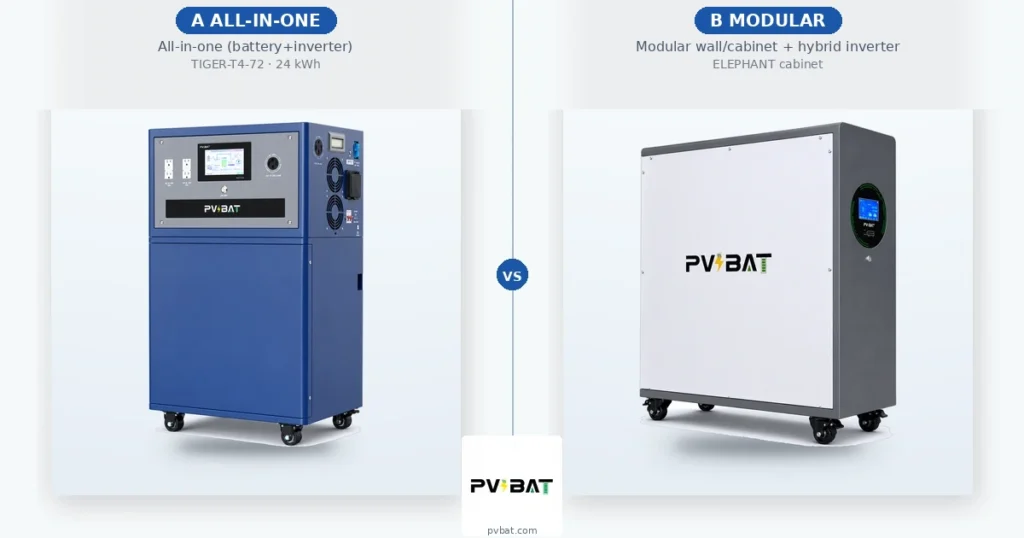
Home backup shopping often confuses two architectures. An all-in-one ESS packages battery, inverter, and outlets together—useful when you want integrated 120/240V output and mobility after a load review. Modular wall or cabinet batteries usually store energy only and need a separate hybrid inverter for AC. Neither is universally “better.” Match the architecture to your install path, loads, and expansion plans. The PVBAT TIGER-T4-72 is an all-in-one example: 24 kWh LiFePO4 · 16.5 kVA · 13 kW continuous · 120/240V—a wheeled serious backup class, not a suitcase camping station. Panel, transfer, solar, and utility work still belong to a licensed electrician. PVBAT provides guidance and California warehouse coordination—not installation.
Two architectures (block view)
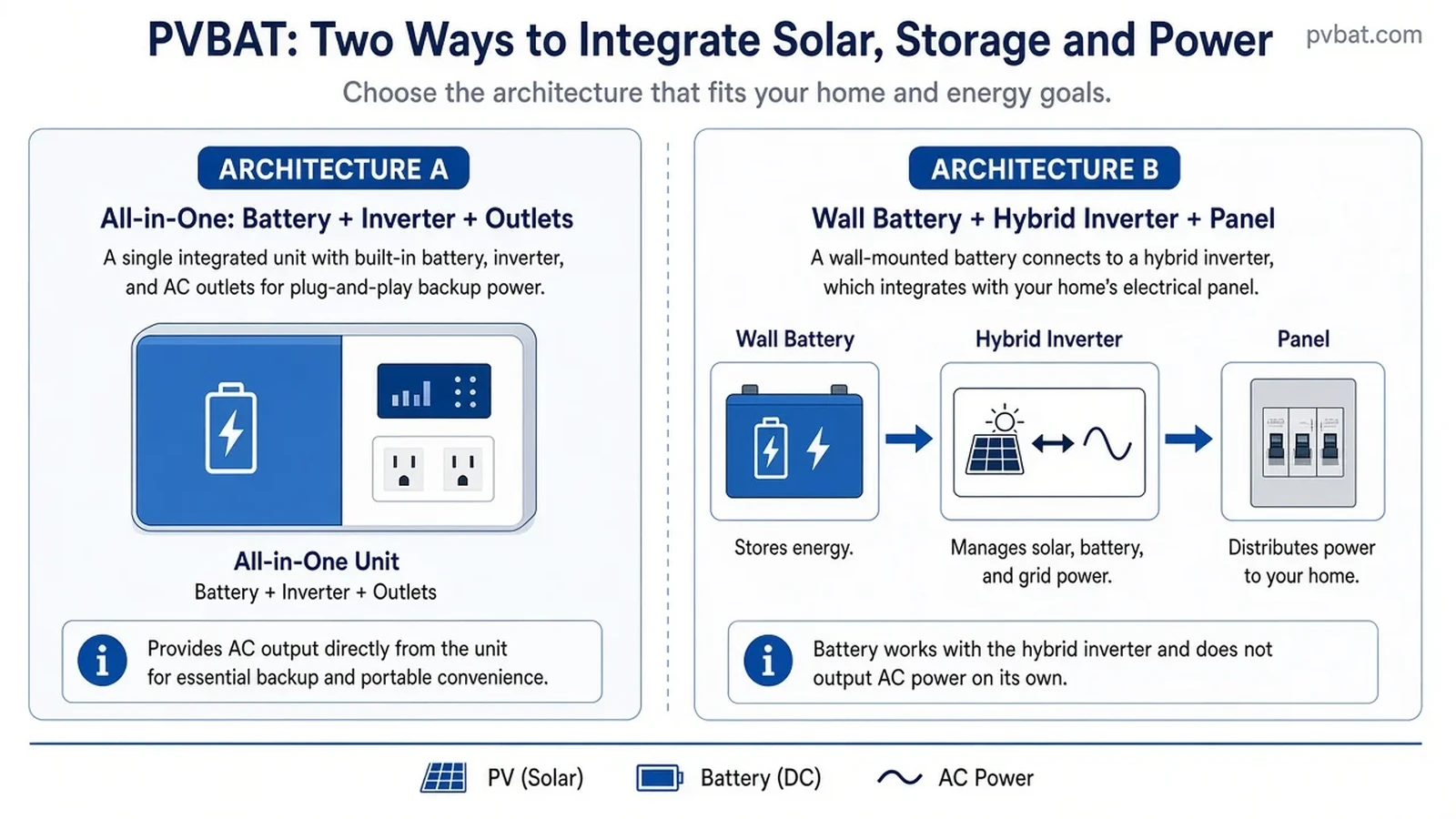
| A — All-in-one ESS | B — Modular wall / cabinet battery | |
|---|---|---|
| What you buy | Battery + inverter (+ outlets) in one package | Battery modules/cabinet (energy) |
| AC creation | Built-in inverter | Needs compatible hybrid inverter |
| Typical vibe | Faster path to usable backup for reviewed loads; mobility options | Fixed install; ecosystem stacking |
| Expansion | Package-dependent | Often stack per inverter/BMS rules |
| Common fit | Shops, rural staging, well-pump candidates, battery-first sites | Homes already on a hybrid inverter plan |
Comparison table (decision factors)
| Factor | All-in-one (TIGER class) | Modular wall/cabinet |
|---|---|---|
| Capacity example | 24 kWh packaged | Varies by module count (e.g. cabinet classes on site) |
| Inverter | Integrated (16.5 kVA / 13 kW continuous on TIGER-T4-72) | Separate purchase / existing hybrid |
| Outlets / direct loads | Often included—still verify ratings | Via inverter / panel design |
| Mobility | Wheeled / relocatable designs exist | Usually fixed |
| Install path | Review plug-compatible loads; electrician for building ties | Almost always designed electrical install |
| Best when | You want integrated split-phase backup class without assembling a stack first | You want fixed solar-hybrid architecture or brand ecosystem |
When all-in-one wins
- You need a clear 120/240V backup story for rural, shop, or staged sites
- You want fewer “battery sold separately from inverter” surprises
- Mobility between buildings or tasks matters after connector checks
- Battery-first / without solar yet is the plan (without solar guide)
- Well-pump or workshop candidates after nameplate review (well pump blog · farm checklist)
When modular wins
- You already selected a hybrid inverter ecosystem
- The project is a fixed residence with designed critical-loads or gateway equipment
- You prefer stacking cabinet/wall energy over a mobile package
- SKUs like wall-mount or cabinet batteries on pvbat.com are explicitly battery storage—plan the inverter separately (for example ELEPHANT-class cabinets: not plug-and-play AC by themselves)
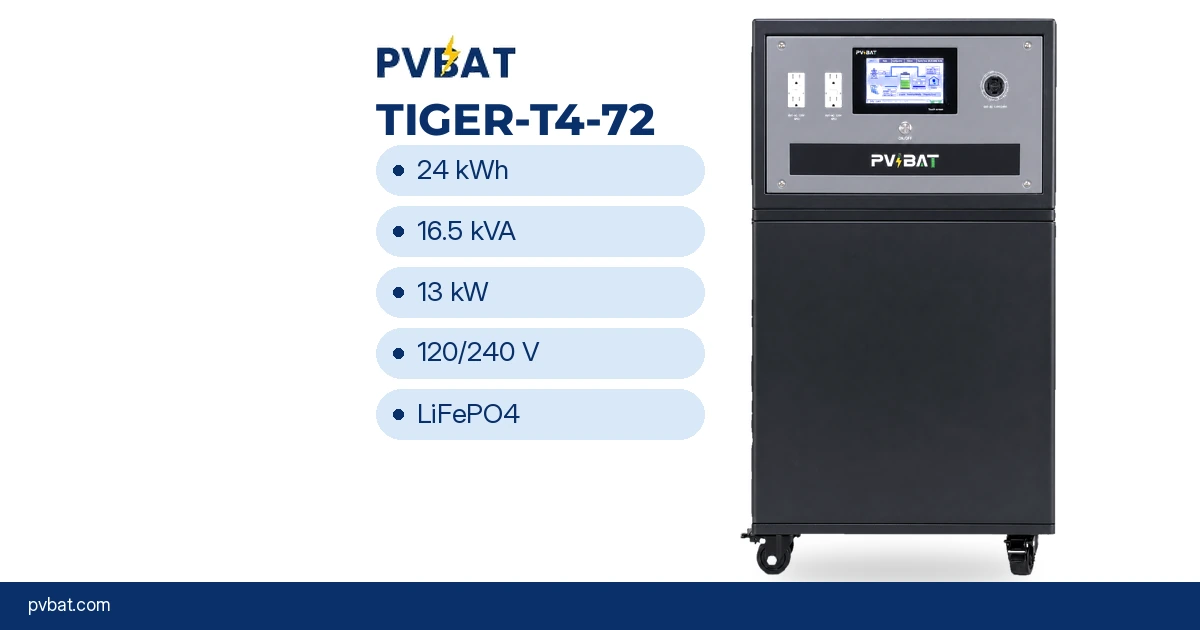
Spec card: TIGER-T4-72 locked facts
| Spec | Value |
|---|---|
| Model | TIGER-T4-72 |
| Energy | 24 kWh LiFePO4 |
| Inverter rating | 16.5 kVA |
| Continuous active power | 13 kW |
| Output | 120/240V split-phase |
| Form | All-in-one mobile ESS (wheeled class) |
Product page: TIGER-T4-72.
These facts describe the packaged class. They do not guarantee every well pump HP, every central AC, or “whole-home automatic forever.”
Myths to skip
- “Portable” ≠ suitcase. A 24 kWh all-in-one is serious equipment.
- kWh ≠ whole-home automatic. Power limits and load management still rule—see 24 kWh runtime and the buying guide.
- Wall battery ≠ AC outlet magic. Modular packs need the inverter path.
- Guidance ≠ installation. Electricians handle code-compliant ties.
Simple decision flow
- Do you already own / require a specific hybrid inverter ecosystem? → lean modular.
- Do you need an integrated split-phase backup package with mobility? → lean all-in-one.
- List 240V and motor loads → do nameplate / surge homework (N1 surge article).
- Confirm who does electrical work and where the unit lives.
- Ask PVBAT about California warehouse stock/logistics if U.S. fulfillment timing matters.
Soft CTA
If an all-in-one class matches your checklist, start with the TIGER-T4-72 product page and bring your load list. If modular fits better, browse cabinet/wall storage on pvbat.com and plan the inverter with your electrician.
Scenario pages: Well pump · Farm workshop · Rural off-grid.
Contact: pvbat.com · +1 (626) 341-8963 · City of Industry, CA · service@pvbat.com
U.S. support & installation guidance. Ask about California warehouse coordination for current stock and logistics.
Quick FAQ
What is an all-in-one ESS vs a wall battery?
An all-in-one ESS typically integrates battery storage, inverter, and user outlets in one mobile or packaged unit. A modular wall or cabinet battery usually stores energy only and needs a separate compatible hybrid inverter to make AC power for a home or shop.
Does TIGER replace a hybrid inverter?
For compatible direct loads and reviewed use cases, an all-in-one like TIGER includes its own inverter and split-phase output—so you are not shopping a separate hybrid inverter for that package. It does not automatically replace every site’s existing solar hybrid architecture; designs differ.
When should I choose modular wall batteries instead?
Choose modular when you want a fixed install, already standardized on a hybrid inverter brand/ecosystem, or prefer stacking cabinet/wall energy with a designed electrical plan. Modular packs are not automatically “plug into dryer outlet” AC systems by themselves.
Can I expand capacity later?
It depends on the architecture. Modular systems are often designed around stacking rules set by the inverter and BMS. All-in-one units may expand differently—or not at all beyond the packaged capacity. Confirm expansion rules before purchase.
Do I still need an electrician?
Yes for panel, transfer, utility, solar, or generator ties. Even outlet-based use needs voltage, surge, and connector checks. PVBAT provides guidance, not installation.