
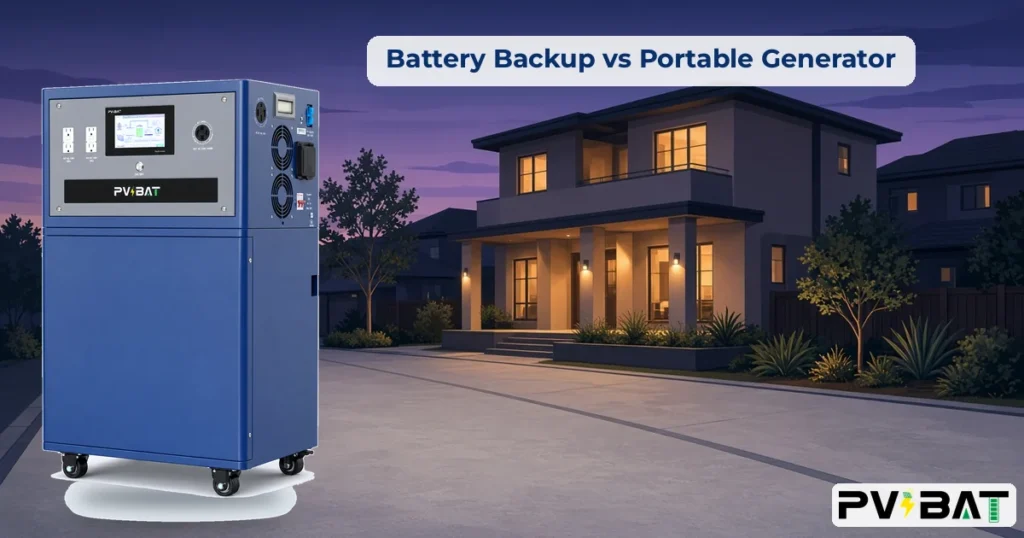
For most U.S. homes, a battery backup is the better first line of defense for short and medium outages: it is quiet, needs no fuel runs, has no exhaust, and can be ready when power drops. A portable generator still wins on raw refuel-and-keep-going endurance during multi-day outages.
Many rural homes and farms get the best of both by pairing a battery with a generator that recharges it, so the generator runs a few hours a day instead of all night. Start with the PVBAT solar battery calculator to size backup hours and see the two home paths we recommend. Current pricing is on the product pages. Permanent panel or transfer-switch work belongs with a licensed electrician. Do not backfeed the utility grid.
Battery backup vs portable generator: the quick comparison
| Factor | Home battery backup | Portable generator |
|---|---|---|
| Noise | Near silent (cooling fans only) | Loud enough to matter to neighbors and sleep |
| Fuel | None during the outage; recharges from grid, solar, or a compatible generator | Gasoline, propane, or dual fuel; must be stored and refilled |
| Exhaust / CO risk | No combustion | Must run outdoors, away from windows and doors |
| Startup surge (motors) | Depends on inverter design and rating | Depends on alternator size; small units often bog down |
| Long outages | Limited by stored kWh unless recharged | Runs as long as you can refuel |
| Maintenance | Low: keep charged, check firmware and connections | Oil changes, carburetor care, stale fuel, test runs |
| Upfront cost | Higher | Lower |
Operating cost: how to estimate your own numbers
The sticker price often favors the generator. The running cost usually does not.
A portable generator burns fuel whenever it runs, even when your house is only drawing a few hundred watts overnight. Most small generators are least efficient at light load, so the hours when you need the least power are often the most expensive per kilowatt-hour you actually use.
A battery only gives back what you put in. Recharging from the grid costs your normal utility rate; recharging from solar has no per-kWh fuel cost once the array is in place. There are no fuel runs during a storm, no stale gas in the spring, and fewer moving parts to service.
A simple way to estimate your own numbers
- Check your generator’s published fuel use at 25% and 50% load in its manual.
- Multiply by your local fuel price and the hours you expect to run it per outage.
- Compare that with the kWh you actually need—at your utility rate—using the planning calculator and the runtime examples in what a 24 kWh battery backup can run.
We do not publish a single savings number, because fuel prices, load profiles, and outage lengths vary from home to home. Use your manual and your local fuel and utility rates.
Startup surge: the part most buyers underestimate
Well pumps, refrigerators, freezers, sump pumps, air compressors, and shop tools pull a brief inrush current when their motors start—often several times their running watts. Whatever powers them must ride through that spike.
A small inverter generator may trip or stall on a 240V well pump even if its running watts look sufficient. On a battery system, the inverter—not the stored kWh—decides whether a motor starts. Low-frequency, transformer-based inverters are generally better suited to motor-starting and high-inrush loads than many compact high-frequency units.
Before you buy either, get the motor’s nameplate data: voltage, running current, and locked-rotor amps (LRA) if listed. A licensed electrician should confirm those figures against the inverter or generator you plan to use. Read battery backup for 240V well pumps and, for the surge math, well pump startup surge and inverter sizing.
Quiet, safe, automatic: why batteries fit everyday outages
Most U.S. outages last hours, not weeks. For those events, a battery has practical advantages:
- No one has to go outside in a storm to start, fuel, or move a generator.
- There is no carbon-monoxide exposure from a unit placed too close to the house.
- It is quiet enough to run overnight in neighborhoods with noise rules.
- With a properly installed transfer setup, backed-up circuits can stay powered without manual cord swaps.
Generators remain a solid tool. For the “lights out at 9 p.m., back at 3 a.m.” outage, a battery is simply easier to live with. Whole-home coverage is not automatic; it depends on the loads you connect and how the system is designed.
When you still need a generator, and the hybrid approach
Be honest about your outage history. A generator still makes sense if:
- You regularly lose power for several days (wildfire shutoffs, ice storms, hurricane zones).
- You have no solar and cannot count on the grid to recharge the battery.
- You run large loads continuously (heat, irrigation, livestock ventilation) that would drain any reasonable battery bank.
The hybrid approach: generator charges, battery runs selected loads
Instead of running a generator around the clock, run it a few hours to recharge the battery, then shut it off and let the battery carry selected loads quietly. This cuts runtime hours, fuel, and noise, and it lets the generator operate at a more efficient load while it charges. This is a charging plan, not a combo SKU or a bundled kit.
If you plan this, a licensed electrician should design the connection. Confirm that the battery system’s charging input supports your generator’s voltage, output, and power quality before you rely on it.
How long can a battery run selected loads?
Take a 24 kWh battery system. Allowing for usable depth of discharge (80%) and conversion efficiency of 96% or higher: 24 × 0.80 × 0.96 ≈ 18.4 kWh usable for planning.
- At a constant 1,000 W combined load: about 18 hours
- At a constant 2,000 W combined load: about 9.2 hours
These are calculation examples, not runtime guarantees. Real runtime depends on how often appliances cycle, startup surges, battery temperature, and state of charge. For realistic home load examples, see what a 24 kWh battery backup can run. To size hours from your bill and the loads you want to keep on, use the planning calculator. How to use the PVBAT solar battery calculator walks through the estimate.
Which should you buy? A decision checklist
- Outage length: Mostly under a day → start with a battery. Multi-day, with no solar → a battery plus a generator charger, or a generator alone if budget is tight.
- Motor loads: A 240V well pump or compressor → have a licensed electrician confirm voltage, running current, and locked-rotor / startup demand against the inverter or generator.
- Voltage: Do you need 120/240V split-phase, or are 120V circuits enough? Keep the split-phase buyer checklist handy.
- Who will operate it: If no one can safely refuel and start a generator, lean battery.
- Recharging plan: Grid, solar, generator—or a mix.
- Installation: Any panel or permanent-circuit connection should be done by a licensed electrician with a proper transfer method. Do not backfeed the utility grid.
Not sure whether you need solar at all? Read home battery backup without solar. For how we recommend choosing capacity and a backup tier, see the home battery backup buying guide. Comparing system formats? See all-in-one home battery vs cabinet + inverter.
The two home paths we recommend
We recommend starting with the planning calculator, then choosing one of these two home-backup paths:
- The TIGER T4-72 all-in-one home backup we recommend: 24 kWh LiFePO4 storage, a 16.5 kVA inverter with 13 kW continuous active output, and 120/240V split-phase. Usable energy for planning is about 18.4 kWh (80% depth of discharge and conversion efficiency of 96% or higher). The TIGER-T4-72 installation guide covers solar charging, grid charging without solar (Option 2), or both. Current pricing is on the TIGER product page.
- The ELEPHANT-48628 cabinet plus the L2P G2 12 kW split-phase hybrid inverter, sold separately. Plan them together. The L2P G2 + ELEPHANT-48628 installation guide is an educational overview, not a wiring diagram. Current pricing is on each product page.
If a commercial plan needs more than 100 kWh of battery storage, a PVBAT engineer should match the system. Home plans are not forced into engineer matching solely because storage is above 100 kWh.
For farm, workshop, emergency, or mobile use, we recommend the MPS-100 100 kWh all-terrain mobile power station, with 18 kW AC output, solar charging, and CCS1 EV charging. Farm and workshop planning notes are in the farm and workshop backup power checklist.
Frequently asked questions
Is a battery backup better than a portable generator?
For short and medium outages, usually yes: it is quiet, fuel-free, and has no exhaust. For long multi-day outages without solar, a generator—or a battery recharged by a generator—is more practical.
Is a home battery cheaper to run than a generator?
Typically. A battery’s running cost is the electricity used to recharge it (and no per-kWh fuel cost from solar). A generator burns fuel every hour it runs, and small units are least efficient at light overnight loads. Compare with your own fuel price and utility rate rather than a published savings figure.
Can a battery backup start a well pump?
It can if the inverter handles the pump’s startup surge at the right voltage. A licensed electrician should confirm voltage, running current, and locked-rotor / startup demand against the inverter you plan to use.
Can I recharge a home battery with a portable generator?
Often, yes—it is a common hybrid setup, not a bundled kit. A licensed electrician should design the connection and confirm that the battery system’s charging input supports your generator’s voltage, output, and power quality.
How long will a 24 kWh battery power my house?
Usable energy for planning is about 18.4 kWh (80% depth of discharge and 96% or higher conversion). That is roughly 18 hours at a steady 1,000 W or about 9.2 hours at 2,000 W. Real results vary with appliance cycling and surges. Use the calculator and the 24 kWh runtime examples rather than treating those hours as a guarantee.
Do I need an electrician to install a battery backup?
Yes, for any connection to your home panel or permanent circuits. A licensed electrician should install the transfer method, follow the product manuals and local code, and never backfeed the utility grid.
Next step
Map the loads that must stay on, then run the PVBAT solar battery calculator. Read both home paths we recommend and open the product pages for current pricing. If you want help choosing a path, contact PVBAT or send the estimate from the calculator.
Related reading: how to use the calculator · home battery backup buying guide · what a 24 kWh battery backup can run · home battery backup without solar · battery backup for 240V well pumps
U.S. support and installation guidance. California warehouse coordination is available—ask for current pickup or shipping options.