
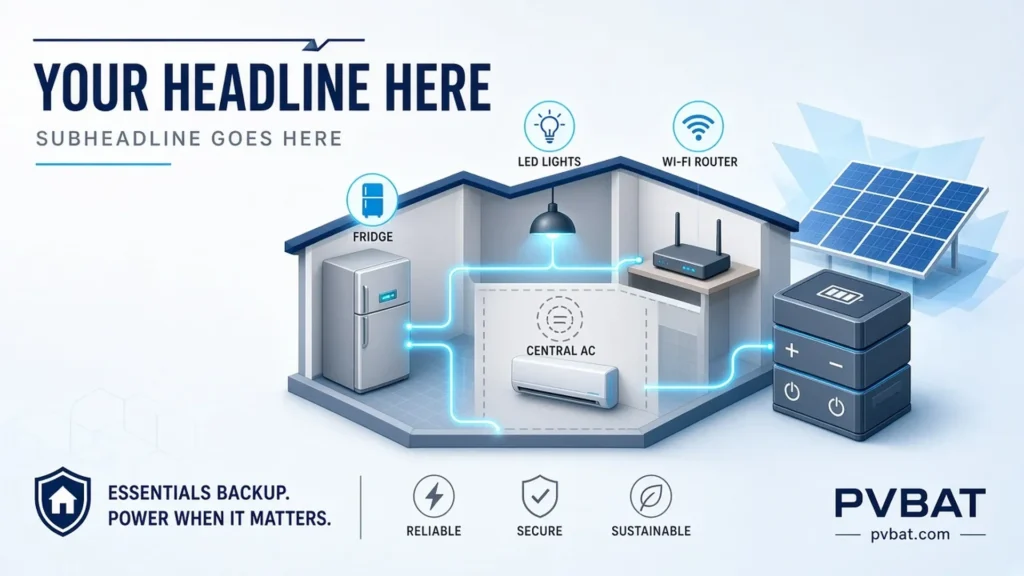
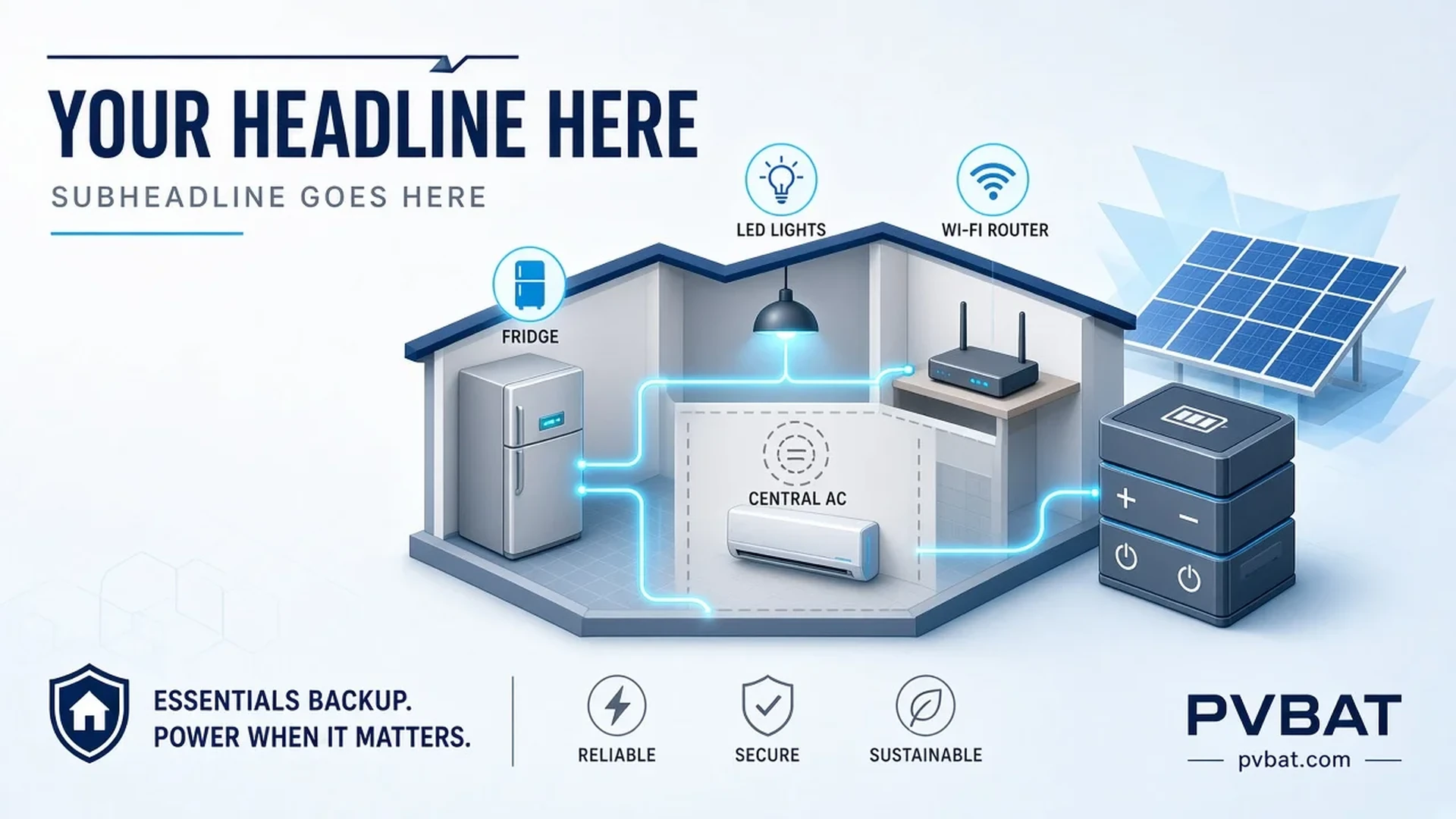
A 24 kWh battery is an energy store—not a promise that every appliance will run forever. What you can power depends on inverter kW / kVA (what starts and runs at once) as much as kWh (how long stored energy lasts). Essentials such as a fridge, lights, Wi-Fi, selected outlets, and cycling pumps usually stretch farther than continuous high loads like central air. U.S. homes often need 120/240V split-phase for some appliances. An example class is the PVBAT TIGER-T4-72 (24 kWh · 16.5 kVA · 13 kW continuous · 120/240V). All runtimes below are illustrative estimates—efficiency, temperature, reserve settings, and load management change real results. PVBAT provides product options and installation guidance, plus California warehouse coordination—not installation services.
Capacity vs power: why two numbers matter
Battery marketing loves one big number. You need two:
| Spec | Unit | What it decides |
|---|---|---|
| Energy | kWh | How long the system can run at a given average load |
| Power | kW / kVA | What can run—or start—at the same time |
A large battery with a weak inverter may keep lights on for a long time and still fail when a well pump or compressor starts. A strong inverter with too little capacity may start appliances and then empty quickly. Size both.
For shopping context, see the 2026 home battery backup buying guide.
Typical runtime examples (estimates only)
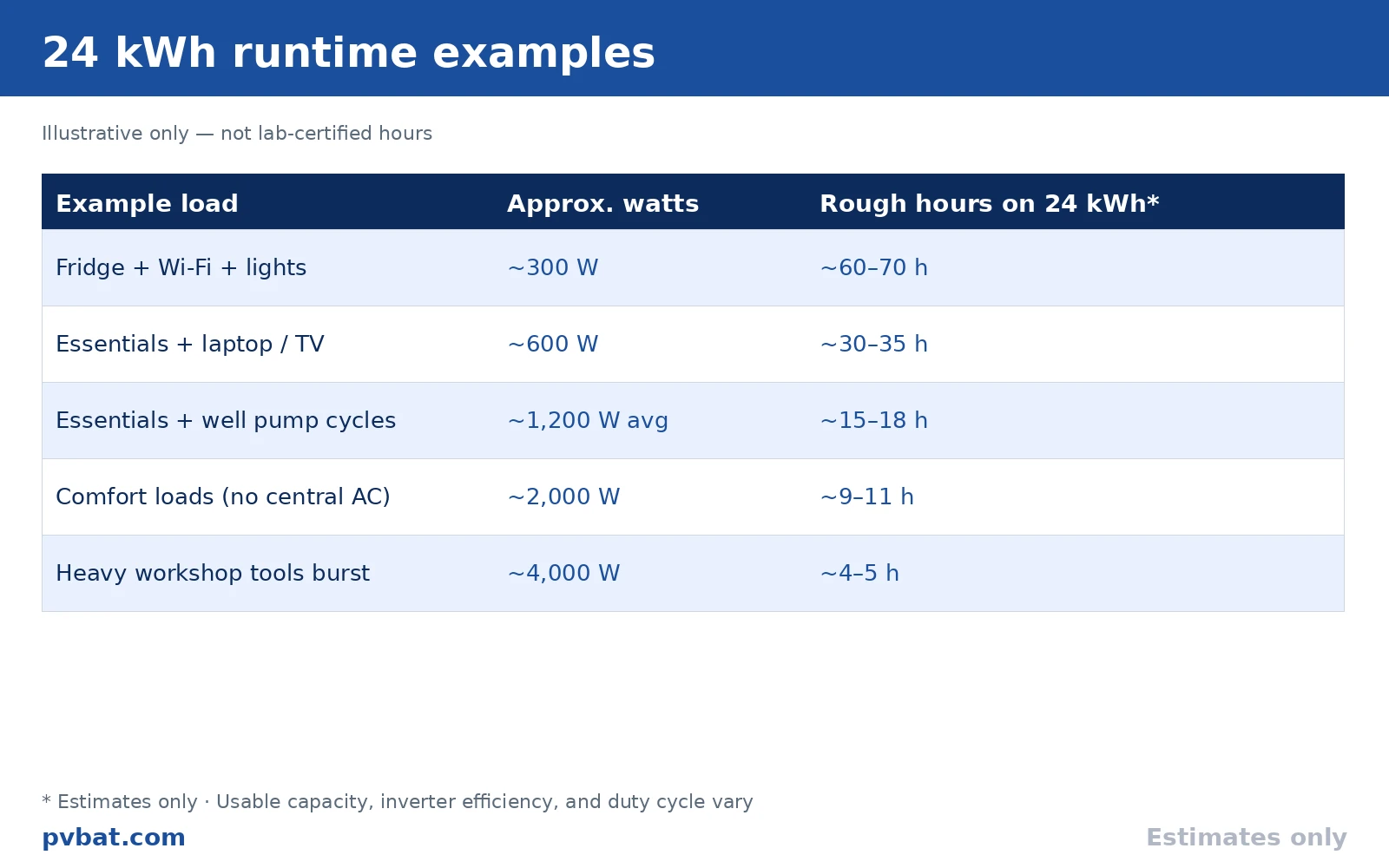
Actual runtime depends on average load, inverter efficiency, battery condition, temperature, depth-of-discharge reserve, and whether heavy loads share the inverter. The table is a practical starting point, not a lab certificate.
| Average load | Estimated runtime from ~24 kWh* |
|---|---|
| 300 W | About 65–75 hours |
| 500 W | About 38–45 hours |
| 1,000 W | About 19–22 hours |
| 2,000 W | About 9–11 hours |
| 3,000 W | About 6–7 hours |
| 4,000 W | About 4.5–5.5 hours |
*Assumes roughly usable capacity near the labeled class and ignores extreme cold, aggressive reserve cutoffs, and heavy surge events. Estimates only.
A real home rarely pulls a flat wattage all day. Refrigerators cycle. Lights run at night. A well pump may run in short bursts. That is why careful households often stretch a 24 kWh class farther than a continuous-run calculator suggests—or drain it faster if they leave everything “normal.”
What household loads are usually realistic?
With a properly sized inverter and load plan, a 24 kWh class backup often supports:
- Refrigerator and freezer
- Wi-Fi router / modem
- LED lights and phone/laptop charging
- Garage door opener
- Microwave or coffee maker for short use
- TV and basic electronics
- Sump pump (check surge)
- Selected 120V tools
- Some 240V loads—only if the inverter is split-phase and continuous/surge limits clear
For well-pump specifics, see Battery Backup for 240V Well Pumps and the scenario page 240V Well Pump Battery Backup.
Why 240V matters in the U.S.
Many American homes use 120/240V split-phase service. Standard outlets are usually 120V; larger appliances—well pumps, some water heaters, shop compressors, certain HVAC equipment—may need 240V.
A 120V-only camping station can still help with phones, lights, and many fridges. Once you want workshop gear or a residential well pump, split-phase output becomes a gate check, not a nice-to-have badge.
Can it run air conditioning?
It depends. Central air often has a high starting surge and multi-kilowatt running draw. Some systems are unrealistic on day-one battery backup without soft-start devices, a carefully designed load plan, and honest inverter limits.
Smaller window units, mini-splits, or high-efficiency loads are sometimes more realistic. For long outages, most households get better results by prioritizing essentials first: refrigeration, communication, lights, fans, pumps, and selected outlets—not “run the house exactly like Tuesday.”
Do not treat any blog’s HVAC hour claim as a guarantee for your equipment.
Fridge and freezer: multi-day framing (careful language)
Refrigeration is usually a cycling load. Peak watts when the compressor starts are higher than the long-term average. That is why a 24 kWh class system can often keep food cold for multiple days if you:
- Keep doors closed
- Avoid adding large simultaneous loads
- Leave reserve margin instead of draining to empty
Exact hours still depend on fridge size, ambient temperature, and what else shares the battery. Treat “several days” as a planning goal under load management—not a warranty.
Battery vs generator: different jobs
| Battery ESS | Fuel generator | |
|---|---|---|
| Runtime model | Stored kWh (plus recharge path) | Fuel supply |
| Noise / exhaust | Quiet; no exhaust at the battery | Noise + exhaust management |
| Best at | Short–medium outages, essentials, clean indoor-adjacent use when applied correctly | Multi-day coverage when fuel is available |
| Weakness | Finite store without solar/generator recharge | Fuel, maintenance, placement rules |
Many properties use both: battery for quiet coverage; generator as a longer-duration charger in extended emergencies. See also Home Battery Backup Without Solar.
When a 24 kWh class makes sense
Strong fit when you want:
- Essentials for many hours—or multi-day coverage with careful management
- 120/240V for rural, farm, garage, or well-pump contexts after nameplate review
- More than a suitcase power station can honestly deliver
Probably overkill if you only need phones and one lamp. Architecture choice (all-in-one vs modular wall batteries) is covered in All-in-One 24 kWh ESS vs Modular Wall Batteries: When TIGER Fits.
Optional education: ~24 kWh vs rack modules
As a rough educational comparison, about five ~5.12 kWh server-rack modules land near ~25 kWh of storage. That does not mean the products are interchangeable: rack batteries typically still need a compatible hybrid inverter and a fixed install path, while an all-in-one mobile ESS integrates inverter, outlets, and mobility differently. Compare the full architecture.
Example system class (not a universal guarantee)
The PVBAT TIGER-T4-72 is one all-in-one example built around:
- 24 kWh LiFePO4 storage
- 16.5 kVA inverter rating with 13 kW continuous active output
- 120/240V split-phase output
Treat it as a candidate class after load and connection review—not a promise for every HVAC or pump brand. Permanent panel or transfer work requires a licensed electrician. PVBAT does not provide installation services; ask about California warehouse coordination for U.S. fulfillment questions.
Farm and workshop owners may also review Farm Workshop Backup Power.
Quick FAQ
Is 24 kWh enough for a whole house?
It can support many essential home loads, but “whole house” depends on what you run at once. Refrigeration, lights, Wi-Fi, pumps, and selected outlets are realistic with load management. Large HVAC, electric water heating, and high-power appliances need careful sizing of both kWh and inverter kW / kVA.
How long will 24 kWh run a refrigerator?
A typical refrigerator cycles on and off, so its average draw is much lower than its nameplate peak. With careful load management, a 24 kWh class battery can often support refrigeration for multiple days—treat any hour count as an estimate, not a guarantee.
Can 24 kWh run 240V appliances?
Only if the inverter supports 120/240V split-phase output and the appliance’s continuous and startup demand fit within system limits. Capacity alone does not create 240V or surge headroom.
Do I need solar with a 24 kWh battery?
Not always. A battery can charge from the grid for outage prep. Solar (or a generator as a charger) helps extend multi-day events when the utility stays down.
How does 24 kWh compare to server-rack modules?
Roughly speaking, about five ~5.12 kWh rack modules land near 25 kWh of storage—but rack batteries usually still need a compatible hybrid inverter, while an all-in-one ESS integrates inverter and outlets. Compare architecture, not only the kWh label.
Next step
- List must-run loads and note which are 120V vs 240V.
- Check continuous and surge power—not only kWh.
- Use the estimate table as a conversation starter with your electrician or equipment reviewer.
- Product example: TIGER-T4-72
- Related: Buying guide 2026 · Without solar · 240V well pump
Contact: pvbat.com · +1 (626) 341-8963 · City of Industry, CA · service@pvbat.com
U.S. support & installation guidance. Ask about California warehouse coordination for current stock and logistics.

Is this the biggest battery you have? How many server rack batteries does it equals.
The TIGER T4 is our largest all-in-one system currently available from our US stock. It includes a 24kWh LiFePO₄ battery.
Compared with standard 51.2V 100Ah server rack batteries (about 5.12kWh each), one TIGER T4 battery capacity is approximately equal to about 5 server rack batteries.
If you need a larger capacity system, we also have expandable battery solutions available. May I know your target battery capacity (kWh) or your expected backup time?