Hybrid Inverters vs. Standard Inverters: Don’t Make the Wrong Choice—There’s a World of Difference

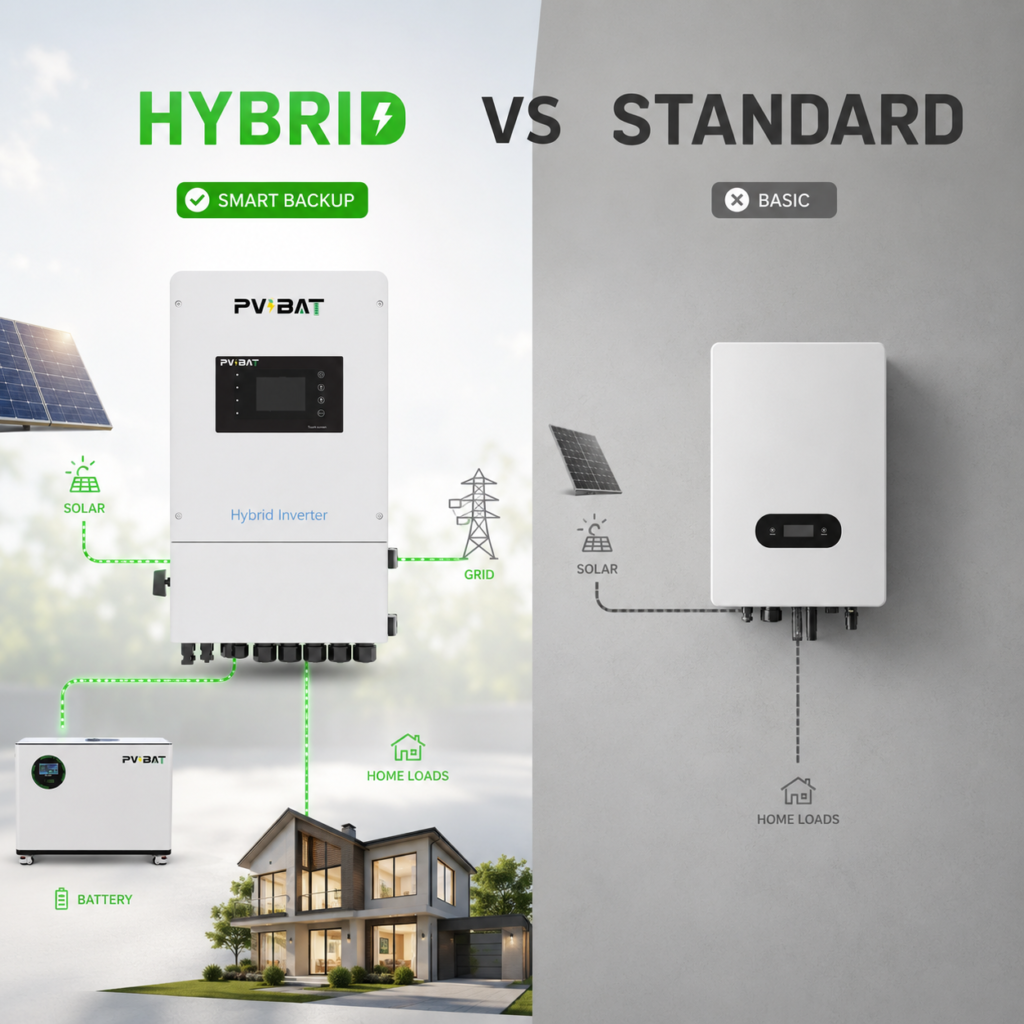
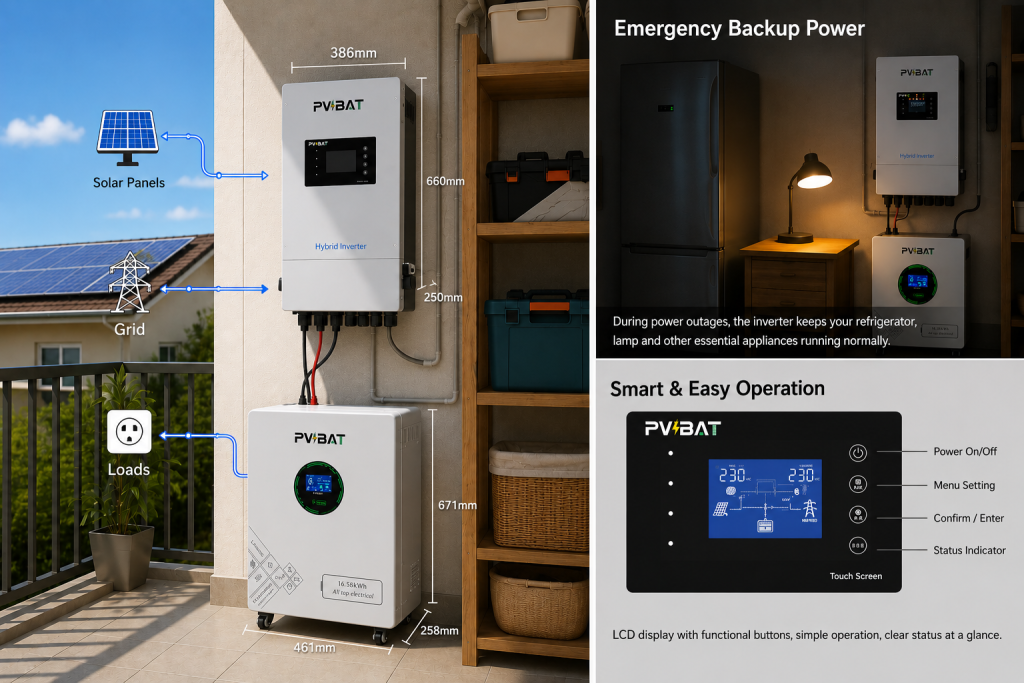
Many people can’t tell the difference between these two types of inverters, which leads to buying the wrong one, rendering it unusable and wasting money. Simply put: Standard Inverter: Converts power only (DC to AC)Hybrid Inverter: Manages the entire home energy system (solar + batteries + grid + loads) Standard Inverter: Simple and affordable, suitable only for pure solar systemsWhat it does: Converts DC power from solar panels or batteries into AC power for household use. Suitable for: Systems with only solar panels, no batteries, tight budgets, and simple setups. Disadvantages: Cannot manage batteries, cannot automatically switch to backup power, and cannot optimize electricity costs. Hybrid Inverter: A must-have for home energy storage—a one-stop solutionWhat it does:Prioritizes solar power for household use → charges batteries → sells excess to the gridIntelligent battery charge/discharge managementAutomatic switchover to backup during power outages, with millisecond-level switchingSaves money with peak-off-peak electricity ratesSupports off-grid operation Key Differences (At a Glance)Standard Inverter: Only converts power; does not manage batteries; weak backup; inexpensiveHybrid Inverter: All-in-one management, battery-friendly, robust backup, slightly more expensive but worth it Which one should you choose for home energy storage?Solar only, no battery: Standard inverterInstalling a battery, need backup, want to save money: Must choose a hybrid inverter What to look for when buying a hybrid inverter?Voltage compatibility (48V/51.2V)Communication protocols (CAN/RS485)120V/240V phase separation (essential for U.S. homes)Continuous power + peak powerSupports parallel operation, off-grid mode, and generator input

Hybrid Inverters vs. Standard Inverters: Don’t Make the Wrong Choice—There’s a World of Difference Read More »

Off-Grid Log Cabins / Farm Energy Storage: Don’t Base Your Choice on Urban Homes—It’s a Whole Different Story

Off-Grid Log Cabins / Farm Energy Storage: Don’t Base Your Choice on Urban Homes—It’s a Whole Different Story

Off-grid, farm, and rural residential settings operate on a completely different power logic than urban areas: cities rely on the grid, while off-grid systems rely on solar panels + batteries + generators. When selecting batteries, don’t just look at capacity; focus on load, starting power, runtime, and scalability. Common power-consuming devices in off-grid/farm settingsRefrigerators, freezers, water pumps, lighting, Wi-Fi, surveillance, power tools, small air conditioners, irrigation equipment. Key Point: Water pumps, freezers, air conditioners, and power tools have high startup power requirements; the inverter must be capable of handling them. Capacity Recommendations (Direct Reference)Small weekend cabin: 10–20 kWh (16.58 kWh/20.48 kWh is sufficient)Year-round cabin: 20–30 kWhBasic farm backup: 20–40 kWhMultiple water pumps / refrigerators / tools: 30kWh+ Long-term off-grid: Multiple battery banks in parallel + solar + generator backupWhy is LiFePO4 suitable for off-grid systems?Long cycle life; daily charging and discharging won’t damage the batteriesLow maintenance; no need for daily monitoringQuiet and clean; more comfortable than a generatorPV charging during the day, battery power at night, generator backup on cloudy or rainy days How to configure an off-grid system?Solar panels (primary power source)Hybrid inverter (energy management)LiFePO4 batteries (energy storage)Distribution panel for critical loadsCircuit breakers + cablesOptional: Generator (backup for cloudy or rainy days)Monitoring system (for remote status checks) Important ReminderIf using water pumps or large power tools, you must verify the inverter’s peak power and the battery’s discharge capacity; otherwise, the equipment may fail to start or be damaged.

Off-Grid Log Cabins / Farm Energy Storage: Don’t Base Your Choice on Urban Homes—It’s a Whole Different Story Read More »

Breaking Free from the Limits of Traditional Power Supply: How PVBAT Hybrid Inverters Are Reshaping the Home Energy Landscape

Breaking Free from the Limits of Traditional Power Supply: How PVBAT Hybrid Inverters Are Reshaping the Home Energy Landscape

Today, as household energy needs become increasingly diverse, the shortcomings of traditional power supply models are becoming more apparent—power outages causing appliances to stop working, peak-hour electricity rates driving up living costs, and the inability to efficiently store solar power. These pain points severely limit households’ energy independence. The introduction of the PVBAT hybrid inverter is far more than a simple upgrade to power supply equipment; it provides residential users with a comprehensive home energy storage solution that fundamentally redefines the logic of household energy use. It makes “self-sufficient power generation, cost savings, and peace of mind” a reality, establishing itself as the top choice in the residential hybrid inverter market. Unlike conventional inverters, which only perform a single “power generation to supply” conversion, the PVBAT hybrid inverter integrates four core functions: PV charging, battery storage, grid interaction, and backup power supply. It truly achieves closed-loop management of “self-generation for self-consumption, surplus power storage, and emergency backup,” making it the top choice among PV storage inverters. In terms of installation, its user-friendly wall-mounted design, combined with clear wiring instructions, allows professionals to complete the installation quickly without the need for complex modifications to the home’s electrical system. During operation, the built-in intelligent control system automatically prioritizes power supply from the PV array, the grid, and the battery, achieving optimal energy distribution without manual intervention—a hassle-free and efficient solution that perfectly meets the needs of home PV storage systems. For residential users, the core value of the PVBAT hybrid inverter lies in two key dimensions: “cost savings” and “peace of mind.” On one hand, it maximizes the utilization of solar power, reducing reliance on grid electricity. Especially during peak-rate periods, it can seamlessly switch to battery power, significantly lowering monthly electricity bills, making it a benchmark product in energy-saving inverters; On the other hand, during sudden grid outages, the inverter can rapidly switch to backup power mode, reliably ensuring the normal operation of critical appliances such as refrigerators, air conditioners, and lighting. This completely resolves the inconveniences caused by power outages, highlighting the core advantages of an emergency power supply inverter. From an industry perspective, the design of the PVBAT hybrid inverter aligns closely with global energy transition trends. It not only actively responds to the environmental call for “carbon reduction” but also effectively addresses the storage challenges of distributed photovoltaic power generation, laying a solid foundation for the widespread adoption of residential distributed energy systems. Its compatibility with various battery types—including lead-acid and lithium-ion batteries—and support for multiple units in parallel allow it to flexibly adapt to households of different sizes and energy needs. With maximum practicality and scalability, it has become one of PVBAT’s core energy storage products.

Breaking Free from the Limits of Traditional Power Supply: How PVBAT Hybrid Inverters Are Reshaping the Home Energy Landscape Read More »

第二

An Analysis of the PVBAT 51.2V 628Ah Lithium-Ion Battery: Achieving Both Safety and Efficiency in the Era of High-Capacity Energy Storage

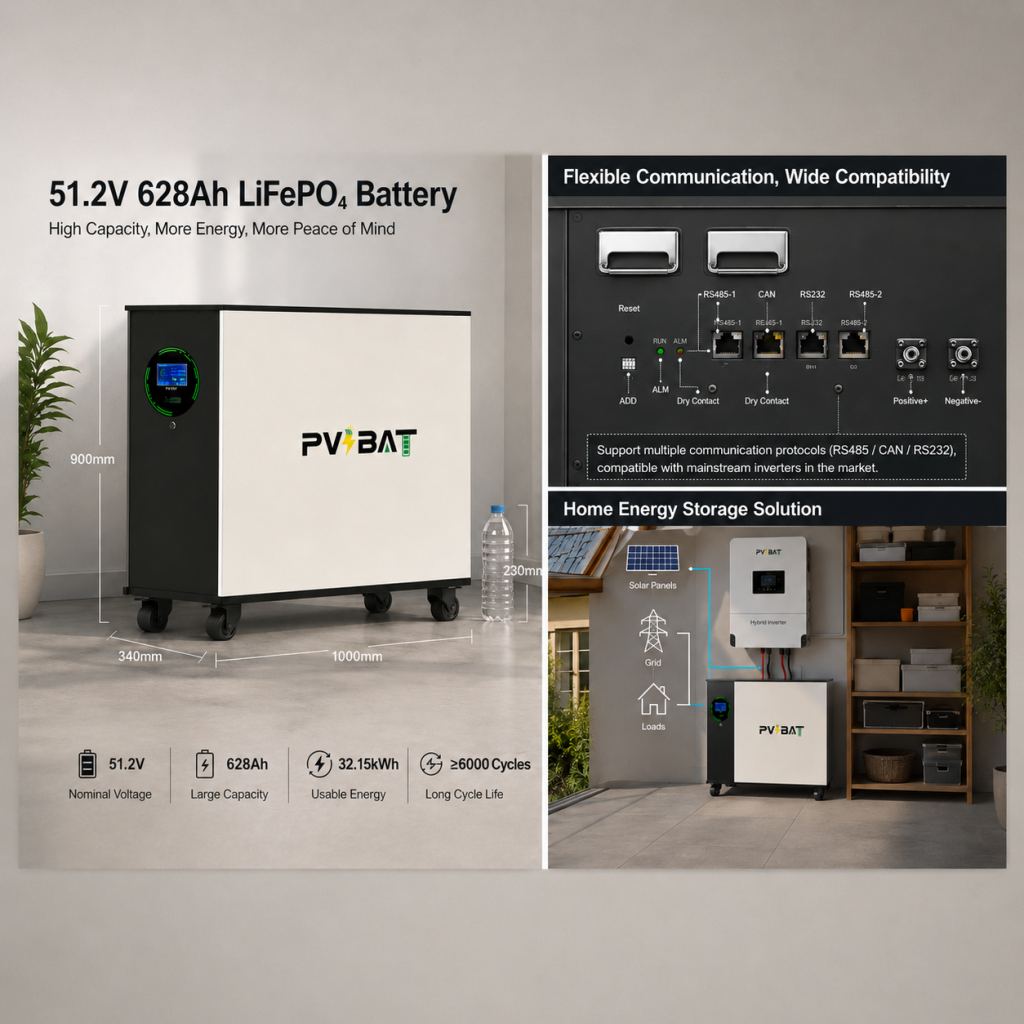
With the rapid evolution of energy storage technology, lithium-ion batteries have become the core component of residential and commercial energy storage systems. However, “insufficient capacity, safety concerns, and short lifespan” remain widespread challenges in the industry. PVBAT’s newly launched 48V 628Ah LiFePO4 lithium battery (Elephant-48628) addresses these industry challenges with its core advantages of “high capacity, high safety, and long lifespan.” It offers a reliable solution for medium-to-large-scale energy storage needs, redefining the application standards for high-capacity energy storage lithium batteries and establishing itself as PVBAT’s flagship product. In terms of core specifications, this lithium battery has a rated capacity of 628Ah and a rated energy of 32.15kWh, sufficient to meet the normal electricity needs of a family of three for 3–5 days. Whether paired with a photovoltaic system to store excess power or used as an emergency backup power source, it handles the task with ease, making it the top choice for high-capacity household lithium batteries. What’s more noteworthy is that it utilizes lithium iron phosphate (LiFePO4) cells, which inherently offer strong high-temperature stability and are non-flammable and non-explosive. Combined with a built-in intelligent BMS (Battery Management System), it provides comprehensive protection against overcharging, over-discharging, overcurrent, short circuits, and extreme temperatures. This eliminates safety hazards at the source, giving users greater peace of mind and highlighting the core advantages of safety-oriented energy storage lithium batteries. In terms of practicality, the PVBAT 48V 628Ah lithium battery supports multi-module parallel operation, allowing users to flexibly scale capacity according to their energy needs. It adapts to various scenarios ranging from residential to small commercial settings, meeting the demands of commercial energy storage lithium batteries; The passive cooling design operates completely silently, causing no disruption to daily life or work environments. It is also compatible with communication protocols from leading inverters such as Panneng, Gurewatt, and Deye, enabling seamless integration with various photovoltaic energy storage systems. No additional adaptation or debugging is required—it is ready to use out of the box, making it an excellent choice for photovoltaic-compatible lithium batteries. From an industry perspective, the launch of this lithium-ion battery challenges the conventional wisdom that “high capacity equals low safety.” With a cycle life of 6,000 cycles—far exceeding the industry average—it not only reduces equipment replacement costs for users but also enhances the long-term cost-effectiveness of energy storage systems. This effectively drives the adoption of high-capacity energy storage products, providing a more reliable solution for distributed energy storage and establishing itself as the benchmark for long-life energy storage lithium-ion batteries.

An Analysis of the PVBAT 51.2V 628Ah Lithium-Ion Battery: Achieving Both Safety and Efficiency in the Era of High-Capacity Energy Storage Read More »

A 20.48 kWh battery—how long will it actually last Don’t be fooled by the theoretical figures

A 20.48 kWh battery—how long will it actually last? Don’t be fooled by the theoretical figures.

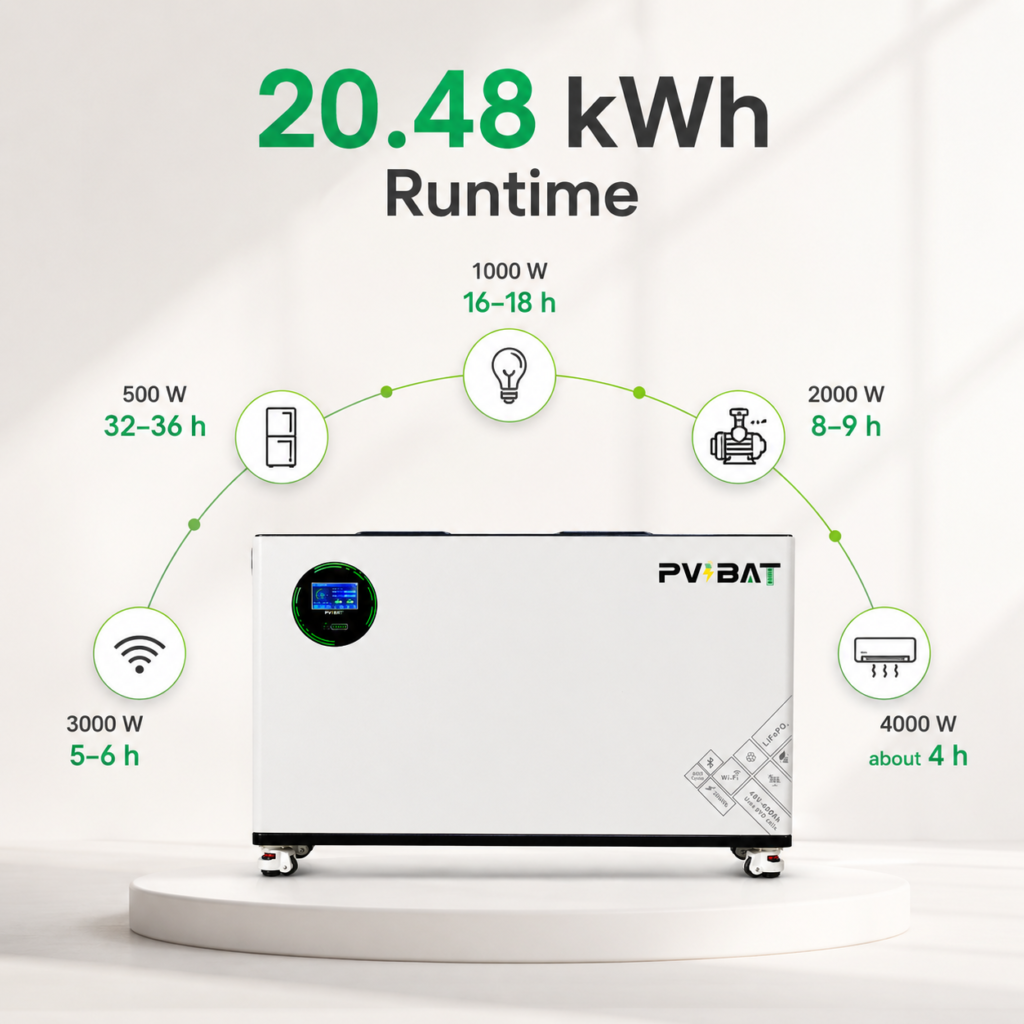
The 20.48kWh model is the most popular, but almost everyone asks: Can this battery last through the night during a power outage? How long does it last? Let’s be honest: there’s no set answer—it all depends on how many devices you have running at the same time. First, let’s calculate the actual usable capacityRated at 20.48kWh, but you can actually use 80%–90% of that: Actual usable capacity: 16.4–18.4kWhActual runtime under different loads 500W (refrigerator + lights + Wi-Fi): 32–36 hours1000W (basic appliances + TV + computer): 16–18 hours2000W (plus water pump + small kitchen appliances): 8–9 hours3000W (small air conditioner running): 5–6 hours4000W (multiple high-power devices): About 4 hours Why such a big difference?Refrigerators and air conditioners draw high power during startupAir conditioners are major power consumers; running one cuts runtime in halfSolar power replenishment during the day can double the runtime Who is the 20.48 kWh system suitable for? Frequent power outagesInstalled solar panels and want to use electricity at nightDon’t want to just cover the basics; want to maintain a normal lifestyleDon’t want to buy a generator; find them noisy and troublesome Practical TipsDuring installation, run separate circuits for critical loads: refrigerator, lights, Wi-Fi, water pump, and essential outlets. During a power outage, avoid randomly turning on high-power devices—you’ll have no problem getting through the night.

A 20.48 kWh battery—how long will it actually last? Don’t be fooled by the theoretical figures. Read More »

What's the difference between 16.58 kWh, 20.48 kWh, and 32.15 kWh Don't just buy anything

What’s the difference between 16.58 kWh, 20.48 kWh, and 32.15 kWh? Don’t just buy anything

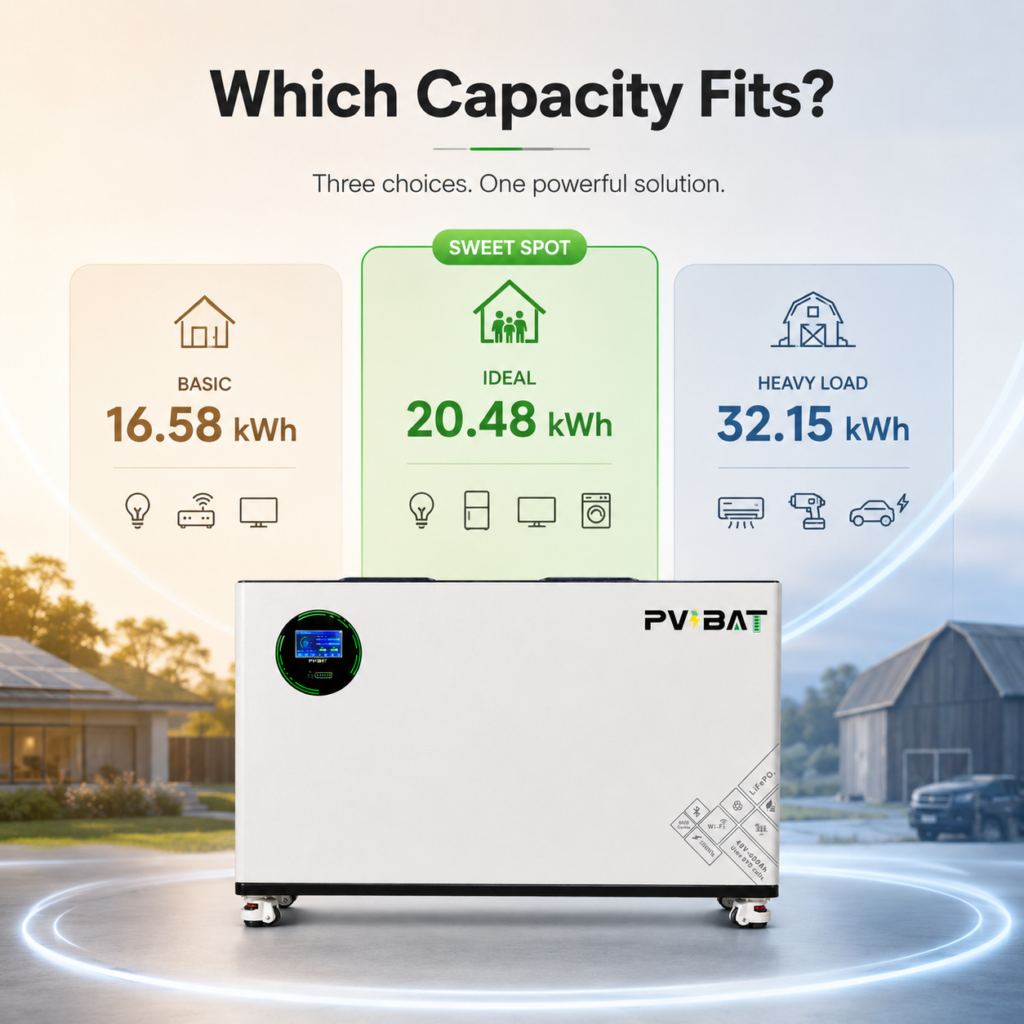
While the capacity figures for these three models may seem similar at first glance, their practical applications, runtime, and cost are completely different. In a nutshell: 16.58 kWh is sufficient, 20.48 kWh offers peace of mind, and 32.15 kWh can handle heavy-duty use. 16.58 kWh: The Essential Choice for Average HouseholdsSuitable for: Standard urban homes, homes with solar panels, tight budgets, and those needing to cover only basic living needs. Can power: Refrigerator, lights, Wi-Fi, TV, smartphones, computers, and common outlets. Not suitable for: Air conditioning, electric stoves, or deep-well pumps—these won’t last long. 20.48kWh: The safe choice for most householdsSuitable for: Areas with frequent power outages, those seeking reliability, homes with solar panels, and those wanting to use solar power at night. Advantages over the 16.58kWh model:Longer backup timeSupports more devices: water pumps, small kitchen appliances, small air conditioners for short periodsBest balance of price and capacity—no waste, no regrets 32.15kWh: For Heavy Loads / Off-Grid Use OnlySuitable for: Large homes, farms, warehouses, small shops, long-term off-grid use, or locations with many water pumps, freezers, and tools. Features: No worries during extended power outages; run high-power devices freely; expand capacity by paralleling multiple units. How to choose quickly?Just want uninterrupted power: 16.58 kWhWant stability and peace of mind: 20.48 kWhLarge homes / farms / off-grid: 32.15 kWh

What’s the difference between 16.58 kWh, 20.48 kWh, and 32.15 kWh? Don’t just buy anything Read More »

How many kWh should a home backup battery be It’s not just a matter of “the bigger, the better.”

How many kWh should a home backup battery be? It’s not just a matter of “the bigger, the better.”

When many people choose a home energy storage battery, their first instinct is: the bigger, the better. But that’s not how it works in reality. There are only three factors that truly determine the capacity you need: the devices you must keep running during a power outage, how long you want to last, the battery’s actual discharge capacity, and inverter efficiency. A simple, practical formula (easy for anyone to use) Battery Capacity ≈ Total Power of Critical Devices × Backup Duration ÷ Actual Discharge Efficiency ÷ Inverter Efficiency Example: You want to power your refrigerator, lights, Wi-Fi, TV, and charge your phone, with a total power of about 1000W (1kW), and you want to last for 12 hours. Theoretical capacity: 1kW × 12h = 12kWh However, lithium iron phosphate (LiFePO4) batteries have a safety margin, so only 80%–90% of the rated capacity is usable. Factoring in inverter losses, you’ll need to purchase at least 15 kWh to ensure reliability. How to Choose Based on Household Needs (Pick the Category That Fits) Basic Backup (5–10 kWh): Refrigerator, lights, Wi-Fi, and phone charging—sufficient for short power outages. Standard Household (10–20 kWh): Supports most daily appliances; the most common and well-balanced option. Whole-House Backup (20–30 kWh+): Supports air conditioners, water pumps, and kitchen appliances; suitable for areas with frequent power outages. Off-Grid / Farm (30 kWh+): For long-term off-grid use with multiple high-power devices; parallel connection of multiple units is recommended. How to Choose Among PVBAT’s Three Popular Capacities 16.58kWh (FALCON-48G2): Sufficient for average households; suitable for solar energy storage and electricity cost optimization. 20.48kWh (BEAR-48G1): The ideal capacity for most households—long runtime, high load capacity, and moderate price. 32.15kWh (ELEPHANT-48628): The top choice for large homes, farms, small businesses, and off-grid applications; remains stable even under heavy loads. Quick Summary Not sure how to choose? Start by listing the equipment you must use during a power outage, calculate the total power consumption and runtime, then select the capacity. Bigger isn’t always better—the most cost-effective approach is to choose a capacity that meets your needs with a little extra margin.

How many kWh should a home backup battery be? It’s not just a matter of “the bigger, the better.” Read More »

chatgpt image 2026年5月15日 21 09 57

Troubleshooting Common Issues with PVBAT Solar Energy Storage Systems: A Guide Even Beginners Can Follow

During long-term operation, photovoltaic energy storage systems are bound to experience minor malfunctions, such as inverter alarms, batteries failing to charge, and decreased power generation efficiency. When faced with these issues, many users are unsure how to troubleshoot them and can only wait for service engineers, which wastes time and disrupts normal use. PVBAT has compiled a list of common system faults and troubleshooting methods that are simple and easy to understand, even for beginners, helping users quickly resolve minor issues and restore normal system operation. We provide a PV storage troubleshooting guide to empower beginners to perform self-diagnosis and resolve common PV storage faults. Fault 1: Inverter alarm displaying “Communication Fault (F01).” Troubleshooting steps: Inspect the communication cables between the inverter and the batteries/PV panels to ensure connections are secure, with no loose or damaged cables; Inspect the communication ports to ensure they are free of dust and oxidation, preventing poor contact; if the issue persists, restart the inverter and battery, then reconnect the communication cables; if the alarm persists after restarting, contact an after-sales engineer to resolve the inverter communication failure. Fault 2: Lithium battery not charging. Troubleshooting: Inspect the lithium battery terminals to ensure positive and negative connections are correct and secure, avoiding reverse polarity; Check the inverter’s charging parameters to ensure the charging current and voltage are set appropriately; Check the lithium battery’s SOC. If the SOC has reached 100%, charging will not occur (this is normal); If the SOC is below 100% and charging still does not occur, check whether the lithium battery is in a protection state (e.g., over-temperature or over-current protection). Wait until the fault is resolved before attempting to charge again to resolve the issue of the energy storage lithium battery not charging.

Troubleshooting Common Issues with PVBAT Solar Energy Storage Systems: A Guide Even Beginners Can Follow Read More »

第十六 2

Don’t Panic During a Power Outage: Real-World Testing of the PVBAT Energy Storage System’s Emergency Power Supply

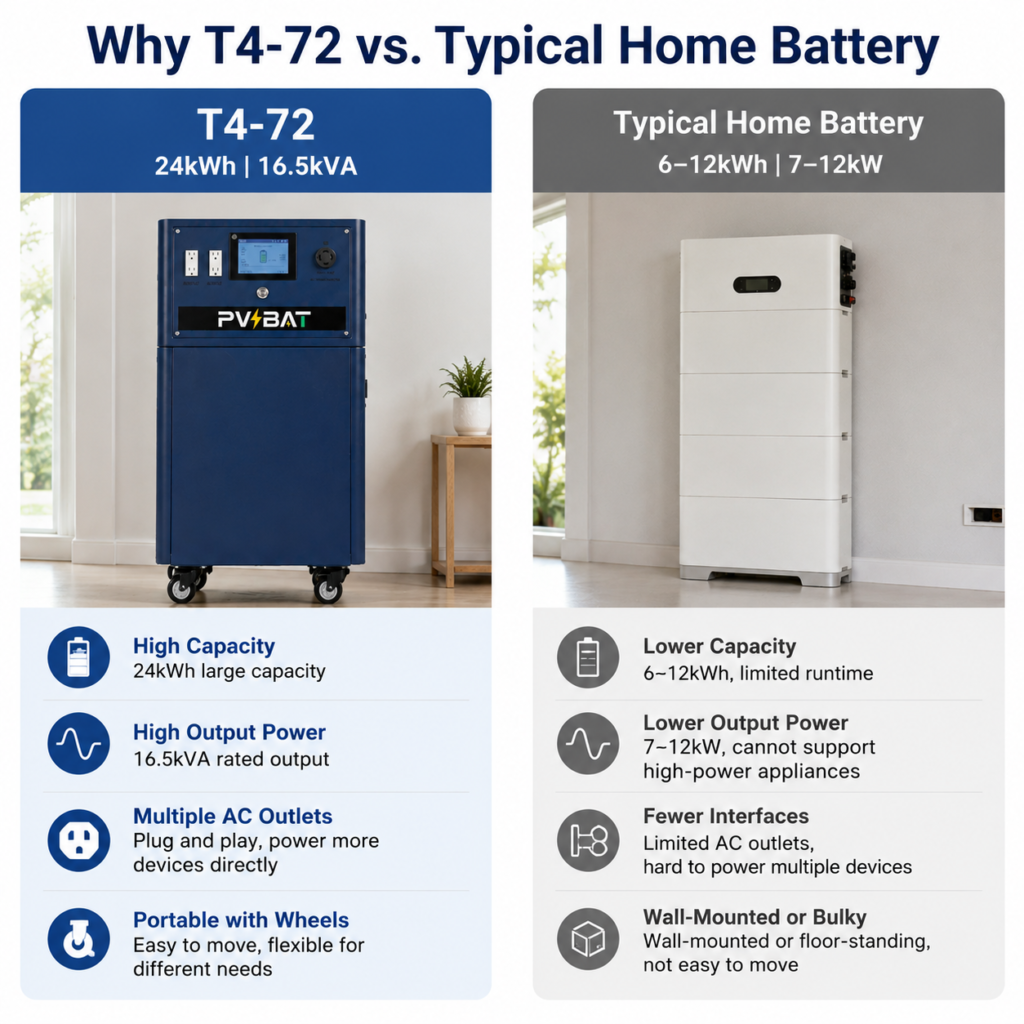
Power outages are unexpected events that both residential and commercial users may face, especially during summer peak demand periods or severe weather conditions such as heavy rains and typhoons. Power outages not only disrupt daily life and business operations but can also result in significant financial losses. To verify the emergency power supply capabilities of the PVBAT energy storage system, we conducted real-world field tests to determine whether it can truly meet power demands during outages and provide users with peace of mind. This emergency power supply test focused on validating the PVBAT’s emergency power capabilities, offering a reference for users selecting emergency energy storage equipment. Test Scenario 1: Residential Emergency Power Supply (using a PVBAT 6kW hybrid inverter + 48V 628Ah lithium battery). Simulating a typical household power usage scenario, we connected loads such as a refrigerator, air conditioner (1.5 HP), desk lamp, and computer, with a total load power of approximately 3 kW. After the grid power was manually disconnected, the inverter rapidly switched to backup power mode in less than 0.5 seconds, with no noticeable power interruption, and all loads continued to operate normally. During the continuous power supply test, with the battery fully charged, it provided stable power for approximately 10 hours, fully meeting a household’s normal daily power needs. This effectively prevented issues such as food spoilage in the refrigerator and air conditioner shutdown caused by power outages, demonstrating the advantages of residential emergency energy storage. Test Scenario 2: Commercial Emergency Power Supply (using a PVBAT 12kW hybrid inverter paired with two 48V 628Ah lithium-ion batteries in parallel). Simulating a convenience store power usage scenario, the system connects to loads including freezers (2 units), cash registers (2 units), lighting, and air conditioning, with a total load power of approximately 7 kW. After the grid power is cut off, the inverter quickly switches to backup power mode, and all commercial equipment continues to operate normally. With fully charged batteries, it can provide stable power for approximately 10 hours, which is sufficient to sustain the convenience store through a short-term power outage. This prevents economic losses such as food spoilage and the inability to process payments, demonstrating the value of commercial emergency energy storage. Test Scenario 3: Outdoor Emergency Power Supply (paired with the PVBAT TIGER-T4-72 integrated energy storage system). Simulating an outdoor performance scenario, the system was connected to loads such as sound systems, projectors, and LED screens, with a total load power of approximately 10 kW. After the grid power was cut off, the TIGER-T4-72 immediately activated emergency power supply, and all equipment continued to operate normally. With the battery fully charged, it provided a stable power supply for approximately 2.5 hours, fully meeting the power requirements for small-scale outdoor performances. By eliminating reliance on the grid and achieving self-sufficient power supply, this demonstrates the system’s capabilities in outdoor emergency energy storage. Test results demonstrate that the PVBAT energy storage system delivers stable and reliable emergency power supply, featuring fast switching and extended runtime. It effectively addresses power outages in various scenarios—including residential, commercial, and outdoor settings—providing users with peace of mind through assured emergency power protection. This capability represents one of the core competitive advantages of PVBAT products, establishing the brand as a trusted provider of emergency energy storage solutions.

Don’t Panic During a Power Outage: Real-World Testing of the PVBAT Energy Storage System’s Emergency Power Supply Read More »

第15

Unveiling PVBAT’s Product Development Philosophy: User Needs at the Core, Building Reliable Energy Storage Equipment

In today’s increasingly competitive energy storage market, many brands focus solely on packing in technical specifications and flashy designs, while neglecting users’ core needs: safety, efficiency, convenience, and durability. As a brand dedicated to the energy storage sector, PVBAT has always adhered to a “user-centric” R&D philosophy. Every product design and every feature upgrade stems from actual user needs. We are committed to creating reliable energy storage equipment that allows users to “use with peace of mind and without worry,” embodying the PVBAT brand’s R&D philosophy and delivering high-quality energy storage products. PVBAT’s R&D philosophy is first and foremost embodied in “Safety First.” Whether it’s inverters, lithium-ion batteries, or integrated energy storage systems, safety is the core prerequisite for development. For example, hybrid inverters feature built-in multi-layered protection mechanisms to comprehensively guard against safety hazards; lithium-ion batteries utilize lithium iron phosphate (LiFePO₄) cells and intelligent BMS systems to ensure safety at the source; and integrated energy storage systems incorporate optimized thermal management designs to prevent overheating. All products undergo rigorous quality inspections and aging tests to ensure safe and stable operation across various environments, providing users with worry-free use and delivering safe energy storage equipment. Secondly, we adhere to the principle of “practicality above all.” PVBAT’s product design rejects the accumulation of flashy yet impractical features; every function is tailored to meet users’ actual needs. For example, the hybrid inverter’s multiple operating modes can adapt to different users’ energy management requirements; the parallel expansion capability of lithium-ion batteries meets users’ growing power demands; the portable design of the TIGER-T4-72 adapts to various scenarios, including outdoor and temporary setups; and the remote management features via the mobile app lower the operational and maintenance barriers for users. These design elements stem from a deep understanding and precise grasp of user needs, resulting in practical energy storage products. Furthermore, we prioritize “technological innovation” and “quality control.” PVBAT maintains a professional R&D team that continuously monitors technological trends in the energy storage industry, constantly optimizing product performance and improving efficiency—such as MPPT technology enhancements for hybrid inverters, extended cycle life for lithium-ion batteries, and intelligent upgrades for integrated energy storage systems. Simultaneously, we strictly control every stage of production, from raw material procurement and manufacturing to finished product testing, adhering to rigorous standards to ensure stable product quality and a long service life. This provides users with long-term, reliable performance and delivers energy storage equipment with extended longevity. From an industry perspective, PVBAT’s “user-centric” R&D philosophy has not only earned the recognition and trust of users but has also driven the healthy development of the energy storage sector. It has guided the industry’s shift from “specification-based competition” to “value-based competition,” providing users with more practical and cost-effective energy storage solutions while leading trends in energy storage product development.

Unveiling PVBAT’s Product Development Philosophy: User Needs at the Core, Building Reliable Energy Storage Equipment Read More »