
Real home battery installs look like cabinets, conduit, and a wall-mount hybrid inverter—not a showroom render. These U.S. customer installation photos show a PVBAT LiFePO4 battery cabinet paired with a wall-mounted hybrid inverter and a small distribution enclosure—the common modular cabinet storage path for backup and hybrid systems. That architecture is different from an all-in-one mobile ESS (battery + inverter + outlets in one package). Use these frames to understand install space, wheeled vs fixed placement, and dual-cabinet capacity stacking. PVBAT provides equipment, U.S. support, installation guidance, and California warehouse coordination—not installation. Panel, transfer, utility, and solar ties belong to a licensed electrician.
Photo 1 — Cabinet battery + wall hybrid inverter
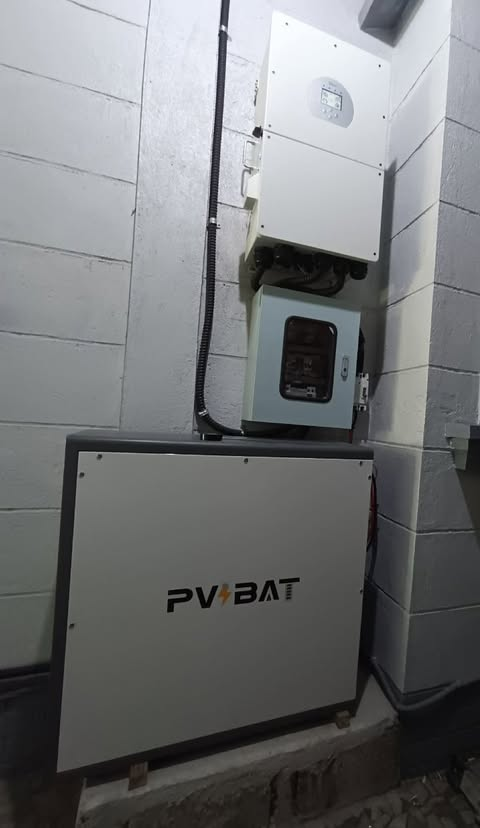
Customer installation: PVBAT battery cabinet under a wall-mount hybrid inverter, with a distribution / breaker enclosure and flexible conduit on a utility wall.
- Battery cabinet on the floor — modular energy storage (LiFePO4 class), not a suitcase power station
- Hybrid inverter on the wall — where AC conversion typically lives in a cabinet-style backup design
- Distribution enclosure between battery and inverter — overcurrent / isolation hardware for a code-oriented install path
- Conduit-managed conductors — tidy routing between cabinet, inverter, and building electrical
This is the classic hybrid inverter + battery cabinet layout for a home battery installation.
Photo 2 — Wheeled cabinet + metal raceway
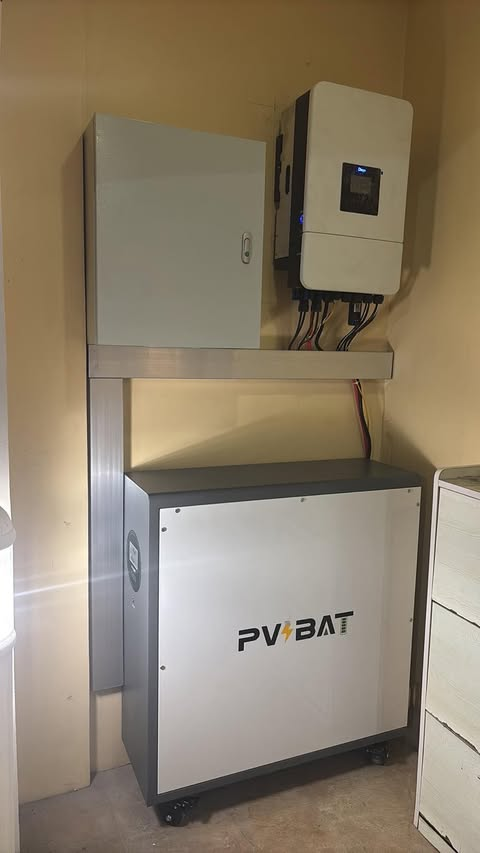
Same architecture, clearer mobility cue: caster wheels on the cabinet and an L-shaped metal raceway feeding the inverter and enclosure.
Wheels matter when the pad or utility room layout may change, equipment needs to roll for service access, or the site wants modular cabinet storage that can be repositioned before final anchoring. Final fastening and bonding still follow electrician / AHJ rules.
Metal raceway keeps conductors organized and protected—typical of a professional LiFePO4 backup install, not a temporary cord tangle.
Photo 3 — Dual cabinets in a utility room
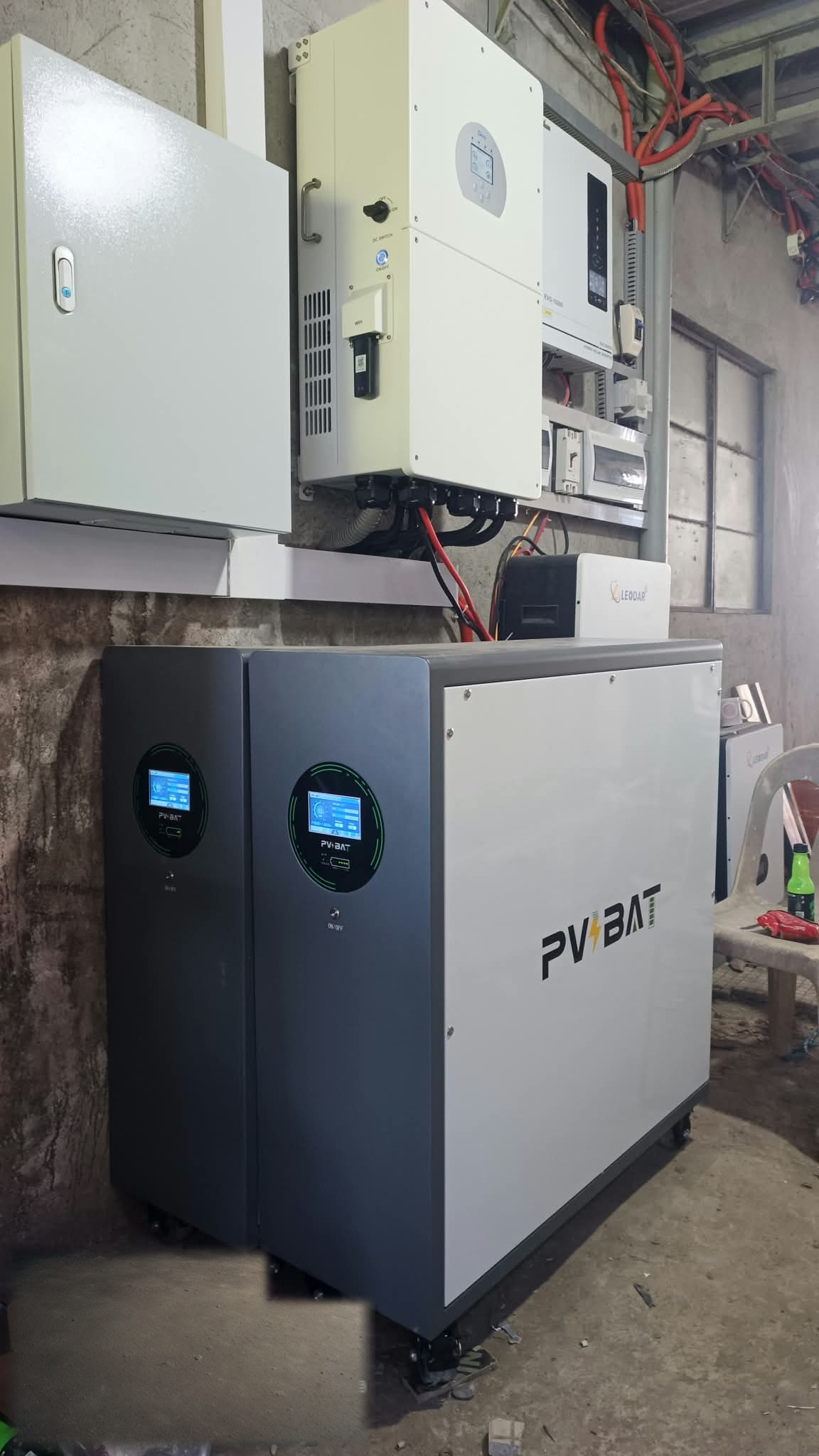
Dual wheeled PVBAT cabinets side-by-side under wall-mounted hybrid inverter and distribution equipment in a utility / garage-style space.
Dual cabinets usually mean the load plan needs more stored energy than a single cabinet—still within the rules of the inverter, BMS, and wiring design. Do not assume “two cabinets = whole-home automatic forever.” Size kWh for hours of coverage and kW / surge for motors and 240V loads separately.
What architecture is this?
| Piece | Role on these sites |
|---|---|
| Battery cabinet | Stores energy (LiFePO4 modular / cabinet class) |
| Wall-mount hybrid inverter | Creates AC for the home / critical loads (separate product from the cabinet) |
| Distribution / breakers | Isolation, protection, and tidy interconnection |
| Conduit / raceway | Mechanical protection and organized routing |
This is modular wall/cabinet storage + hybrid inverter—not an all-in-one package.
For the architecture contrast (integrated battery + inverter + outlets vs modular cabinet that needs a hybrid inverter), read: 24kWh All-in-One ESS vs Modular Wall Batteries.
Related product reading (not a claim that these photos are a specific SKU):
- Cabinet-class storage example: ELEPHANT-48628 high-capacity LiFePO4 energy storage battery
- All-in-one contrast example: TIGER-T4-72 — locked specs when discussing that class only: 24 kWh · 16.5 kVA · 13 kW · 120/240V (these install photos are not presented as TIGER)
Install planning checklist (before you buy)
- Photo your utility space — wall clearance, floor type, ventilation, and where the main panel lives
- List priority loads — well pump, refrigeration, networking, selected HVAC or shop tools (see farm / workshop checklist and 240V well pump backup)
- Decide architecture — modular cabinet + hybrid inverter vs all-in-one ESS (architecture comparison)
- Confirm who installs — licensed electrician for panel, transfer, utility, and solar ties; PVBAT = guidance + CA warehouse logistics
- Ask about stock timing — California warehouse coordination for U.S. fulfillment
Battery-first sites (no solar yet) are valid—see home battery backup without solar. Rough household energy orientation: what a 24 kWh backup can run.
Soft CTA
Planning a home battery installation with a cabinet ESS and hybrid inverter—or comparing to an all-in-one path? Send your ZIP, utility-room photos, and priority load list for a written quote.
Contact: pvbat.com · +1 (626) 341-8963 · City of Industry, CA · service@pvbat.com · Contact
U.S. support & installation guidance. Ask about California warehouse coordination for current stock and logistics. PVBAT does not install—use a licensed electrician for building electrical work.
Quick FAQ
What do these customer installation photos show?
They show real PVBAT battery cabinet installs paired with a wall-mount hybrid inverter and distribution hardware—typical of a modular LiFePO4 backup install, not a studio product shoot and not an all-in-one mobile ESS package.
Is a cabinet battery the same as an all-in-one ESS?
No. A modular battery cabinet usually stores energy and needs a compatible hybrid inverter for AC. An all-in-one ESS (for example TIGER class) packages battery, inverter, and often outlets together. See the architecture comparison.
Why are some cabinets on wheels?
Casters help with positioning and service access in utility rooms and garages. Final placement, bonding, and any required anchoring still follow the electrician’s design and local code—not “roll it anywhere anytime.”
Can I run two battery cabinets together?
Often yes when the inverter, BMS, and wiring plan allow paralleling or multi-cabinet capacity. Dual cabinets increase stored energy; they do not automatically remove power limits or surge limits. Confirm stacking rules before purchase.
Does PVBAT install the system?
No. PVBAT supplies equipment, U.S. support, installation guidance, and California warehouse coordination. Panel, transfer, utility, and solar work require a licensed electrician.